

The Arc logo

Schools Are Restraining and Secluding Students With Disabilities. New Bill Would Limit Practices.

Students with disabilities disproportionately experience restraint and seclusion, practices that are not evidence-based and cause lasting trauma.

Washington, DC – Restraint and seclusion are traumatic, outdated, and ineffective discipline practices that are commonplace in schools throughout the country. Even though they have caused thousands of injuries and deaths, there are no federal laws to protect children from the abusive use of these tactics. Today, Senator Chris Murphy and Representative Don Beyer reintroduced the Keeping All Students Safe Act (KASSA) for the 14th Congress in a row. KASSA would eliminate the use of seclusion and prohibit the practice of restraint in most cases and give parents a private right of action against school districts that misuse these practices. Restraint and seclusion are disproportionately used against students with disabilities, particularly Black students, and have long-lasting consequences on their achievement and health. We urge Congress to once and for all pass minimum federal safety standards for these practices.

“Protecting students with disabilities from physical harm and abuse shouldn’t be a debate, but it’s something we’ve been fighting for over a decade,” shared Robyn Linscott, Director of Education and Family Policy at The Arc of the United States. “Instead of evidence-based de-escalation practices, untrained school personnel are subjecting students with disabilities to terrifying violations of their human rights and their lives. Thousands of times a day, students are being locked in closets and bathrooms, pinned to the ground, restrained with mechanical devices for hours, and worse. These practices are life-threatening and they’re denying students with disabilities a full and safe inclusion in our education system. Now is the time for elected officials to show their constituents that their safety in school matters.”

Restraint is intended to be used as a last resort in emergencies when there is a threat of imminent physical harm. Too often, it is used for minor behavioral issues, not complying with instructions, or even to punish manifestations of a child’s disability. Over 101,990 students, the majority of which are students with disabilities, are subjected to restraint and seclusion every year, a number that experts agree is drastically underreported. Students with disabilities represent 13% of the student population, but account for roughly 80% of those subjected to restraint and 77% subjected to seclusion. Some students are repeatedly restrained and secluded despite the fact that there is no evidence these tactics are effective in reducing the occurrence of the behaviors being punished. A patchwork of state policies and a lack of federal oversight and accountability allow these practices to continue freely.

To make matters worse, many parents are not notified at all or in a timely manner after their child is subjected to restraint or seclusion. In some cases, parents have gone weeks or years without knowing these disciplinary tactics were used against their child. This is particularly challenging for parents of children with intellectual and developmental disabilities, many of whom are not able to communicate what happened to them. KASSA would ensure parents are notified of an incident of restraint within 24 hours.

Since 2009, the Keeping All Students Safe Act (KASSA) has been introduced every Congress, but it has not garnered the support it needs to pass. Restraint and seclusion are serious civil rights issues affecting students with disabilities proportionately. KASSA would create federal standards around the use of these practices, empower families when their rights are violated, and offer a variety of supports and contingency plans to help teachers and school personnel effectively respond to medical and behavioral needs.

###

About The Arc of the United States: The Arc advocates for and serves people with intellectual and developmental disabilities (IDD), including Down syndrome, autism, Fetal Alcohol Spectrum Disorders, cerebral palsy, and other diagnoses. Founded in 1950 by parents who believed their children with IDD deserved more, The Arc is now a network of nearly 600 chapters across the country promoting and protecting the human rights of people with IDD and actively supporting their full inclusion and participation in the community throughout their lifetimes. Through the decades, The Arc has been at the forefront of advances in disability rights and supports. Visit thearc.org or follow us @TheArcUS to learn more. Editor’s Note: The Arc is not an acronym; always refer to us as The Arc, not The ARC and never ARC. The Arc should be considered as a title or a phrase.

Media Contact: Jackie Dilworth, dilworth@thearc.org
The Arc logo

Voting and Civil Rights Groups Challenge Inequity in Access to Voting Under Georgia Law

Organizations Seek Emergency Relief to Ensure the Rights of Georgia Voters With Disabilities Are Protected in Time for the 2024 Elections

Washington, DC – Voting and civil rights groups filed an emergency preliminary injunction motion seeking to lift restrictions in Georgia’s anti-voter law, S.B. 202, that target voters with disabilities. These S.B 202 provisions violate the Americans with Disabilities Act and Rehabilitation Act by unjustly burdening—and in some cases completely disenfranchising—Georgians with disabilities and denying them a full and equal opportunity to access and participate in the state’s elections. If granted, the preliminary injunction would help voters with disabilities have equal access to absentee voting in Georgia in the upcoming 2024 elections and allow counties to again provide drop boxes in locations that are accessible.

The American Civil Liberties Union, the American Civil Liberties Union of Georgia, the Legal Defense and Fund (LDF), Southern Poverty Law Center, The Arc of the United States, WilmerHale, and Davis Wright Tremaine LLP represent Georgians with disabilities seeking full political participation and equal access to voting in the state.

The preliminary injunction filed in the federal district court for the Northern district of Georgia in Atlanta asks the court to block two provisions of S.B. 202:

  1. A provision that makes it a felony for friends, neighbors, and even some institutional staff (among others) to help a person with a disability return their absentee ballot.
  2. A provision that requires counties to move ballot drop boxes from easily accessible outdoor locations to indoor locations that are more difficult for many people with disabilities to reach and limits the hours they can be used.

Zan Thornton, co-chair of Georgia ADAPT: “It’s essential that we stop S.B. 202 from infringing on our rights. We need this injunction to preserve our right to vote as disabled citizens of Georgia. In 2022, ADAPT got an avalanche of requests for rides from disabled people across Georgia who couldn’t cast their absentee ballots easily and needed to travel to the polls instead. That dramatic rise in barriers facing disabled voters of Georgia underscores the need for an injunction before 2024.”

Shannon Mattox, state director for The Arc Georgia: “S.B. 202 erects barriers that make it harder for Georgians with disabilities, especially people of African descent, to vote, which is a violation of their civil rights. People with disabilities in Georgia are entitled to equal access in voting and have the right to vote on issues that matter to them. We’ll continue to do everything in our power to ensure the rights of Georgians with disabilities are protected and enforced.”

Devon Orland, litigation director for the Georgia Advocacy Office: “Voting is a fundamental right. These laws were changed without thought for people who experience disabilities and the challenges they face accessing transportation, technology and care. Choosing to make access to a fundamental right harder is not only illegal, it is the antithesis of the foundational pillars of democracy.”

Brian Dimmick, senior staff attorney with the ACLU’s Disability Rights Program: “There are hundreds of thousands of voters with disabilities in Georgia, and many of them face challenges in voting in person and so rely on absentee voting. Instead of making absentee voting easier and more accessible, SB 202 puts new barriers in the way of voters with disabilities trying to exercise their fundamental right. We need the court to protect voters with disabilities by restoring the more accessible voting rules that were in place before SB 202.”

Caitlin May, voting rights staff attorney with the ACLU of GA: “With the passage of SB 202, Georgia has added barriers to voting for people with disabilities rather than making it easier for them to cast their ballots. It is unconscionable that SB 202 drastically reduces options Georgians with disabilities rely on to make their voices heard in elections. Today we’re filing to block some of the policies making the vote inaccessible to many Georgia voters, and hope that we can move towards expanding that access in the future.”

Poy Winichakul, senior staff attorney for voting rights with Southern Poverty Law Center: “S.B. 202 has created barrier after barrier for Georgia voters, restricting nearly every method of voting available to them. These cruel barriers to voting, enacted by the state’s supermajority legislature, especially target people of color and people with disabilities and violate their fundamental rights. We will continue to challenge this anti-voter law until all Georgians have full and equitable access to voting.”

John Cusick, Assistant Counsel, LDF: “S.B. 202 criminalizes aspects of the voting process and otherwise ensures that it’s difficult, if not impossible, for voters with disabilities, who include Black people, from accessing the ballot box. We are grateful that hard-won statutes enforcing civil rights like the Americans with Disabilities Act and Rehabilitation Act exist.”

By mandating that counties place drop boxes inside buildings and close them after business hours, Georgia makes voting an onerous ordeal for some voters with disabilities and completely impossible for others. A preliminary injunction is necessary to ensure voters with disabilities are not denied equal access to absentee voting in Georgia in the upcoming 2024 elections. Here, the Court should require Georgia to stop enforcing the confusing, chilling felony provisions and allow counties to provide accessible drop boxes.

The motion was filed as part of ongoing litigation in AME Church v. Kemp, which challenges S.B. 202 for illegally creating barriers to voting that diminish the voices of communities of color, women, and people with disabilities. Plaintiffs are the Sixth District of the American Methodist Episcopal Church, Delta Sigma Theta Sorority, Georgia ADAPT, and the Georgia Advocacy Office, represented by the ACLU of Georgia, ACLU, LDF, and Wilmer Hale, as well as the Georgia Muslim Voter Project, Women Watch Afrika, Latino Community Fund of Georgia, and The Arc Georgia, represented by SPLC, The Arc of the United States, and DWT.

CONTACTS:
Jackie Dilworth, The Arc, 240-593-5529, dilworth@thearc.org
Rotimi Adeoye, ACLU, 267-221-0828, radeoye@aclu.org
Evan Nowell, SPLC, 470-656-9395, evan.nowell@splcenter.org
Ella Wiley, LDF, 925-819-0555, ewiley@naacpldf.org

The Arc logo

Medicaid Work Requirement in Debt Ceiling Bill Puts People With Disabilities at Grave Risk

Navigating these complex and extreme benefit tests will be particularly difficult for people with intellectual and developmental disabilities.

Today, the U.S. House of Representatives passed H.R. 2811, The Limit, Save, Grow Act of 2023, which includes radical new work requirements for Medicaid enrollees in exchange for lifting the debt ceiling. This Medicaid benefit test will harmfully transform our country’s primary health care for people with disabilities, deepen health inequities experienced by people with disabilities, and do little to boost employment. The Arc urges Senators and the President to reject this extreme benefit test and other harmful cuts contained in the bill as they work towards a deal to lift the debt ceiling.

The bill requires Medicaid beneficiaries to meet an 80-hour per month work-reporting requirement unless they meet an exemption. This doesn’t just apply to new enrollees or people eligible under the Affordable Care Act’s Medicaid expansion provisions – it applies to everyone ages 19-55 receiving Medicaid. Millions of enrollees will be forced to go through an obstacle course and navigate complicated red tape to keep coverage, including many who rely on home and community-based service waivers and Supplemental Security Income. The Congressional Budget Office estimates that 1.5 million adults will lose federal funding for their Medicaid coverage and the bill will cut Medicaid by an estimated $109 billion over the next decade.

“Medicaid is a lifeline for people with disabilities,” shared David Goldfarb, Director of Long-Term Supports and Services Policy at The Arc of the United States. “This policy not only undermines their access to life-sustaining health care and community living, but it also undermines their inclusion in the workforce. Navigating these complex and extreme benefit tests will be particularly difficult for people with intellectual and developmental disabilities, over 45% of which have a co-occurring health condition. In addition, many of the exemptions for the rule are vague and highly subject to the stigmas and biases of those with the power to determine eligibility. Millions of people who rely on these safety net programs will fall through the cracks in a system that is already difficult to grasp – and these changes will compound that problem.”

People with disabilities would need a doctor or other medical professional to deem them “physically or mentally unfit for employment,” which is not a standardized disability determination. Many people with disabilities already face barriers to accessing health care and discrimination from providers, which, if this legislation passes, would now come with the risk of losing Medicaid coverage. There is also an exception for caregivers who give care to an “incapacitated person.” This terminology is vague, subjective, crude, and could extremely limit the definition of caregivers.

All of this chaos and administrative burden comes at the misguided hope that this new benefit test will boost employment opportunities and outcomes. In fact, most adults that utilize Medicaid are working, the majority of which are working full-time. Those who are not working or are working part-time face barriers to employment, such as having a disability or caregiving responsibilities. What’s more, Arkansas had a short-lived work requirement for Medicaid back in 2018, which failed to increase employment and caused 18,000 people to lose coverage. The reality is that having Medicaid supports people’s ability to join the workforce, not hinders it.

The proposal comes at a time when:

  • states are expected to drop millions of beneficiaries due to the end of the Medicaid continuous coverage requirement during the COVID-19 pandemic;
  • over 650,000 people with disabilities desperately wait for home and community-based services, some of them for years;
  • and the nation is experiencing major labor shortages in health and long-term care.

Congress should be focusing on ways to expand access to services, not on cutting Medicaid.

###

About The Arc of the United States: The Arc advocates for and serves people with intellectual and developmental disabilities (IDD), including Down syndrome, autism, Fetal Alcohol Spectrum Disorders, cerebral palsy, and other diagnoses. The Arc has a network of nearly 600 chapters across the country promoting and protecting the human rights of people with IDD and actively supporting their full inclusion and participation in the community throughout their lifetimes and without regard to diagnosis. Visit thearc.org or follow us @TheArcUS to learn more. Editor’s Note: The Arc is not an acronym; always refer to us as The Arc, not The ARC and never ARC. The Arc should be considered as a title or a phrase.

Media Contact: Jackie Dilworth, dilworth@thearc.org
The Arc logo

Comcast & The Arc Partner To Expand Tech Training and Special Education Advocacy for People With Disabilities

Washington, DC & Philadelphia, PA, April 11, 2023 – Comcast today announced that it is expanding its partnership with The Arc of the United States to foster digital and advocacy skills in people with intellectual and developmental disabilities (IDD) and their families. The expansion comes in the form of Comcast providing two new grants to The Arc totaling $710,000. The funding will allow The Arc to establish more Tech Coaching Centers at chapters across the country and offer The Arc@School special education advocacy curriculum to Spanish-speaking families. These programs have already helped over 3,500 people with IDD develop more independence, equity, and opportunities for their future.

“Far too many people with IDD are left behind in our society,” said Ruben Rodriguez, COO and Acting CEO of The Arc of the United States. “A quality educational experience and understanding of technology is fundamental in creating equal opportunities of all kinds. These systems continue to deepen extraordinary disparities among people with IDD, especially underrepresented communities and low-income families. Our continued partnership with Comcast is making opportunity a reality for all people with IDD. It’s chiseling away at our society’s inequities and helping everyone – no matter your disability – build bright futures.”

A first grant of $560,000 will support The Arc’s Tech Coaching Centers at 10 locations across the country. It will also expand the training model to include caregivers and family members of people with IDD to ensure they can support in the implementation of technology across all environments, including assistive technology.

With technology being an increasingly vital part of navigating and participating in today’s plugged-in world, including transportation, employment, recreation, and social interaction, people with IDD face unique barriers to understanding and adopting digital tools. This is exacerbated by a higher rate of poverty and lower overall income among people with IDD. Since 2014, Comcast has supported The Arc’s Tech Coaching Centers, reaching nearly 2,500 people with IDD through 19 chapters and giving them access to devices, services, and training that advance measured outcomes in employment, health, independent living, education, and interpersonal connections.

“We know that digital skills training can open new doors to opportunity and help people living with disabilities gain independence,” said Dalila Wilson-Scott, EVP and Chief Diversity Officer of Comcast Corporation. “That’s why we are proud to continue our long-standing partnership with The Arc to reach even more people with IDD – including their caregivers and families — and to create pathways that can help enrich their lives.”

A second grant of $150,000 will go towards advancing efforts to help marginalized communities better advocate for their education. This investment will allow The Arc to fully translate The Arc@School curriculum into Spanish to better meet this population’s needs and increase access to the content.

Academic achievement and graduation rates for students with disabilities lag far behind their peers, trends caused by inordinate discrimination, suspensions, and isolation within school settings across the country. In 2016, The Arc created The Arc@School, an evidence-based, self-paced online training program designed to help families, educators, and advocates navigate the special education system. Since 2021, Comcast has partnered with The Arc to connect underserved communities to these educational advocacy resources. To date, more than 500 families of color and low-income households have been given free access to The Arc@School, in addition to a facilitation guide, Spanish language overview of the special education process, and cultural competency resources and sections.

These grants were distributed through Project UP, Comcast’s $1 billion commitment to reach tens of millions of people in order to advance digital equity and help create a future of unlimited possibilities.

###

About The Arc of the United States: The Arc advocates for and serves people with intellectual and developmental disabilities (IDD), including Down syndrome, autism, Fetal Alcohol Spectrum Disorders, cerebral palsy, and other diagnoses. The Arc has a network of nearly 600 chapters across the country promoting and protecting the human rights of people with IDD and actively supporting their full inclusion and participation in the community throughout their lifetimes and without regard to diagnosis. Visit www.thearc.org or follow us @TheArcUS to learn more. Editor’s Note: The Arc is not an acronym; always refer to us as The Arc, not The ARC and never ARC. The Arc should be considered as a title or a phrase.

About Comcast Corporation: Comcast Corporation (Nasdaq: CMCSA) is a global media and technology company. From the connectivity and platforms we provide, to the content and experiences we create, our businesses reach hundreds of millions of customers, viewers, and guests worldwide. We deliver world-class broadband, wireless, and video through Xfinity, Comcast Business, and Sky; produce, distribute, and stream leading entertainment, sports, and news through brands including NBC, Telemundo, Universal, Peacock, and Sky; and bring incredible theme parks and attractions to life through Universal Destinations & Experiences. Visit www.comcastcorporation.com for more information.

Media Contacts:
Jackie Dilworth, dilworth@thearc.org

Kim Atterbury, k.kim_atterbury@comcast.com

The Arc logo

The Arc and The Coca-Cola Foundation Renew Shared Commitment to Education Equity and Self-Determination

Washington, DC, April 4, 2023 – The Arc is thrilled to announce that a grant from The Coca-Cola Foundation will help us empower families and students navigating the special education process, which continues to be a source of confusion and frustration for countless families across the country.

Too often, students and their caregivers do not know all the supports and services that they are entitled to, or how to successfully advocate for them. With The Coca-Cola Foundation’s support, The Arc is working to change that reality.

The new grant will support dissemination and facilitation of The Arc@School’s Self-Determination Toolkit and Special Education Advocacy Curriculum in five selected chapters of The Arc across the country. Through these resources, students with intellectual and developmental disabilities and their families will expand their knowledge about rights within the special education system and how to receive what they need to thrive in school.

Each chapter will utilize the Self-Determination Toolkit to work directly with students with disabilities and local school systems, with the ultimate goal of leading their own Individualized Education Program (IEP) meetings. Assisting students with disabilities to better understand self-determination is critically important to help them be their own advocate and develop those skills that will be important in their day to day lives now and in the future. Additionally, their parents and guardians will have the opportunity to access the online Special Education Advocacy Curriculum training for free to expand their knowledge on the IEP process and feel empowered to be meaningful partners alongside their children as they advocate for themselves.

“An equitable education is a vital building block of community life for people with disabilities,” said Katy Schmid, Senior Director of National Program Initiatives at The Arc of the United States. “Issues like restraint, seclusion, segregation, and a lack of accommodations don’t just hurt students during their formative years—they can have long-term negative effects socially, psychologically, academically, and sometimes even physically. Inclusion starts in the classroom, and we thank The Coca-Cola Foundation for their continued commitment to making sure students with disabilities thrive in school and beyond.”

###

About The Arc of the United States: The Arc advocates for and serves people with intellectual and developmental disabilities (IDD), including Down syndrome, autism, Fetal Alcohol Spectrum Disorders, cerebral palsy, and other diagnoses. The Arc has a network of nearly 600 chapters across the country promoting and protecting the human rights of people with IDD and actively supporting their full inclusion and participation in the community throughout their lifetimes and without regard to diagnosis. Visit www.thearc.org or follow us @TheArcUS to learn more. Editor’s Note: The Arc is not an acronym; always refer to us as The Arc, not The ARC and never ARC. The Arc should be considered as a title or a phrase.

About The Coca-Cola Foundation: Established in 1984, The Coca-Cola Foundation has invested more than $1.5 billion globally to protect the environment, empower women to thrive and to enhance the overall well-being of people and communities.

Media Contact: Jackie Dilworth, dilworth@thearc.org
The Arc logo

New Bill Would Advance Equity & Independence for Millions of Americans With Disabilities

People with disabilities and older adults want to live in their own homes and communities, and they deserve that right just like everyone else. Today, Sens. Bob Casey (D-PA), Chair of the Senate Aging Committee, Tim Kaine (D-VA), Sherrod Brown (D-OH), and Maggie Hassan (D-NH) along with Rep. Debbie Dingell (D-MI) introduced a critical bill – developed with The Arc and other advocates – that will fundamentally change how these populations live full and inclusive lives. The Arc stands unwaveringly behind the Home and Community-Based Services (HCBS) Access Act and urges Congress to pass this long overdue bill.

HCBS waivers were established under Medicaid in the early 1980s, and millions of people rely on it today for daily activities, such as dressing, bathing, meal preparation, taking medication, employment support, mobility assistance, and more. Yet HCBS has been chronically underfunded for years, resulting in a national shortage of direct care workers, years-long wait lists for access to services, and, ultimately, isolation that strips people with disabilities and older adults of their dignity.

“We know that everyone benefits when people with disabilities are a part of the fabric of their communities, not locked away in institutions or nursing homes,” said David Goldfarb, Director of Long-Term Supports and Services Policy at The Arc of the United States. “Yet this country has treated the independence of people with disabilities as an idea, not a right. One in four U.S. adults live with a disability. These are your neighbors, your relatives, your coworkers, your friends, and they deserve better. We applaud the bill’s sponsors, Senators Casey, Hassan, Brown, and Kaine, and Representative Dingell, for their commitment to helping people with disabilities live with dignity.”

The HCBS Access Act would:

  • Make home and community-based services a mandatory Medicaid benefit and increase funding for these services;
  • Provide grant funding for states to expand their capacity to meet the needs of people who prefer HCBS;
  • Make steps to improve the stability, availability, and quality of direct care providers to help address the decades-long workforce shortage crisis;
  • Provide states with resources so that caregiving workers—who are disproportionately women of color—have stable, quality jobs and a living wage;
  • Provide training and support for family caregivers; and
  • Create better evaluation measures to assess the quality of HCBS being provided.

To meet real-life people who are impacted by the inadequacies of HCBS, watch Susan’s story.

###

About The Arc of the United States: The Arc advocates for and serves people with intellectual and developmental disabilities (IDD), including Down syndrome, autism, Fetal Alcohol Spectrum Disorders, cerebral palsy, and other diagnoses. The Arc has a network of nearly 600 chapters across the country promoting and protecting the human rights of people with IDD and actively supporting their full inclusion and participation in the community throughout their lifetimes and without regard to diagnosis. Visit www.thearc.org or follow us @TheArcUS to learn more. Editor’s Note: The Arc is not an acronym; always refer to us as The Arc, not The ARC and never ARC. The Arc should be considered as a title or a phrase.

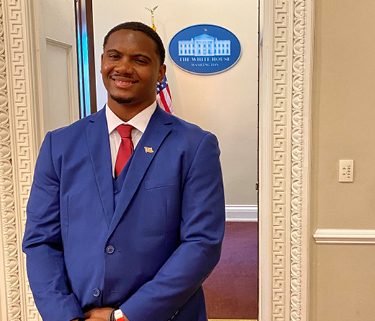
A man in a blue suit with a red tie stands in front of a doorway at the White House. In the background is a blue oval plaque on the wall with white text that reads "The White House" and behind him is an American Flag.

Disability Justice Advocate Neli Latson Joins White House Black History Month Event

Washington, DC – Neli Latson’s story of unjust prosecution and abuse in the criminal legal system was heard at the White House today, bringing attention to the need for better treatment of people with disabilities in interactions with law enforcement.

Latson was invited to speak with high level government officials during a Black History Month event with other young advocates on a variety of social justice issues.A man in a blue suit with a red tie stands in front of a doorway at the White House. In the background is a blue oval plaque on the wall with white text that reads "The White House" and behind him is an American Flag.

“Being at the White House today was not only an honor, it was a dream come true. For years, when I was locked up in solitary confinement, I daydreamed about getting out and telling my story. I wanted to stand up and speak out so that other autistic people, and other Black people, and other Black and autistic people, would not experience the terrible things that happened to me,” said Latson.

In 2010, Latson was an 18-year-old high school student, waiting outside his neighborhood library in Stafford County, Virginia for it to open. Someone called the police reporting a “suspicious” Black male, possibly with a gun. Latson, who has autism and intellectual disability, had committed no crime and was not armed. The resulting confrontation with a deputy who came to investigate resulted in injury to the officer when Latson, whose autism is accompanied by tactile sensitivity, resisted being manhandled and physically restrained. This was the beginning of years of horrific abuse in the criminal legal system. Prosecutors refused to consider Latson’s disabilities, calling it a diagnosis of convenience and using “the R-word,” and rejected an offer of disability services as an alternative to incarceration. Instead, Latson was convicted, sentenced to prison and punished with long periods of solitary confinement, Taser shocks, and the use of a full-body restraint chair for hours on end for behaviors related to his disabilities.

The Arc of Virginia and national disability advocates, including The Arc’s National Center on Criminal Justice and Disability and the Autistic Self Advocacy Network, urged then-Virginia Governor Terry McAuliffe to pardon Latson.  In 2015, he was granted a conditional pardon. Although this released Latson from prison, it required him to live in a restrictive residential setting and remain subject to criminal legal system supervision for ten years. The terms meant Latson could be sent back to jail at any time, causing constant anxiety.

Finally, in 2021, then-Virginia Governor Ralph Northam granted Latson a full pardon, giving him his freedom. Since this development, Latson now lives in his own apartment and receives community-based supports.

“It’s gratifying to have the White House acknowledge the importance of Neli’s advocacy for a society that treats all people with disabilities, particularly Black people, with dignity and respect. The painful truth is that Black people with disabilities live at a dangerous intersection of racial injustice and disability discrimination, and Neli’s life was forever altered by his experience,” said Tonya Milling, Executive Director of The Arc of Virginia, who attended the event with Latson.

“This case galvanized disability rights activists, bringing national attention to overly aggressive and sometimes deadly policing, prosecution and sentencing practices and to the horrifying mistreatment of people with intellectual and developmental disabilities in jails and prisons. Neli’s advocacy is a testament to his strength and desire to make sure no one is treated like he was in that moment that forever changed his life,” said Leigh Ann Davis, Senior Director, The Arc’s National Center on Criminal Justice and Disability.

“I still have a lot of trauma to overcome. I am fearful and it’s hard for me to do a lot of things. At the same time, I am happy that the activism and publicity about my case not only helped me, but also helped to make change for others,” concluded Latson.

The Arc logo

Statement on the Killing of Tyre Nichols

Washington, DC – As the public learns more about the killing of Tyre Nichols, The Arc stands in solidarity with his family and friends.

“Yet again, the nation watches another video exposing police violence against a Black man after a traffic stop.  We are horrified to witness the brutalization of an unarmed man. Tyre had Crohn’s disease, which made the blows against his very lean body more damaging. Another dying Black son is crying out for his mother and another Black life ended by people who pledge to protect all of us in our communities.

“We speak out in solidarity with Tyre’s family and friends because so many people in The Arc watch with horror as this happens again, and again – and our minds also go to the fear in all of us that people with disabilities within BIPOC or other marginalized communities can end up in the same deadly circumstances as Tyre, during a routine encounter with police.

“The Arc believes everyone belongs and will advocate tirelessly to make this happen. With their intersecting identities, all members of the disability community are valued, respected, and celebrated for who they are. And that belief is steadfast in solidarity with the Nichols family and friends, whom we offer our deepest sympathies and condolences for their loss,” said Peter Berns, CEO, The Arc.

As the largest community-based organization advocating for and with, and serving, people with intellectual and developmental disabilities (IDD) and their families, The Arc works tirelessly to uphold our vision “for people with IDD to be valued members of their communities, have the opportunity to achieve their full potential and a future that is secure.”

The Arc advocates for and serves people wit­­h intellectual and developmental disabilities (IDD), including Down syndrome, autism, Fetal Alcohol Spectrum Disorders, cerebral palsy and other diagnoses. The Arc has a network of nearly 600 chapters across the country promoting and protecting the human rights of people with IDD and actively supporting their full inclusion and participation in the community throughout their lifetimes and without regard to diagnosis.

Editor’s Note: The Arc is not an acronym; always refer to us as The Arc, not The ARC and never ARC. The Arc should be considered as a title or a phrase.

The United States Capitol Building

A Recommitment to Care With the Introduction of the Better Care Better Jobs Act

Today, Senator Bob Casey (D-PA) introduced a landmark piece of legislation to invest in the country’s care economy and make important improvements to Medicaid home and community-based services (HCBS).

The care workforce is a vital part of community living and inclusion for people with disabilities—and yet the system that supports it continues to be underfunded and complicated to navigate. Hundreds of thousands of people with intellectual and developmental disabilities remain on waiting lists for the services they need to live in and thrive in their communities. The new Better Care Better Jobs Act will address these deficits through several key improvements, including a permanent increase in federal Medicaid funding for eligible states, adding over $300 billion toward expanding and improving access to HCBS.

The proposed updates to Medicaid complement President Biden’s American Jobs Plan—which targets the current care infrastructure crisis and aims to fortify it for the future—by expanding eligibility, requiring coverage for personal care services, expanding supports for family caregivers, addressing the direct care workforce crisis by raising wages, and more.

“People with disabilities deserve the supports to live meaningful and dignified lives in their communities. Their care workers deserve the pay and hours to avoid burnout and turnover. And their families deserve the aid of care workers so they do not have to quit or cut their hours to fill in the gaps. It’s 2023, and we should not have to still be fighting for these basic needs so that everyone has the ability to build the life they want.

“The Arc is, as always, ready to rally support for these much-needed changes and looks forward to making sure Congress knows the difference that they would make in the lives of countless people with disabilities,” said Peter Berns, CEO, The Arc.

The United States Capitol Building

Congress’s End-of-Year Legislation Includes Disability Priorities and Leaves Unfinished Business

As Congress wrapped its work for the year, disability advocates pushed for progress on a variety of priorities. Congress has now passed a package that includes some important victories but leaves others out.

One of the biggest wins is an extension of the Money Follows the Person program, which helps people transition out of institutions and nursing homes, and back to their communities.

The Money Follows the Person (MFP) program provides grants to states to transition Medicaid participants from institutions into the community. MFP has moved more than 107,000 seniors and individuals with disabilities out of these institutions and has helped 43 states and the District of Columbia improve access to home and community-based services (HCBS). Medicaid requires states to provide care in nursing homes, but HCBS is optional. The MFP program is then critical because it incentivizes investment in HCBS by providing federal funding for transitional services for individuals who wish to leave a nursing home or other institution. Congress has now extended it through 2027.

“This program makes it possible for more people with disabilities to change their lives, on their own terms. And it proves what people with disabilities and their families know – the opportunities for a life in the community, with the services to make it happen, are game changers. We will continue to relentlessly advocate for major investments in home and community-based services,” said Peter Berns, CEO, The Arc.

Other victories in the bill include:

  • Creating a path for a ban on the use of electric shock devices for behavior modification on people with intellectual and developmental disabilities (IDD). The brutal treatment is widely recognized as cruel, harmful, and ineffective. Yet it’s still used at one institution in Massachusetts.
  • Extending the requirement that states apply Medicaid’s spousal impoverishment protections to HCBS through 2027. A spouse shouldn’t have to live in poverty for their partner to receive services in the community.
  • Expanding ABLE account eligibility. ABLE accounts are tax-advantaged savings accounts for individuals with disabilities. This legislation increases the age of disability onset to access an ABLE account from prior to age 26 to age 46, starting in 2026.

Congress’s action or inaction on certain issues creates unfinished business for The Arc and our advocates to rally around in 2023, including:

  • No action to increase to SSI’s asset limits. Right now, people who get SSI can only have $2,000 in assets, and married couples can only have $3,000.
  • Congress is ending important eligibility and funding improvements tied to the COVID-19 public health emergency. This means states may begin to remove ineligible people from their program starting April 1.

“It’s very disappointing that Congress didn’t take the opportunity to help lift people with disabilities out of poverty, by simply bringing the SSI asset limit out of the 1980s into this century. We will continue to push for this change in the New Year,” said Berns.