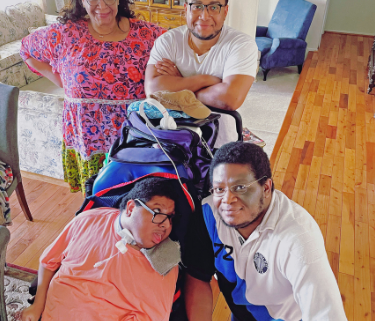
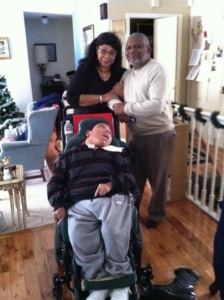
A mom, dad and young man stand around another young man who is in wheelchair. They are standing in their living room.

Families Like Debbi, Josh, and Victor Need Your Support.

The Arc has been advocating for decades to help family caregivers—advocating for health insurance, for paid family and medical leave, and respite services and other family supports. And this advocacy has taken on even more urgency during the COVID-19 pandemic.

Families like Debbi, her husband Victor, and their son Josh need our support more than ever.

“Josh was born about eight weeks early with a grade four brain hemorrhage, so he was one of the sickest babies in the neonatal intensive care unit. It started our roller coaster of a journey of having a child with complex medical needs and disabilities.”

Debbi and Victor struggled to hold onto their jobs while managing Josh’s complex medical needs and raising their two other children. Victor was often called away for active duty with the military. Debbi often worked during the night to meet her deadlines and hold onto the health insurance they depended on to pay for Josh’s medical care.

“And that insurance, it was always in the back of my mind, was what was keeping Josh alive.”

The challenges of balancing work and family caregiving responsibilities began to mount. Debbi struggled to get approved for unpaid leave and as Josh’s care needs increased, Debbi had to reduce her working hours substantially. This was a financial burden for the entire family and increased her worry about losing her job altogether.

Reflecting on that time, Debbi explains:

“It was a very difficult time emotionally, physically, and also financially. If I had been able to get paid leave, our struggles would have been so much less critical.”

Like Debbi, most Americans cannot take extended unpaid time away from work to care for a family member. Nor are they able to wait on years-long waiting lists for supports and services that may never come.

That’s why The Arc is working to make a national paid family leave program a reality for ALL who need it.

That’s why we’re advocating for home and community-based services to be available when they’re needed most.

Family caregivers, and their loved ones with intellectual and developmental disabilities, experience challenges in their daily lives that you and I never even have to think about. The Arc must be there alongside them. But we can’t do it without you.

You can help overwhelmed families navigate the complex developmental disabilities services systems for infants, children, and adults with IDD by giving to The Arc.

Can we count on you to stand with family caregivers by supporting The Arc today?

Join us and make a difference. Donate to support our critical advocacy today and sign up for updates to advocate with us when it matters most.

Your gift will be matched!


The Arc logo

House of Representatives Passes Historic Disability Funding Through Build Back Better Plan

“We need the Senate to understand all that is on the line”

Today, the U.S. House of Representatives passed President Biden’s Build Back Better plan, bringing us one important step closer to making significant investments in our country, in the lives of people with disabilities and their families, and the direct support workforce. The reality is change can’t come soon enough for millions of people.

The proposal includes $150 billion for Medicaid home and community-based services, or HCBS, which provide the support people with disabilities need to be a part of their community, and better pay for the workers who support them.

“This plan is major progress in our country doing what we know is right: putting vital dollars behind something that really should never come with a price tag – basic humanity. People with disabilities, families, and the direct support professionals who support them are struggling to persevere through the hardest of times while suffering in unprecedented ways. And the clock is ticking on how much more they can take,” said Peter Berns, Chief Executive Officer of The Arc.

For years, the service system that people with intellectual and development disabilities (IDD) and their families rely on, Medicaid, has been underfunded. Millions of adults and children all over the country are stuck on waiting lists for HCBS, the direct care workforce is underpaid and undervalued – the quality of services suffer, and too often, unpaid family caregivers are left to fill the gaps, struggling to balance work and family responsibilities.

Build Back Better expands access to services for people with disabilities on waiting lists and starts addressing the direct care workforce crisis, including raising wages and creating more jobs. We need this plan – and more, and we urge the Senate to move swiftly and further humanize this deal, by adding more funding for HCBS.

Congress has heard the outcry from across the country on the need for paid leave, and included a national program so no one has to choose between taking care of themselves or a family member, and their paycheck. The Arc has long advocated for a national paid leave program for family caregivers. The pandemic forced millions of people to choose between their own health, the well-being of their families, and their livelihood.

“Taking time off to care for the people we love should not be so hard. The pandemic has only underscored the urgency of implementing a national paid leave policy, and so the time is now to do the right thing for all caregivers,” said Berns.

The Arc is also pleased that the proposal includes:

  • The expansion of the Supplemental Security Income (SSI) program to over 3 million people with disabilities living in U.S. territories
  • The extension of improvements to the Child Tax Credit for one year and permanent expansion of the credit to the lowest income families
  • The expanded Affordable Care Act premium tax credits through 2025
  • The extension of improvements to the Earned Income Tax Credit for low-wage workers with disabilities.

“We need the Senate to understand all that is on the line. The futures of people with disabilities, families, and this critical workforce depends on this moment,” said Berns.

Brittany-simuangco

Child Tax Credit Helps Working Moms Like Molly Stay Afloat and in the Workforce

A woman sits on the ground with mulch and a fallen tree around her. On her lap is her young son. She is wearing a mask and holding him affectionately. For moms like Molly, the past four months have meant long-overdue help in making ends meet. Molly works full time and manages the care for her 15-year-old son, Reid, who has a condition called Angelman’s Syndrome. Reid requires specialized caregiving for feeding, diaper changes, and constant monitoring for safety due to seizures and mobility issues.

What has been the difference in the last four months? The Child Tax Credit (CTC), a monthly cash benefit for children for which low and middle-income families can qualify. It has helped families like Molly’s pay for rent, food, child care, health care co-pays, school supplies, and other expenses across the country. For caregiver parents, it’s an especially needed benefit. As Molly says, “I am using this to pay for help, food, and transportation so I can stay afloat when forced to leave work to be a caregiver when no one else can and give Reid’s elderly grandma a break once in a while so she can continue to help with his care going forward.”

But Congress is currently debating if they should continue these crucial payments. Some legislators want to reduce this credit, limit the families who can receive it, and take it away from some of the lowest-income families by instituting a work requirement. This change would disproportionately impact parents who took time away from work to care for their child with a disability or complex medical needs. As Molly says:

“We have always had a hard time getting caregivers to help in the home and rely heavily on Reid’s 73-year-old grandma to fill in the scheduling gaps.  A few years ago I gave up working in the clinic as a prosthetist and as an instructor at the University of Washington and took on a work-from-home role with the corporate office of my company.  This was necessary in order to have enough schedule flexibility to ensure Reid is cared for in the summer and enabled to attend school the rest of the year.  Reid qualifies for Medicaid and has a Basic Plus Waiver for in home caregivers and other assistance. Over the past two years, I have had to take unpaid time off work, accept furlough from my job, and rent out half my house in order to make up for Reid not being in school and the lack of available Medicaid-paid caregivers.” The CTC is making a critical difference for Molly, Reid, and many more families, so penalizing caregiver parents is unacceptable.

As we learned when a work or earnings requirement was proposed in Medicaid a few years ago, these unnecessary rules only create costly, bureaucratic processes that restrict access. They often penalize people who are working, but who need to leave the workforce for a period of time for their own health reasons or to take care of a loved one. As Molly says: “Every time I’ve had to take time away from my paid job to be a caregiver for Reid, I am scared to death that I will lose my job and jeopardize my career prospects.  I have worked for years to be a good prosthetist and excellent corporate employee.  The small amount of assistance the tax credits give for caregiving is not in any way an incentive to leave my paid job. They are only enablement to continue working at BOTH of the jobs in which I am fulfilled as a productive member of society.”

A work requirement would disproportionality harm parents with disabilities and families with children with disabilities. It is past time for Congress to recognize that caregiving is work and provide essential supports to families through the Child Tax Credit.

A woman in a motorized chair plays with a small dog on a grassy field in front of a community of houses

New Budget Framework Provides Historic Investment in the Disability Services System

Today, President Biden announced the Build Back Better budget framework that would make significant investments in our nation, people with disabilities, their families, and the direct support workforce. This new deal includes $150 billion for Medicaid home and community-based services, or HCBS, which provide the support people with disabilities need to be a part of their community, and better pay for the workers that support them.

For years, the service system that people with intellectual and development disabilities (IDD) and their families rely on, Medicaid, has needed an investment. People are stuck on waiting lists for HCBS, the direct care workforce is underpaid, and too often, unpaid family caregivers are filling in the gaps.

“This proposal is a huge down payment on investing in the futures of people with disabilities and their families. It will expand access to services for people with disabilities on waiting lists and start addressing the direct care workforce crisis, including raising wages and creating more jobs. Without a robust and well paid workforce, the promise of services in the community falls apart – so it was urgent that the direct support workforce be bolstered in this deal,” said Peter Berns, CEO, The Arc.

While the investment in HCBS is major, and includes long fought for funding, even with the most robust investment in these services, families still need paid leave. The Arc has long advocated for a national paid leave program for family caregivers. The pandemic forced millions of people to choose between their own health, the health of their families, and their livelihood. As the BBB package moves forward, The Arc urges Congress to include paid leave as the package moves through the House and Senate.

“We have always known because of the many stories from our network, but the pandemic highlighted for everyone how crucial paid leave is for people with disabilities and their families. Leaving out paid leave is unacceptable, and Congress should include paid leave in this package,” said Berns.

The Arc is also pleased that the framework includes:

  • The extension of improvement to the Child Tax Credit for one year and permanent expansion of the credit to the lowest income families;
  • The expanded Affordable Care Act premium tax credits through 2025; and
  • The extension of improvements to the Earned Income Tax Credit for low-wage workers with disabilities.

“We urge Congress to act quickly on this plan, add more funding for HCBS as negotiations continue, and fulfill the promise on paid leave. Change can’t come soon enough for millions of people with disabilities and their families,” said Berns.

The Arc logo

Members of Congress Join Parents, Caregiving Advocates to Demand Urgent Care Infrastructure Investments in Build Back Better Budget Reconciliation

WASHINGTON, DC — Speaker Nancy Pelosi, U.S. Senators Cory Booker (D-NJ), Maria Cantwell (D-WA), Robert Casey (D-PA), Tammy Duckworth (D-IL), Kirsten Gillibrand (D-NY), Patty Murray (D-WA) and Ron Wyden (D-OR), Reps. Rosa DeLauro (D-CT), Debbie Dingell (D-MI), Lloyd Doggett (D-TX), Sara Jacobs (D-CA), Jackie Speier (D-CA) and Bobby Scott (D-VA) joined parents, caregivers, care workers, and advocates Thursday to express support for care infrastructure investments in the Build Back Better budget reconciliation package.

Specifically, members of Congress voiced their support and explained why workers, families, businesses and our economy need care infrastructure investments immediately, including paid family and medical leave, in-home-and community-based services for elders and people with disabilities, a fully refundable Child Tax Credit (CTC), living wages and a path to citizenship for all care workers.

“All over the country people with disabilities, and their families are going without the support that they need due to decades of lack of investment in Home and Community-Based Services, resulting in stagnant pay for direct care worker wages, for a workforce doing life-giving work,” said Nicole Jorwic, Senior Director of Public Policy, The Arc of the United States. “The dedicated funding for HCBS will raise wages for these workers, create more and better direct care jobs, provide more services for those going without, and support family caregivers who are currently filling the gaps that the service system leaves behind. Now is the time to build back better to support people where they want to live, in their homes and communities.”

“The time to build a care infrastructure that lifts our economy, our families and our country is now. America’s moms, dads, and caregivers are rising across the nation to let Congress know that care can’t wait, and neither can our economy,” said Kristin Rowe-Finkbeiner, Executive Director and CEO of MomsRising. “We must end the days when moms, dads, and caregivers lose their jobs when a baby comes or critical illness strikes, when families can’t afford quality child care, when care workers don’t earn living wages, when people with disabilities and the aging can’t access or afford in-home care, and when tens of millions of America’s children are raised in poverty. A care infrastructure will lift families, enable moms and parents to work, support businesses, boost our economy, and create millions more good jobs. It will allow for a just recovery from the pandemic and make our country more successful.”

“Small businesses are demanding programs like paid leave and child care that will help ease the burden of high costs on working families and support entrepreneurs. It’s past time to level this playing field,” said Main Street Alliance Co-Executive director Chanda Causer. “An investment in our overall care economy is an investment in small businesses, and our local community. It is important to move both pieces of infrastructure legislation together. One without the other will limit an equitable or sustainable recovery. Small businesses are watching closely to make sure any investments in our economy are truly investments in an equitable recovery and future.”

“Home and community based services literally keeps myself and millions of Americans alive and at home with our families. Fully funding home and community-based services, would allow seniors and people with disabilities to receive the care they need at home to live with dignity and respect with their families and loved ones,” said Ady Barkan, Co-Founder of Be A Hero. “Not only will fully funding home and community based services allow for seniors and people with disabilities to live at home with dignity and respect, but it will finally give caregivers the respect they deserve through a living wage.  The historic investments in HCBS will have an outsized impact on the nation’s overall employment, and the employment of women and women of color. Millions of Americans are counting on Members of Congress to seize this moment, be heroes, and fully fund home and community based services.”

“Home care workers no matter where we work or live need the right to form a union,” said Latonya Jones-Costa, a home care worker from Atlanta. “I’m an expert in my field with specialized skills and advanced certifications. I have just as much training and qualifications as other healthcare workers; however, I don’t earn a family-sustaining wage, have healthcare. I have to work two jobs just to keep the lights on. It’s hard to fight for those basic benefits when I don’t have an opportunity to join a union, and unfortunately in our industry that was done by design. Now we have a better chance to undo these injustices and fight for our basic benefits so we can better provide essential care to our clients.”

“The pandemic has exacerbated the care crisis most women — especially Black and Brown women — in this country have been facing for decades. Millions of women have been forced out of the labor market as women-dominated industries were hit the hardest by the pandemic and caregiving needs at home increased,” said Monifa Bandele, Interim President and CEO at TIME’S UP Now. “The system is broken and women and families are suffering, and so is the economy. Women’s labor force participation has reached its lowest point in 30 years. We can’t achieve family economic security or safe, healthy, thriving communities if women can’t productively engage in the workforce because they don’t have access to quality child care or care for their elderly relatives or family members with disabilities. We are the only wealthy nation that doesn’t guarantee paid family leave, which undermines our workers’ productivity. Care can’t wait and the time to care is now.”

“Here’s the bottom line: Babies’ growing brains can’t choose between the things they need. Neither should Congress,” shared Dr. Myra Jones-Taylor, ZERO TO THREE’s Chief Policy Officer. “Millions of parents in this country are forced to make impossible decisions every single day about caring for and supporting their babies. Today, we are on the cusp of shoring up our crumbling care infrastructure and supporting families and parents in providing for their children. The Build Back Better Act answers the call for a baby agenda that provides elements essential for healthy development with paid family and medical leave; a comprehensive child care system that addresses both the high costs and limited supply of quality care that plagues parents with young children; and an enhanced Child Tax Credit that could cut child poverty in half. This is a once-in-a-generation opportunity to respond to families’ needs today and to build a strong foundation for generations to come. Babies and families need a care infrastructure that paves the way for healthy development and strengthens families, communities, and our country.”

“We have the opportunity to do something meaningful—and truly transformational—to help every working family in this country but particularly the women of color hit hardest in an ongoing crisis,” said Dawn Huckelbridge, Director of Paid Leave for All. “We have the opportunity to pass policies that would yield millions of jobs, billions in wages, and trillions in GDP and to leave a powerful, profound legacy—to finally make history by passing paid leave in the United States. Care must be the cornerstone of our recovery, our rebuilding, and this package.”

“Families can’t thrive, and the economy can’t recover, until we have the policy solutions that support all of us in caring for the people we love,” said Olivia Golden, executive director of the Center for Law and Social Policy (CLASP). “That’s why we urge Congress to ensure the Build Back Better Act includes provisions to address our nation’s long-standing failure to support care for children, seniors, and people with disabilities—problems, which the pandemic has magnified, that disproportionately affect women, children, and communities of color. Significant investments in child care, pre-K, paid family and medical leave, continuation of the expanded child tax credit and Earned Income Tax Credit, and a pathway to citizenship are essential for our economic recovery.”

“People across the country are waiting for the Build Back Better agenda to pass, including robust investments in the care work that allows all other work to happen,” said Ai-jen Poo, executive director of National Domestic Workers Alliance and Caring Across Generations. “We all deserve an economy that gets women back to work, and we’ll get there when our leaders invest in home and community-based services, expand care services for our elderly and our loved ones with disabilities, lower care costs for families, and raise wages for the essential workers who do the work that make it all possible. It’s time for Congress to deliver and ensure that all of us, especially care workers themselves, can access the care we deserve.”

“Comprehensive, universal paid family and medical leave is essential for workers now more than ever,” said Lelaine Bigelow, Vice President for Social Impact and Congressional Relations at the National Partnership for Women & Families. We are grateful to our Congressional leaders who understand this, and who continue to fight for legislation that truly builds back better and provides support for women and families at this time when they need it most. Without robust care policies, our economy will only continue to suffer. At a time when many Americans are worried about their health and their economic stability, care simply cannot wait.”

The event was organized by MomsRising and Care Can’t Wait in partnership with Better Balance, Advocates for Children of NJ, American Association of People with Disabilities, American Federation of Teachers, Be a Hero, Building Back Together, Campaign for a Family Friendly Economy, CAP Action, Caring Across Generations, Center for American Progress, Center for Law and Social Policy (CLASP), Child Care Services Association, Coalition of Labor Union Women, AFL-CIO, Community Change Action, DC Action, Equal Rights Advocates, Family Values @ Work, Family Voices NJ, First Focus on Children, Institute for Women’s Policy Research, Kansas Breastfeeding Coalition, Low Income Investment Fund, Main Street Alliance, NARAL Pro-Choice America, National Asian Pacific American Women’s Forum (NAPAWF), National Association for Family Child Care, National Council of Jewish Women, National Domestic Workers Alliance, National Organization for Women, National Partnership for Women & Families, National Women’s Law Center, NCBCP/Black Women’s Roundtable, Oxfam America, Paid Leave for All, PL+US: Paid Leave for the U.S., SEIU, Stand for Children, Supermajority, The Arc of the United States, TIME’S UP Now, UltraViolet, United for Respect, United State of Women, We Demand More Coalition, Women’s March, and ZERO TO THREE.


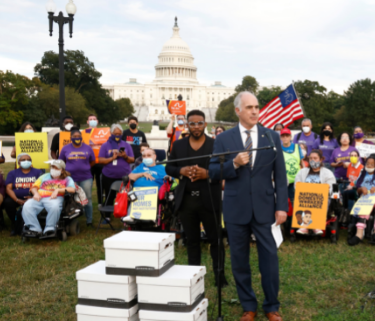
A senator stands in a suit, speaking in front of a group of activists. The US Capitol is behind them, and beside the Senator are 5 large white boxes stacked.

Senator Bob Casey Meets Disability Rights Advocates From 24-Hour Storytelling Vigil, Urges Congress to Pass the Build Back Better Plan

Activists From Across the Nation Deliver 7,500 Stories from Individuals Impacted by Dearth of Home and Community-Based Services

Photos of the Vigil and Rally: https://bit.ly/3ahKPN9

A senator stands in a suit, speaking in front of a group of activists. The US Capitol is behind them, and beside the Senator are 5 large white boxes stacked.

WASHINGTON, DC – OCTOBER 07: Sen. Bob Casey (D-PA) speaks at a 24-hour vigil outside of the U.S. Capitol building, Sen. Bob Casey (D-PA) joins people with disabilities and advocates to demand funding for home care services in President Biden’s “Build Back Better” package before Congress on October 07, 2021 in Washington, DC. (Photo by Paul Morigi/Getty Images for Unbendable Media)

Senator Bob Casey met disability rights activists and care workers who participated in a 24-hour storytelling vigil and reiterated his commitment to fully fund services critical for the health and well-being of people with disabilities and aging adults. Flanked by dozens of ADAPT activists in wheelchairs, SEIU members in purple shirts and other prominent caregiving advocates, Senator Casey closed out the vigil outside the Capitol Thursday by imploring his colleagues in Congress to vote “yes” on the transformative Build Back Better plan that could “put the country on the road to having the best caregiving in the world.”

Advocates from the diverse “Care Can’t Wait” coalition of disability rights, labor, health, aging and caregiving groups also shared the steep health and financial costs that families pay as a result of poverty wages paid to care workers and long waitlists for home and community-based services (HCBS).

“I came here today because I am literally fighting for my life and freedom,” said Latoya Maddox, a mother from Philadelphia who has used HCBS for the past 17 years and is active in Philly ADAPT. “Home and community-based services and accessible housing keep me from being stuck in an institution to get my needs met-something nobody of any age wants. I want Congress to understand that their political games are putting my life and my freedom at risk, and to stop the posturing and realize what your inaction is doing to real people.”

Earlier in the vigil, advocates traveling from states hard hit by COVID-19—including Tennessee, Texas and Kansas—continuously read stories collected from thousands of impacted individuals—disproportionately people of color— across the country who were unable to travel to D.C., in part because they do not have access to paid leave, childcare or long-term services.

More than 800,000 people with disabilities are on waiting lists for HCBS, such as in-home care, meal delivery, transportation services and respite care. The Better Care Better Jobs provisions in the budget reconciliation seeks to eliminate long standing HCBS waitlists and allow states to expand the number of people who are eligible to receive these essential services.

“We need Congress to pass the Better Care Better Jobs Act and invest the proposed $400 billion in Medicaid HCBS funding,” said Nicole Jorwic, Senior Executive Officer of Public Policy at The Arc and one of the advocates who participated in the 24-hour vigil. “Together, we must recognize this unprecedented opportunity to begin fixing our nation’s inadequate care systems and transform the way we treat people served, and those providing the care, who deserve dignity, respect, and opportunity. Our nation must finally recognize the value of all people and significantly invest in care during this historic moment.”

Even as negotiations around the biggest jobs plan since the New Deal have stalled, the long-term care provision in the Build Back Better plan is still popular with the overwhelming majority of people across the country.

“People across the political spectrum overwhelmingly want Congress to invest in the care infrastructure that is the backbone of our economy and our lives,” said Ai-jen Poo, Executive Director of Caring Across Generations and National Domestic Workers Alliance. “Increasing wages for care workers will ensure that they can care for themselves and their own families. Increasing wages will also make care work more sustainable in the long-run and ensure a more robust workforce that can meet the rising demand for these services.”

The event was co-hosted by ACLU, ADAPT, The Arc of the United States, Autistic Self Advocacy Network, AAPD, Bazelon Center for Mental Health Law, Be A Hero, Care Can’t Wait Coalition, Caring Across Generations, Little Lobbyists, Justice in Aging, National Council on Independent Living, National Domestic Workers Alliance, National Council on Aging, National Health Law Program, and SEIU.

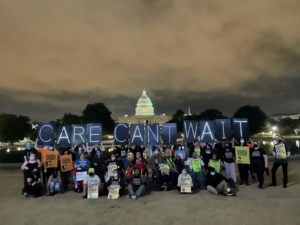
A group of activitists poses in front of the US Capitol at night, holding light up signs that say Care Can't Wait

The United States Capitol Building

Disability Rights, Care Workers to Hold 24-Hour Vigil at the U.S. Capitol to Hold the Line on Care Funding

As negotiations around the biggest jobs plan since the New Deal stall, care advocates from across the country will hold a 24-hour vigil outside the U.S. Capitol to urge elected leaders to hold the line on caregiving funding in the Build Back Better plan.

People with disabilities, direct care workers, older adults, and caregivers will share the steep health and financial costs that families pay as a result of poverty wages paid to care workers and long waitlists for home and community-based services (HCBS). Advocates traveling from states hard hit by COVID-19—including Tennessee, Texas and Kansas—will continuously read stories collected from thousands of impacted individuals—disproportionately people of color— across the country who aren’t able to travel to D.C. in part because they don’t have the paid leave, child care or long-term services that enable them to do so. Overwhelming majorities of people across the country want Congress to invest in long-term care and support the Build Back Better’s plan to do so.

WHAT:

A 24-hour vigil in front of the Capitol during which advocates will continuously read stories of those struggling to access home and community based services and to make enough money to care for themselves and their families. The vigil will culminate in a closing ceremony with advocates delivering boxes of printed out stories to members of Congress.

The event is co-hosted by ACLU, ADAPT, The Arc of the United States, Autistic Self Advocacy Network, AAPD, Bazelon Center for Mental Health Law, Be A Hero, Care Can’t Wait Coalition, Caring Across Generations, Little Lobbyists, Justice in Aging, National Council on Independent Living, National Domestic Workers Alliance, National Council on Aging, National Health Law Program, and SEIU.

WHEN: 

Vigil: Wed, Oct 6 at 7 pm to Thurs, Oct 7 at 7 pm

Closing Program: Thurs, Oct 7 from 6-7 pm

WHERE: 

Union Square in front of Capitol Reflecting Pool

The area is bounded by Pennsylvania Avenue, NW; First Street, NW/SW; Maryland Avenue, SW; and Third Street, SW/NW

Live Stream: https://fb.me/e/3WaL3atkg

WHO:

Closing ceremony speakers:

  • Bob Casey, S. Senator representing Pennsylvania
  • Maria Town, President and CEO, AAPD
  • Mike Oxford, National Organizer, ADAPT
  • Nicole Jorwic, Senior Executive Officer of State Advocacy and Public Policy, The Arc
  • April Verrett, President of SEIU, Local 2015

Vigil speakers available for media interviews:

  • Domonique Howell, a Black and disabled advocate from Philadelphia. She is an independent living specialist and co-chair of ADAPT’s housing work group.
  • Latoya Maddox, a Philadelphia-based Black disabled mother who has used home and community-based services for the past 17 years
  • Lydia Nunez, Ombudsman and organizer with Gulf Coast ADAPT in Texas. She is white and disabled and fights for home and community-based services for other people with disabilities and older adults.
  • Josue Rodriguez, a Latino organizer with El Paso ADAPT who uses HCBS for attendant services.
  • Family caregivers and care workers 

VISUALS:

People holding posters and banners featuring portraits of care workers, family caregivers, aging adults and people with disabilities. Miniature houses featuring portraits of care recipients, caregivers and care workers

BACKGROUND:

More than 800,000 people with disabilities are on waiting lists for home and community-based services (HCBS), such as in-home care, meal delivery, transportation services and respite care. The Better Care Better Jobs Act—introduced in the Senate by lead sponsor Sen. Bob Casey and in the House by lead sponsor Rep. Debbie Dingell and supported by over 480 organizations—provides a blueprint for how $400 billion investment in HCBS could support a profoundly undervalued and underpaid workforce and get hundreds of thousands of people off waitlists by helping to:

  • Increase access to HCBS: expanding financial eligibility criteria for HCBS and supports for family caregivers, and adopting programs that help people navigate enrollment and eligibility.
  • Make permanent “Money Follows the Person,” a federal demonstration program that helps aging individuals and people with disabilities transition back to their homes and communities from institutions by providing federal matching funds that incentivizes HCBS in states
  • Support oversight and monitoring of the quality of HCBS
  • Increase HCBS payment rates to promote recruitment and retention of care workers
a young boy in a hospital bed with medical equipment on his face. He is smiling.

Surviving on a GoFundMe Campaign: How a Hospital Stay Without Paid Leave Forced One Family Into a Crisis No One Should Face

A selfie of a young boy with his father. They are laying in a hospital bed together and the son has a hospital gown on and medical equipment on his face and neck.

For Kerri, Ken, and their family, Father’s Day weekend 2019 started out as planned—peaceful and filled with quality family time. But early Saturday morning, Kerri and Ken awoke to their 17-year-old son, Yosh, screaming in pain. His stomach had swollen so badly overnight that it looked like a beach ball.

They were terrified for their son. Yosh, who has Down syndrome and autism, is not able to express himself well with verbal language and struggles to understand what is going on around him. However, even without words to explain what he was experiencing, it was clear his pain was severe.

Over the next several days, Yosh was placed in an induced coma as the hospital staff performed tests—and unfortunately found blockages throughout his intestines. For Kerri and Ken, the news was devastating. Yosh had never had any stomach issues. They grappled with trying to understand what was happening—all the while, never leaving Yosh’s side. They barely left the hospital as Yosh received treatment, taking turns watching him while the other rested.

They ended up at their local hospital, where Yosh is considered a VIP because of his frequent visitor status and is well-known to the hospital staff. But even as familiar with Yosh as the hospital staff are, Kerri and Ken know him best. To diagnose Yosh, Kerri says “you have to look for flying hippos with pink and purple spots” and she and Ken knew they needed to be there to help.

However, as the days turned to weeks, Kerri and Ken had to deal with something no parent should have to imagine: choosing between being with your seriously ill child and working.

Kerri and Ken are self-employed. While New Jersey has paid leave, it only covers workers who receive W2s, so both Kerri and Ken were left without help.

Kerri and Ken lived with a fear no parent should have to experience: that not only could each day be their son’s last, but that they would also lose their home in the process.

While they knew that Yosh’s Medicaid would pay for his hospital bills, without income coming in, they were terrified they would have no place to return to when the hospital stay ended. It was the scariest time of their lives. Both still experience post-traumatic stress from the situation, and Kerri shakes every time she passes the hospital.

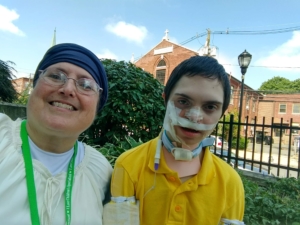
A selfie image of a mom and her teenage son. She is wearing a white t shirt, green lanyard, glasses, and a bandana. He is wearing a yellow shirt and has medical tape and equipment on his face and neck.

While they were in the hospital, a GoFundMe campaign was set up for Yosh and his parents. Family, friends, friends of friends, and strangers donated to Kerri, Ken, and their family that summer.

And, through their help, they were able to pay for their mortgage, utilities, and other essentials.

Kerri and Ken are so grateful for the generosity of others—but also angry that when they were at their lowest point, there were no resources for their family. In addition to advocating for their son, Kerri advocates for and with other families in her work.

“There are so many families that are out there that don’t even know there are resources for them… When a family is in crisis, there needs to be some place for them to go and call in someone who has the knowledge and resources to help them.”

Kerri and Ken don’t want anyone else to ever go through what they did. Paid leave shouldn’t depend on the kind of tax form you get from your job. And no one should have to choose between being there for loved ones and their homes and livelihood.

Learn more and act now to help families like Kerri and Ken’s nationwide.

Visit thearc.org/covid19recovery to learn more.

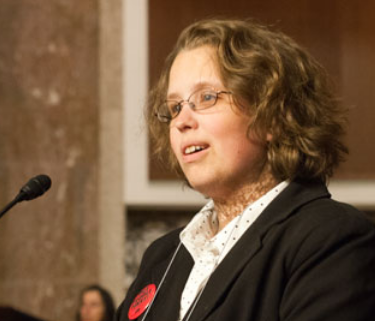
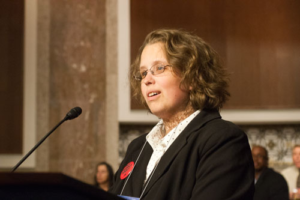
A close up of a speaker at a podium.

The Impact of Student Loan Debt Forgiveness for the Disability Community

My name is Nicole LeBlanc.

I live in Silver Spring, Maryland. I am on the autism spectrum and have anxiety, ADD, seizures, and a learning disability. I am writing to talk about the importance of helping people with disabilities get their student loans discharged, including ending the 3 year monitoring period. As the Biden Administration works to address student loan debt for people with disabilities, it is critically important that the application process be easier and we eliminate the 3 year monitoring period for work earnings. Student loans create a major financial hardship on people like me and many others with disabilities, especially those who live on their own in expensive areas. The amount of loans that I had discharged was around $1,177 which is just slightly less than what I pay in monthly rent for my studio apartment. No one with a disability should have to choose between paying for rent or basic needs and student loans. Many of us in the disability community struggle with finding jobs that pay livable wages where we make enough to live comfortably off public benefits. Benefit cliffs often force us to make big trade-offs between working and needing to stay eligible for public benefits. Some people with disabilities have their Social Security benefits cut to pay their student loans and that isn’t fair.

The application process for student loan discharge needs to be easier and more accessible to fill out, especially for someone with autism or other disabilities who does not get any HCBS services to help complete complex paperwork and navigate government bureaucracy. All government applications should allow us to submit info online without incurring the cost and hassle of printing and mailing stuff. I am glad the Biden Administration started to do that for some people with disabilities, but all people with eligible disabilities should be included.

By letting people with disabilities discharge loans and eliminating the 3-year income monitoring period, it will go a long way towards eliminating the stress and anxiety that comes with the financial challenges of living with a disability. There is no better time like the present to embrace a commitment to creating a stress and anxiety-free world for people with disabilities and their families. Making these changes is one of the best ways the Biden Administration can fulfill President Biden’s campaign promises to the disability community.

A crowd of graduating students against a black backdrop. They are all raising their right arm and turning the tassels on their caps to the other side.

New U.S. Department of Education Regulation Provides Relief to People With Disabilities

Washington, D.C. – The Arc is pleased that the U.S. Department of Education announced a major step in removing barriers in the path of people with disabilities who pursue an education and career goals. The Arc advocated relentlessly for these changes in response to the outcry from people with disabilities across the country.

The Department’s new regulation will provide important relief to more than 323,000 people with disabilities who have outstanding student loans. These borrowers will receive more than $5.8 billion in automatic student loan forgiveness, without having to jump through bureaucratic barriers to access loan forgiveness. The new policy removes these barriers by automating the process and eliminating burdensome paperwork.

“We are encouraged that The Department of Education is implementing recommendations made by The Arc and other advocates to better serve people with disabilities and get rid of these obstacles to financial stability and achieving goals. This is also a huge step toward making sure that people with disabilities do not risk losing their Social Security benefits if they cannot navigate the bureaucratic discharge process. This change helps ensure that government systems work for people with disabilities,” said Peter Berns, Chief Executive Officer of The Arc of the U.S.