The Arc logo

Following Meeting With Dr. Rochelle Walensky, Disability Rights Advocates Release Statement and Readout

Washington, D.C. – Following a meeting between leaders from disability rights organizations and CDC Director Rochelle Walensky, advocates released the following statement:

The dialogue with the CDC Director was long overdue. We should have never gotten to the point where the head of our nation’s leading public health agency finds it encouraging that a disproportionate number of COVID deaths are people with disabilities. The disability community’s coordinated organizing resulted in a number of actionable recommendations that were shared with Director Walensky Friday, including:

  • Commit to regular ongoing meetings and consultation with disability stakeholders and CDC Leadership
  • Ground isolation guidance in public health evidence and data and in an understanding of their impacts on those most at risk
  • Take action to center people with disabilities—and other communities disproportionately impacted by COVID-19—by ensuring that all CDC COVID-19 guidance and other response efforts are inclusive of the needs of people with disabilities.

We are grateful for the opportunity to present these recommendations to the CDC, and we hope they and other federal agencies within HHS and beyond will work quickly to pursue them.

Bethany Lilly, Senior Director of Income Policy at The Arc of the United States, said “This was a good initial step for the CDC– listening and learning from disability advocates. But there are concrete policy steps that the CDC must take and we look forward to meeting with the CDC Director and other leadership to move these policies forward. We also know that the millions of people with disabilities across the U.S. want to hear from the Director as well.” 

Maria Town, President and CEO of the American Association of People with Disabilities said, “The ableism that the disability community has experienced in our nation’s response to the COVID-19 pandemic is not unique nor exclusive to the CDC. It is pervasive in the field of public health and in the medical field. I hope state public health agencies and other healthcare entities are closely following our advocacy so that they center the disability community in their responses to the current emergency and future pandemics.”

Julia Bascom, Executive Director for the Autistic Self Advocacy Network, said “We hope that the CDC will use this moment to begin to rebuild trust with the disability community. This must include both a genuine public apology as well as sustained policy change, beginning with the list of detailed recommendations we provided. We look forward to partnering with the CDC on concrete actions to safeguard and support people with disabilities and transform how the agency approaches its work.”

Elena Hung, Executive Director and Co-founder of Little Lobbyists, said “We appreciate CDC Director Dr. Walensky responding to our request to meet with disability leaders to acknowledge the harm her recent statement and the CDC’s policies caused our community throughout the duration of the COVID-19 pandemic. We anticipate immediate action to address the concerns raised and we look forward to ongoing meetings with CDC leadership to rebuild trust with the disability community. Little Lobbyists will continue the work to hold our leaders accountable and ensure our children with complex medical needs and disabilities are part of every decision that impacts them.”

Susan Henderson, Executive Director at the Disability Rights Education & Defense Fund, said “We will be engaging with other agencies within the Department of Health and Human Services, as well as Congress, to make sure that the entrenched ableism that has led to systemic discrimination on the basis of disability, and has cost hundreds of thousands of disabled people their lives during this pandemic, does not happen again. We hope that, working with Dr. Walensky, the CDC leads by example.”

Matthew Cortland, Senior Fellow, Data for Progress, said, “Tens of millions of chronically ill, disabled, and immunocompromised Americans need not just the CDC but the entire federal government, led by the Biden White House, to swiftly implement substantive policies that actually value our lives. Today’s meeting was only the very first step on the Biden Administration’s path to rebuilding trust with the disability community.

I look forward to the CDC and the entire Biden Administration partnering with the disability community to develop a pandemic response that meaningfully safeguards the lives of tens of millions of chronically ill, disabled, and immunocompromised Americans.”

Jamila Headley, Co-Executive Director of Be A Hero said: “Today we called on the Director of the Centers for Disease Control to do two critical things: to put people with disabilities at the very center of the COVID-19 response, and to ground her agency’s interventions and guidance firmly in the evidence of what will best work to keep all of us safe.

Headley continued, “In the richest country in the world, the agencies in charge of our pandemic response should not be grounding our public health recommendations and interventions in an acceptance that COVID-19 tests and high quality masks are (and will remain) too scarce. Instead, they should ground their approach in evidence of what is most effective, and in the deep knowledge of the communities who are suffering the most at the hands of COVID-19. At this moment people living with disabilities and their loved ones should know that our government is doing everything they can to keep us safe and alive.”

“Even in the middle of the largest global pandemic in a century, this country can afford to ensure that all of us—including the 93 million people in America living with disabilities and the growing numbers of people joining our community—thrive. We will keep fighting until they do just that.”

“Today Dr. Walenksy apologized to disability rights leaders for her hurtful words last weekend, and said that she and her agency needed to do better. I agree and tomorrow, I expect her to begin taking action,” said Headley.

Background & Readout

The meeting took place following comments from Walensky on Good Morning America last Friday, January 7 about a study she found “encouraging,” in which deaths among vaccinated people were mostly isolated to those who have four or more comorbidities. The comment, for which Walensky apologized in the meeting, sparked outrage from the disability community. The hashtag #MyDisabledLifeIsWorthy, started by writer and advocate Imani Barbarin, was a top trend on Twitter last weekend. The frustration extends far beyond Walensky’s initial comment and reflects a greater need for government and society to center disabled and at-risk individuals in managing COVID. In recognition of the growing frustration of the disability community, groups requested a meeting with Walensky.

During the meeting, representatives sought to hold Director Walensky accountable for her comments, establish a working relationship with the CDC, and have a detailed discussion with Director Walenksy about policies the agency should adopt and implement to prioritize the health and safety of the disability community. During the meeting, Director Walensky apologized for her comments, and stated it was not her intent to be harmful to the community. Advocates acknowledged her apology, and also stressed the need for a public apology, as disabled and medically complex Americans who were not in this meeting also deserve to hear from Walensky. Director Walenksy also committed to regular meetings with involvement from senior officials and herself going forward.

The following organizations and individual advocates were in attendance: The American Association of People with Disabilities (AAPD), The Arc of the United States, The Autistic Self Advocacy Network (ASAN), Be A Hero, The Disability Justice Initiative at the Center for American Progress, Disability Rights Education & Defense Fund (DREDF), the Epilepsy Foundation, Little Lobbyists, and Matthew Cortland, Senior Fellow, Data for Progress.

The Arc advocates for and serves people wit­­h intellectual and developmental disabilities (IDD), including Down syndrome, autism, Fetal Alcohol Spectrum Disorders, cerebral palsy and other diagnoses. The Arc has a network of nearly 600 chapters across the country promoting and protecting the human rights of people with IDD and actively supporting their full inclusion and participation in the community throughout their lifetimes and without regard to diagnosis.

Editor’s Note: The Arc is not an acronym; always refer to us as The Arc, not The ARC and never ARC. The Arc should be considered as a title or a phrase.


Rows of empty desks in a classroom

Mask Mandate Preliminary Injunction Continues to Protect Iowa Children

A federal district court today granted a preliminary injunction in our mask mandate lawsuit, blocking enforcement of Iowa’s law prohibiting schools from requiring facemasks.

Previously, the court had issued and then extended a Temporary Restraining Order (TRO), which also blocked enforcement of this harmful law. A preliminary injunction will stay in place as the lawsuit progresses and until the court makes a final decision on the merits of the case.

The court recognized that COVID-19 rates in Iowa continue to pose a risk of severe illness or death to children with disabilities or immunocompromised children represented in the lawsuit who are too young to qualify for the vaccine. The order continues to recognize that the law prohibiting masking requirements at school is likely to violate the civil rights of children with disabilities, including children with underlying conditions that make them more vulnerable to severe illness or death as a result of COVID-19.

With the law blocked, schools remain free to require masks in school. This is something we urge schools to do, in order to meet their obligations to all students as required by the Americans with Disabilities Act (ADA) and Rehabilitation Act.

“The court is making it clear, once again, that students with disabilities have the right to go to school safely during this pandemic. The Arc will continue fighting to ensure that students with disabilities are able to attend their neighborhood schools alongside their peers without disabilities without putting their health and their lives at risk,” said Shira Wakschlag, Senior Director of Legal Advocacy & General Counsel at The Arc.

“With the continuation of this crucial injunction blocking HF847’s masking prohibition, schools are able to require masking in order to meet the needs of kids in their district who have disabilities, including underlying conditions that make them vulnerable to serious illness, hospitalization, or death from COVID-19.  They should continue those masking requirements they’ve put in place, and if they haven’t already, take steps now to adopt masking in school in order to comply with disability rights obligations,” said Rita Bettis Austen, Legal Director at ACLU of Iowa.

The lawsuit is brought by the American Civil Liberties Union, ACLU of Iowa, Disability Rights Iowa, The Arc of the United States, and law firms Arnold & Porter and Duff Law Firm, P.L.C. on behalf of The Arc of Iowa and 11 parents of children with disabilities.

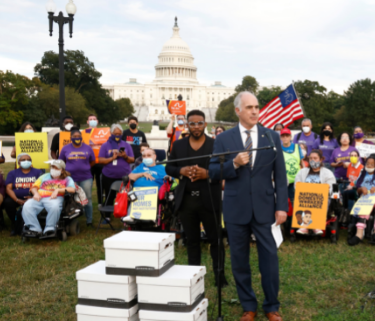
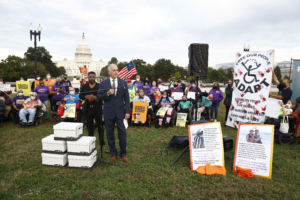
A senator stands in a suit, speaking in front of a group of activists. The US Capitol is behind them, and beside the Senator are 5 large white boxes stacked.

Senator Bob Casey Meets Disability Rights Advocates From 24-Hour Storytelling Vigil, Urges Congress to Pass the Build Back Better Plan

Activists From Across the Nation Deliver 7,500 Stories from Individuals Impacted by Dearth of Home and Community-Based Services

Photos of the Vigil and Rally: https://bit.ly/3ahKPN9

A senator stands in a suit, speaking in front of a group of activists. The US Capitol is behind them, and beside the Senator are 5 large white boxes stacked.

WASHINGTON, DC – OCTOBER 07: Sen. Bob Casey (D-PA) speaks at a 24-hour vigil outside of the U.S. Capitol building, Sen. Bob Casey (D-PA) joins people with disabilities and advocates to demand funding for home care services in President Biden’s “Build Back Better” package before Congress on October 07, 2021 in Washington, DC. (Photo by Paul Morigi/Getty Images for Unbendable Media)

Senator Bob Casey met disability rights activists and care workers who participated in a 24-hour storytelling vigil and reiterated his commitment to fully fund services critical for the health and well-being of people with disabilities and aging adults. Flanked by dozens of ADAPT activists in wheelchairs, SEIU members in purple shirts and other prominent caregiving advocates, Senator Casey closed out the vigil outside the Capitol Thursday by imploring his colleagues in Congress to vote “yes” on the transformative Build Back Better plan that could “put the country on the road to having the best caregiving in the world.”

Advocates from the diverse “Care Can’t Wait” coalition of disability rights, labor, health, aging and caregiving groups also shared the steep health and financial costs that families pay as a result of poverty wages paid to care workers and long waitlists for home and community-based services (HCBS).

“I came here today because I am literally fighting for my life and freedom,” said Latoya Maddox, a mother from Philadelphia who has used HCBS for the past 17 years and is active in Philly ADAPT. “Home and community-based services and accessible housing keep me from being stuck in an institution to get my needs met-something nobody of any age wants. I want Congress to understand that their political games are putting my life and my freedom at risk, and to stop the posturing and realize what your inaction is doing to real people.”

Earlier in the vigil, advocates traveling from states hard hit by COVID-19—including Tennessee, Texas and Kansas—continuously read stories collected from thousands of impacted individuals—disproportionately people of color— across the country who were unable to travel to D.C., in part because they do not have access to paid leave, childcare or long-term services.

More than 800,000 people with disabilities are on waiting lists for HCBS, such as in-home care, meal delivery, transportation services and respite care. The Better Care Better Jobs provisions in the budget reconciliation seeks to eliminate long standing HCBS waitlists and allow states to expand the number of people who are eligible to receive these essential services.

“We need Congress to pass the Better Care Better Jobs Act and invest the proposed $400 billion in Medicaid HCBS funding,” said Nicole Jorwic, Senior Executive Officer of Public Policy at The Arc and one of the advocates who participated in the 24-hour vigil. “Together, we must recognize this unprecedented opportunity to begin fixing our nation’s inadequate care systems and transform the way we treat people served, and those providing the care, who deserve dignity, respect, and opportunity. Our nation must finally recognize the value of all people and significantly invest in care during this historic moment.”

Even as negotiations around the biggest jobs plan since the New Deal have stalled, the long-term care provision in the Build Back Better plan is still popular with the overwhelming majority of people across the country.

“People across the political spectrum overwhelmingly want Congress to invest in the care infrastructure that is the backbone of our economy and our lives,” said Ai-jen Poo, Executive Director of Caring Across Generations and National Domestic Workers Alliance. “Increasing wages for care workers will ensure that they can care for themselves and their own families. Increasing wages will also make care work more sustainable in the long-run and ensure a more robust workforce that can meet the rising demand for these services.”

The event was co-hosted by ACLU, ADAPT, The Arc of the United States, Autistic Self Advocacy Network, AAPD, Bazelon Center for Mental Health Law, Be A Hero, Care Can’t Wait Coalition, Caring Across Generations, Little Lobbyists, Justice in Aging, National Council on Independent Living, National Domestic Workers Alliance, National Council on Aging, National Health Law Program, and SEIU.

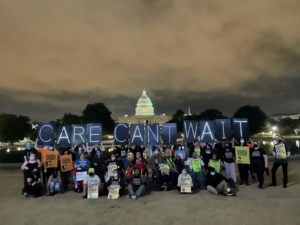
A group of activitists poses in front of the US Capitol at night, holding light up signs that say Care Can't Wait

The United States Capitol Building

Disability Rights, Care Workers to Hold 24-Hour Vigil at the U.S. Capitol to Hold the Line on Care Funding

As negotiations around the biggest jobs plan since the New Deal stall, care advocates from across the country will hold a 24-hour vigil outside the U.S. Capitol to urge elected leaders to hold the line on caregiving funding in the Build Back Better plan.

People with disabilities, direct care workers, older adults, and caregivers will share the steep health and financial costs that families pay as a result of poverty wages paid to care workers and long waitlists for home and community-based services (HCBS). Advocates traveling from states hard hit by COVID-19—including Tennessee, Texas and Kansas—will continuously read stories collected from thousands of impacted individuals—disproportionately people of color— across the country who aren’t able to travel to D.C. in part because they don’t have the paid leave, child care or long-term services that enable them to do so. Overwhelming majorities of people across the country want Congress to invest in long-term care and support the Build Back Better’s plan to do so.

WHAT:

A 24-hour vigil in front of the Capitol during which advocates will continuously read stories of those struggling to access home and community based services and to make enough money to care for themselves and their families. The vigil will culminate in a closing ceremony with advocates delivering boxes of printed out stories to members of Congress.

The event is co-hosted by ACLU, ADAPT, The Arc of the United States, Autistic Self Advocacy Network, AAPD, Bazelon Center for Mental Health Law, Be A Hero, Care Can’t Wait Coalition, Caring Across Generations, Little Lobbyists, Justice in Aging, National Council on Independent Living, National Domestic Workers Alliance, National Council on Aging, National Health Law Program, and SEIU.

WHEN: 

Vigil: Wed, Oct 6 at 7 pm to Thurs, Oct 7 at 7 pm

Closing Program: Thurs, Oct 7 from 6-7 pm

WHERE: 

Union Square in front of Capitol Reflecting Pool

The area is bounded by Pennsylvania Avenue, NW; First Street, NW/SW; Maryland Avenue, SW; and Third Street, SW/NW

Live Stream: https://fb.me/e/3WaL3atkg

WHO:

Closing ceremony speakers:

  • Bob Casey, S. Senator representing Pennsylvania
  • Maria Town, President and CEO, AAPD
  • Mike Oxford, National Organizer, ADAPT
  • Nicole Jorwic, Senior Executive Officer of State Advocacy and Public Policy, The Arc
  • April Verrett, President of SEIU, Local 2015

Vigil speakers available for media interviews:

  • Domonique Howell, a Black and disabled advocate from Philadelphia. She is an independent living specialist and co-chair of ADAPT’s housing work group.
  • Latoya Maddox, a Philadelphia-based Black disabled mother who has used home and community-based services for the past 17 years
  • Lydia Nunez, Ombudsman and organizer with Gulf Coast ADAPT in Texas. She is white and disabled and fights for home and community-based services for other people with disabilities and older adults.
  • Josue Rodriguez, a Latino organizer with El Paso ADAPT who uses HCBS for attendant services.
  • Family caregivers and care workers 

VISUALS:

People holding posters and banners featuring portraits of care workers, family caregivers, aging adults and people with disabilities. Miniature houses featuring portraits of care recipients, caregivers and care workers

BACKGROUND:

More than 800,000 people with disabilities are on waiting lists for home and community-based services (HCBS), such as in-home care, meal delivery, transportation services and respite care. The Better Care Better Jobs Act—introduced in the Senate by lead sponsor Sen. Bob Casey and in the House by lead sponsor Rep. Debbie Dingell and supported by over 480 organizations—provides a blueprint for how $400 billion investment in HCBS could support a profoundly undervalued and underpaid workforce and get hundreds of thousands of people off waitlists by helping to:

  • Increase access to HCBS: expanding financial eligibility criteria for HCBS and supports for family caregivers, and adopting programs that help people navigate enrollment and eligibility.
  • Make permanent “Money Follows the Person,” a federal demonstration program that helps aging individuals and people with disabilities transition back to their homes and communities from institutions by providing federal matching funds that incentivizes HCBS in states
  • Support oversight and monitoring of the quality of HCBS
  • Increase HCBS payment rates to promote recruitment and retention of care workers
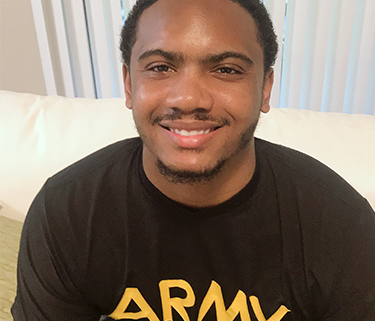
A young man sits smiling on a white couch with white blinds in the background. He is wearing a black shirt with the yellow word "ARMY" on it.

The Arc Recognizes Neli Latson and Lisa Alexander With Catalyst Award

WASHINGTON – The Arc is honored to announce Neli Latson and his mother, Lisa Alexander as recipients of our 2021 Catalyst Award. The award recognizes individuals, businesses, and other organizations that have made extraordinary contributions toward greater social inclusion and the advancement of the human and civil rights of people with intellectual and developmental disabilities (IDD).

“We are honored to recognize Neli and his mother Lisa with The Arc’s most prestigious award. Their strength and commitment to fighting for what’s right and for the human rights of people with intellectual and developmental disabilities entangled in the criminal legal system is exemplary and should serve as a model to society. In the face of discrimination and mistreatment, Neli and his mother never stopped challenging injustice. They have been relentless in shining a light on the need to recognize and respect the humanity of all people, including those with disabilities. The Arc is proud to honor Neli and his mother as true catalysts of change,” said Peter Berns, Chief Executive Officer of The Arc.

Neli persevered in the face of unjust prosecution and abuse in the criminal legal system for more than a decade, throughout his 20s. Displaying courage and an urgency to bring about systemic change, Neli and his mother never gave up seeking justice and fighting for his freedom. They spoke truth: telling the world that Black people with disabilities and all BIPOC people with disabilities experience disparate treatment in policing, in the criminal legal system, and beyond.

Lisa displayed unwavering love and leadership, fighting for her son, throughout this long ordeal. The two are committed to ongoing advocacy to prevent other people with disabilities from suffering from such horrific abuse and discrimination.

In June of this year, after years of advocacy by Neli and his mother, The Arc of the U.S., The Arc of Virginia, a coalition of other groups, and Neli’s attorneys, Virginia Governor Ralph Northam granted Neli a full pardon.

The Catalyst Awards recognize individuals and organizations that are changing how society perceives and treats people with disabilities. Each honoree has done something remarkable that helps fulfill The Arc’s mission to promote and protect the human rights of people with IDD.

The Arc advocates for and serves people wit­­h intellectual and developmental disabilities (IDD), including Down syndrome, autism, Fetal Alcohol Spectrum Disorders, cerebral palsy and other diagnoses. The Arc has a network of over 600 chapters across the country promoting and protecting the human rights of people with IDD and actively supporting their full inclusion and participation in the community throughout their lifetimes and without regard to diagnosis.

Editor’s Note: The Arc is not an acronym; always refer to us as The Arc, not The ARC and never ARC. The Arc should be considered as a title or a phrase.

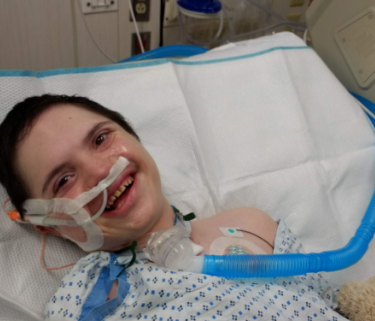
a young boy in a hospital bed with medical equipment on his face. He is smiling.

Surviving on a GoFundMe Campaign: How a Hospital Stay Without Paid Leave Forced One Family Into a Crisis No One Should Face

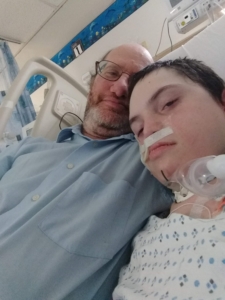
A selfie of a young boy with his father. They are laying in a hospital bed together and the son has a hospital gown on and medical equipment on his face and neck.

For Kerri, Ken, and their family, Father’s Day weekend 2019 started out as planned—peaceful and filled with quality family time. But early Saturday morning, Kerri and Ken awoke to their 17-year-old son, Yosh, screaming in pain. His stomach had swollen so badly overnight that it looked like a beach ball.

They were terrified for their son. Yosh, who has Down syndrome and autism, is not able to express himself well with verbal language and struggles to understand what is going on around him. However, even without words to explain what he was experiencing, it was clear his pain was severe.

Over the next several days, Yosh was placed in an induced coma as the hospital staff performed tests—and unfortunately found blockages throughout his intestines. For Kerri and Ken, the news was devastating. Yosh had never had any stomach issues. They grappled with trying to understand what was happening—all the while, never leaving Yosh’s side. They barely left the hospital as Yosh received treatment, taking turns watching him while the other rested.

They ended up at their local hospital, where Yosh is considered a VIP because of his frequent visitor status and is well-known to the hospital staff. But even as familiar with Yosh as the hospital staff are, Kerri and Ken know him best. To diagnose Yosh, Kerri says “you have to look for flying hippos with pink and purple spots” and she and Ken knew they needed to be there to help.

However, as the days turned to weeks, Kerri and Ken had to deal with something no parent should have to imagine: choosing between being with your seriously ill child and working.

Kerri and Ken are self-employed. While New Jersey has paid leave, it only covers workers who receive W2s, so both Kerri and Ken were left without help.

Kerri and Ken lived with a fear no parent should have to experience: that not only could each day be their son’s last, but that they would also lose their home in the process.

While they knew that Yosh’s Medicaid would pay for his hospital bills, without income coming in, they were terrified they would have no place to return to when the hospital stay ended. It was the scariest time of their lives. Both still experience post-traumatic stress from the situation, and Kerri shakes every time she passes the hospital.

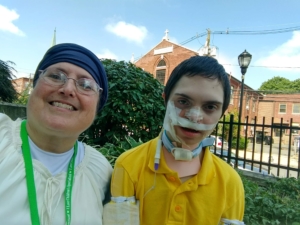
A selfie image of a mom and her teenage son. She is wearing a white t shirt, green lanyard, glasses, and a bandana. He is wearing a yellow shirt and has medical tape and equipment on his face and neck.

While they were in the hospital, a GoFundMe campaign was set up for Yosh and his parents. Family, friends, friends of friends, and strangers donated to Kerri, Ken, and their family that summer.

And, through their help, they were able to pay for their mortgage, utilities, and other essentials.

Kerri and Ken are so grateful for the generosity of others—but also angry that when they were at their lowest point, there were no resources for their family. In addition to advocating for their son, Kerri advocates for and with other families in her work.

“There are so many families that are out there that don’t even know there are resources for them… When a family is in crisis, there needs to be some place for them to go and call in someone who has the knowledge and resources to help them.”

Kerri and Ken don’t want anyone else to ever go through what they did. Paid leave shouldn’t depend on the kind of tax form you get from your job. And no one should have to choose between being there for loved ones and their homes and livelihood.

Learn more and act now to help families like Kerri and Ken’s nationwide.

Visit thearc.org/covid19recovery to learn more.

Rows of empty desks in a classroom

Judge Rules Kanawha County Special Education Lawsuit Can Proceed as Class Action

Federal Judge Irene Berger has ruled that a lawsuit on behalf of Kanawha County students with disabilities can proceed as a class action lawsuit.  The decision to certify the class will affect hundreds of Kanawha County’s students with disabilities who are removed from their classrooms for behavior related to their disabilities.  The case was filed by Mountain State Justice, Disability Rights of West Virginia, The Arc of the United States, the Bazelon Center for Mental Health Law, and represented pro bono by the law firm Latham & Watkins LLP.

Judge Berger’s decision states that the plaintiffs, two individual Kanawha County Schools (KCS) students and The Arc of West Virginia, “have provided significant evidence that KCS does not provide the oversight, support, and resources necessary to support students with disabilities whose behavior impedes their learning or that of their classmates.  It is clear from the Plaintiffs’ data that for many students with emotional and intellectual disabilities, behavior issues are interfering” with the students’ ability to receive an appropriate education.  Judge Berger also stated that “[i]t is equally clear that KCS’s approach is not working.”

Judge Berger’s ruling significantly widens the lens of the lawsuit, G.T. v. Board of Education of the County of Kanawha, which was filed In January 2020.  As a class action, the lawsuit will look beyond the education provided to the two individual KCS students, and will focus on a school district-wide examination of KCS policies, practices, and procedures that result in the denial of a free and appropriate education, free from discrimination, to all KCS students with disabilities who need behavior supports and are suspended or otherwise taken out of their classrooms because of their disability-related behavior.

Lydia Milnes, Senior Attorney with Mountain State Justice, stated “Judge Berger’s order recognizes that the KCS administration has failed to take a leadership role in ensuring that students with disabilities get the support they need to stay in school, and has instead shifted that burden to classroom teachers, who already have too much on their plates.”

Lori Waller of Disability Rights of West Virginia, the state’s “protection and advocacy” agency that advocates for children and adults with disabilities, added, “This litigation is a great opportunity to improve the school experience for children with disabilities.”

Judge Berger’s opinion noted that the students and their families provided “exhaustive” and “significant” evidence of district-wide problems with how KCS addresses the behavior support needs of its students with disabilities, including “a pattern of continuing behavior problems and continuing classroom removals, with repeated suspensions, office referrals, lunch detentions, classroom exclusions, bus suspensions, expulsion petitions, and unofficial parent pick-up requests.”

Judge Berger also noted plaintiffs’ evidence that “KCS staff went through the motions of completing appropriate paperwork without adequately identifying and addressing issues.”  Among other things, evaluations of the students’ needs “do not fully address the needs of students with significant or consistently recurrent behavioral challenges, do not provide sufficient information to develop recommendations for behavioral supports, and do not address developmental, family, or sociocultural issues that have clear relationships to patterns of problem behavior.”

Shira Wakschlag, Senior Director of Legal Advocacy & General Counsel, The Arc of the United States, said “This is a critical step towards justice for students with disabilities in Kanawha County and ensuring that they have the supports they need to thrive in their neighborhood schools among their peers without disabilities. We will continue to fight for them in this litigation.”

Lewis Bossing, Senior Staff Attorney of the Bazelon Center for Mental Health Law, stated “Judge Berger’s opinion makes clear that KCS’s failures to support its students with disabilities are systemic, and that systemic changes are needed.  We hope that KCS will work with us to address the problems that Judge Berger has identified.”

Judge Berger ordered the plaintiffs and KCS to try to negotiate a resolution to the class action, with the assistance of attorney Robert B. Allen of the Charleston law firm Kay Casto & Chaney PLLC.  If the parties are unable to resolve their differences, the litigation will move forward, with trial currently scheduled for August 2022.

Robin Hulshizer, a partner with the pro bono law firm Latham & Watkins LLP, which also represents the plaintiffs, stated “As Judge Berger noted in her opinion, Kanawha County Schools rarely provides behavior supports that are customarily offered in other school districts.  Instead, the behavior supports KCS does provide ‘tend to be directed at performance deficits, with an implicit assumption that the student is capable of performing the desired behavior but chooses not to.’  With this lawsuit, we seek for students to be given the supports they are entitled to by law to be successful both in school and their communities.”


About Mountain State Justice

Mountain State Justice is a non-profit legal services firm dedicated to redressing entrenched and emerging systemic social, political, and economic imbalances of power for underserved West Virginians, through legal advocacy and community empowerment offered regardless of ability to pay. To learn more, visit https://mountainstatejustice.org/.

About Disability Rights of West Virginia

Disability Rights of West Virginia (DRWV) is the federally mandated protection and advocacy system for people with disabilities in West Virginia. DRWV protects and advocates for the human and legal rights of persons with disabilities. To learn more, visit https://www.drofwv.org/.

About The Arc

The Arc is the largest national community-based organization advocating for and serving people with intellectual and developmental disabilities (IDD) and their families. In partnership with its network of more than 600 chapters across the country, including The Arc of West Virginia, The Arc works to promote and protect the rights of people with IDD to live, work, and learn in the community free from discrimination. To learn more, visit www.thearc.org and www.thearcofwv.org

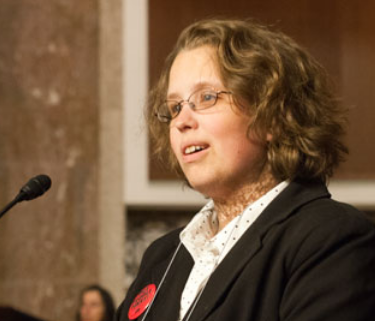
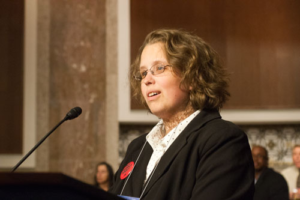
A close up of a speaker at a podium.

The Impact of Student Loan Debt Forgiveness for the Disability Community

My name is Nicole LeBlanc.

I live in Silver Spring, Maryland. I am on the autism spectrum and have anxiety, ADD, seizures, and a learning disability. I am writing to talk about the importance of helping people with disabilities get their student loans discharged, including ending the 3 year monitoring period. As the Biden Administration works to address student loan debt for people with disabilities, it is critically important that the application process be easier and we eliminate the 3 year monitoring period for work earnings. Student loans create a major financial hardship on people like me and many others with disabilities, especially those who live on their own in expensive areas. The amount of loans that I had discharged was around $1,177 which is just slightly less than what I pay in monthly rent for my studio apartment. No one with a disability should have to choose between paying for rent or basic needs and student loans. Many of us in the disability community struggle with finding jobs that pay livable wages where we make enough to live comfortably off public benefits. Benefit cliffs often force us to make big trade-offs between working and needing to stay eligible for public benefits. Some people with disabilities have their Social Security benefits cut to pay their student loans and that isn’t fair.

The application process for student loan discharge needs to be easier and more accessible to fill out, especially for someone with autism or other disabilities who does not get any HCBS services to help complete complex paperwork and navigate government bureaucracy. All government applications should allow us to submit info online without incurring the cost and hassle of printing and mailing stuff. I am glad the Biden Administration started to do that for some people with disabilities, but all people with eligible disabilities should be included.

By letting people with disabilities discharge loans and eliminating the 3-year income monitoring period, it will go a long way towards eliminating the stress and anxiety that comes with the financial challenges of living with a disability. There is no better time like the present to embrace a commitment to creating a stress and anxiety-free world for people with disabilities and their families. Making these changes is one of the best ways the Biden Administration can fulfill President Biden’s campaign promises to the disability community.

The United States Capitol Building

During Congressional Recess, We Must Raise Our Voices for Care!

By: Nicole Jorwic, Senior Director of Public Policy

After a slight delay, both Senators and Representatives are back in their states and districts for August recess, but in fact, it goes until mid-September. That means it is a key time to engage, reach out, and share your stories about why Medicaid home and community-based services (HCBS) matter in the lives of people with disabilities, their families, direct care workers, and the care infrastructure.

Every year, The Arc sends out t-shirts and signs to support advocates and encourage them to get out and ask their members of Congress to support the legislative priorities of people with disabilities. Those boxes were sent out to chapters this year, but with the ongoing pandemic, it is clear that in-person events may not be the best option. Moreover, we know that accessibility issues at town halls, even virtual ones, are a constant barrier to access.

While The Arc staff continues the work to increase access to the political process for all people with disabilities, an alternative way for ALL people with disabilities to participate fully in recess, and have their stories known had to be created.

That is why today, The Arc is launching the “Raise Our Voices for Care” campaign. Even if you can’t get to DC, your state capital, or a local town hall, your story still matters and must be shared. Our story tool is easy to use. At the end of recess, we will put all of those stories together to show the strength of all the voices rising up to support the $400 billion investment in Medicaid Home and Community-Based Services.

As a sister to my brother Chris, who doesn’t use his voice to speak, I know how incredibly important it is that we ensure that every person has the ability to communicate, and that includes with their legislators. Join us, share your HCBS story, and help us Raise Our Voices for Care because #CareCantWait!


The Arc logo

The Arc Celebrates Senate Passage of the $3.5 Trillion Budget Resolution to Invest in Crumbling Care Infrastructure

Washington, D.C. – The Arc is encouraged that the U.S. Senate took an important step in favor of respecting the human dignity of people with disabilities and aging adults. Wednesday, the Senate passed a $3.5 trillion budget resolution triggering the start of the reconciliation process.

The vote paves the way for Congress to pass a comprehensive spending package that would provide generational investments in our nation’s crumbling care infrastructure and groundbreaking benefits that could reshape the future for millions of people with intellectual and developmental disabilities, American families and their children.

“The historic investment in Medicaid Home and Community-Based Services (HCBS) included in the budget resolution will be transformative for a system that currently leaves almost one million people waiting for services all over this country,” said Peter Berns, Chief Executive Officer of The Arc of the United States. “People with disabilities and aging adults, have struggled, well before the pandemic, with a system that does not include the resources to support them in their homes and communities. The infrastructure of care for these groups currently includes the labor of unpaid family caregivers who fill in the gaps in the service system, and a paid workforce that is not paid a family sustaining wage. The $400 billion included to both expand access to HCBS and raise wages for the direct care workforce will shore up the care infrastructure so that people with disabilities can live independently, aging adults can age in place, and family caregivers can return to the workforce.”

The Arc also strongly supports the inclusion of a national paid leave program and hope to see other priorities such as long-overdue improvements to the Supplemental Security Income program included in the final package.