Navigating Special Education: A Comprehensive Online Training for Families, Educators, and Advocates

The services and supports and the quality of education available to students with disabilities has continuously improved since the Individuals with Disabilities Education Act (IDEA) first required schools to educate all students with disabilities back in 1975. However, the process of identifying which students should receive special education services and what services they should receive can be complicated, for both schools and families. The Arc@School’s new, online Advocacy Curriculum provides parents, educators, and non-attorney advocates the basic information they need to navigate the special education system.

What Is Special Education Advocacy and Why Do We Need It?

The IDEA requires schools to provide students with disabilities a free and appropriate public education (FAPE) in the least restrictive environment (LRE) through an individualized education program (IEP).

FAPE means students with disabilities must receive all of the specialized supports and services that they need to benefit from their education, at no cost to them or their family. LRE means students with disabilities must learn in the same classes and same schools that they would attend if they did not have a disability, as much as possible. Finally, an IEP is a document created annually that describes what the student already knows, what the student will learn in one year, and what services and supports the school will provide to help the student reach his or her educational goals.

Young students sitting at wooden desk in classroom; teacher helping boy in wheelchair

The process for creating the IEP is meant to be one of collaboration between a student’s parents, the student once he or she reaches age 16, teachers, service providers, and other school staff who know the student best. However, this collaborative process can break down due to disagreement between parents and school staff regarding the student’s plan. The IDEA builds in a system of accountability where students and their parents have certain rights and can take certain actions when they do not feel that the school is meeting the student’s needs appropriately. Students and parents often struggle to advocate on their own for appropriate educational services, so some seek to educate themselves so that they can advocate for services on their own, and some seek help from a special education advocate to obtain the services they feel the student needs.

What The Arc is Doing to Help

Since its founding in 1950, The Arc has advocated for students with intellectual and developmental disabilities (I/DD) to have access to educational supports and services. A lawsuit brought by a chapter of The Arc was a critical factor in the passage of the IDEA. Many chapters of The Arc continue to provide lay special education advocacy for students with I/DD and their families. In 2016, The Arc created The Arc@School to support chapters of The Arc, families, and educators in ensuring students with I/DD receive the services and supports they need at school.

To help families, educators, and advocates for all students with disabilities better understand how the collaborative process should work, and how they can better work together to meet student’s needs, The Arc@School launched an online curriculum in 2019 that provides basic information on navigating the special education system at an affordable cost for users. The Arc@School’s Advocacy Curriculum includes eight online, self-paced modules on the legal foundation of the special education system, early intervention services, individualized education programs (IEPs), procedural safeguards, Section 504, educational records, and more. Users who complete all 8 modules will receive a certificate of completion.

A successful IEP is the foundation for students with disabilities to successfully transition to postsecondary education, employment, and independent living. The Arc@School’s Advocacy Curriculum can help families, educators, and advocates support students on their path to success!
Opening Up the Online World to People With Disabilities: Employment Spotlight

Digital technology is revolutionizing our day-to-day lives. It is rapidly expanding access to information, tools, and entertainment that helps us connect with the world and each other. It helps us dream bigger and achieve more. But with rapid change comes barriers to understanding and access. This is especially true for people with intellectual and developmental disabilities (I/DD), who may need extra support to master and use technological tools.

As part of The Arc’s extensive and long-standing partnership with Comcast NBCUniversal, 16 chapters across the county were selected to serve as Tech Coaching Centers to expand technology access and understanding for the disability community. Each coaching session is tailored to the participants’ unique needs and goals for navigating the online world. Through one-on-one sessions with their coach, each person has the opportunity to grow their skills and confidence. Read about one of them below.

The Power of Programming

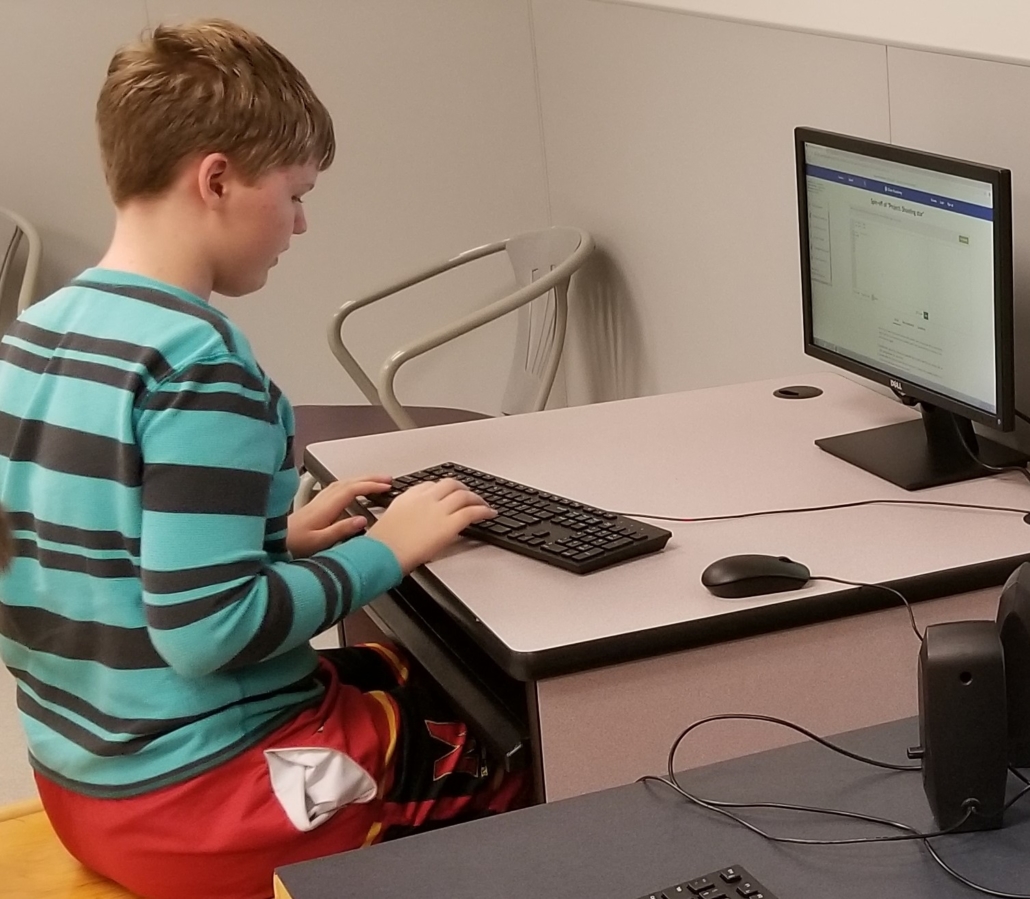
Daniel hard at work coding

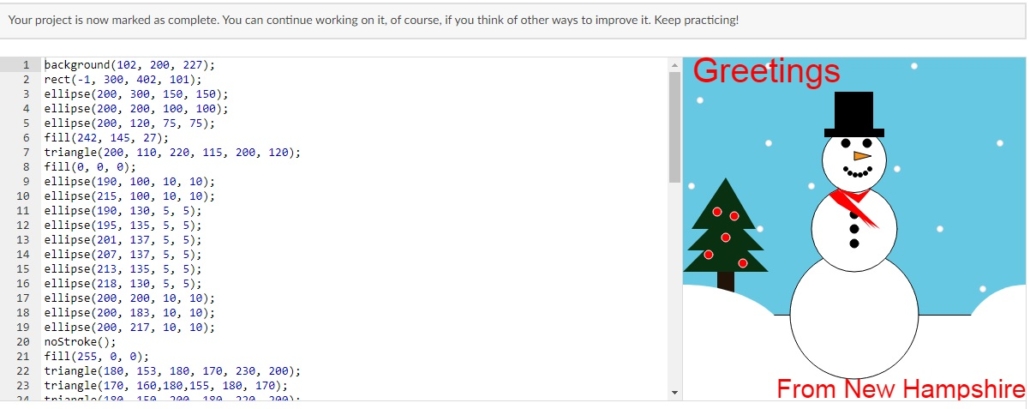
Daniel came to the Tech Coaching Center at The Arc of Carroll County in Maryland as a 14-year-old with a specific goal: he wanted to learn how to master JavaScript to become a web developer. His tech coach from the chapter, Jeremy, saw Daniel’s passion and created a multi-session plan to help him reach his goal. During these sessions, they practiced using code to create individual shapes and fill them in with different colors and textures.

Daniel has autism, ADD, and ADHD, which can present challenges in social interactions and typical learning environments. But when it came to coding, Daniel was an exceptionally driven and fast learner —quickly surpassing what his coach was even able to teach him!

“I found the class helpful in that it moved at the pace each student needed,” Daniel said.

Jeremy can attest to the benefit of the coaching too. “Daniel felt accomplished and proud of his design,” Jeremy said at the end of the coaching sessions. “He was put in a lot of detail and effort into his coding and it showed.” 

The results of Daniel’s efforts!

Without digital skills, people with disabilities—who already face numerous barriers to gainful and competitive employment—lose out on so much. With the right supports, they’re able to hone and present cutting-edge skills like coding to employers, and secure paying jobs in their communities…just like anyone else. At our Tech Coaching Centers, participants can build and refine the skills that will make the difference for THEM as they enter the workforce, including how to network, create and submit resumes, and find good job openings.

Since finishing at the coaching center, Daniel is currently taking two college level classes along with two high school classes. He intends to take two more college classes in the spring semester and apply for a waiver to graduate after 11th grade. Because he already skipped a grade in elementary school, Daniel will be 15 when he graduates! He’d like to major in video game design in college and eventually work in programming after school.

His unflappable motivation, coupled with his lessons at the Tech Coaching center, have given him the opportunity he may not have otherwise had to sharpen an invaluable skill that will make him a standout candidate to employers. Daniel is just one example of what we at The Arc and Comcast already know: when people with disabilities have the opportunity to learn and develop skills, they can participate in these spaces just like everyone else!

Visit thearc.org/technology to see all the ways we are working to increase digital literacy in communities across the country.

Tech Coaching Centers and more made possible by:

The Arc logo

Save Money on Office Supplies and Services!

Is your chapter taking advantage of your free Purchasing Point access?

What chapter doesn’t purchase office supplies, use federal express or order food and supplies from time to time? PurchasingPoint® is a fantastic, free benefit that chapters are eligible for due to The Arc’s partnership. Your gateway to well-known companies offering discounted prices is a deal that’s not to be missed. In the last quarter alone, chapters enrolled in the program purchased $44,051.26 worth of services and products and saved $15,047.68. The Arc is committed to supporting chapters in numerous ways and obtaining discounts through programs like PurchasingPoint is one of them. If you’re interested in learning more about this program contact Karen Wolf-Branigin.

The Arc logo

Connecting Passionate Volunteers to Meaningful Causes: Addressing Food Insecurity in NYC

By Andrew Pfadt-Trilling, Vivian Murray, and Joyce Minault (AHRC NYC)

New York City is a city of contrasts. It is the financial capital of the world while 1.4 million residents rely on emergency food programs. A place where luxury condominiums are built on the same block as people who don’t know where their next meal is coming from.

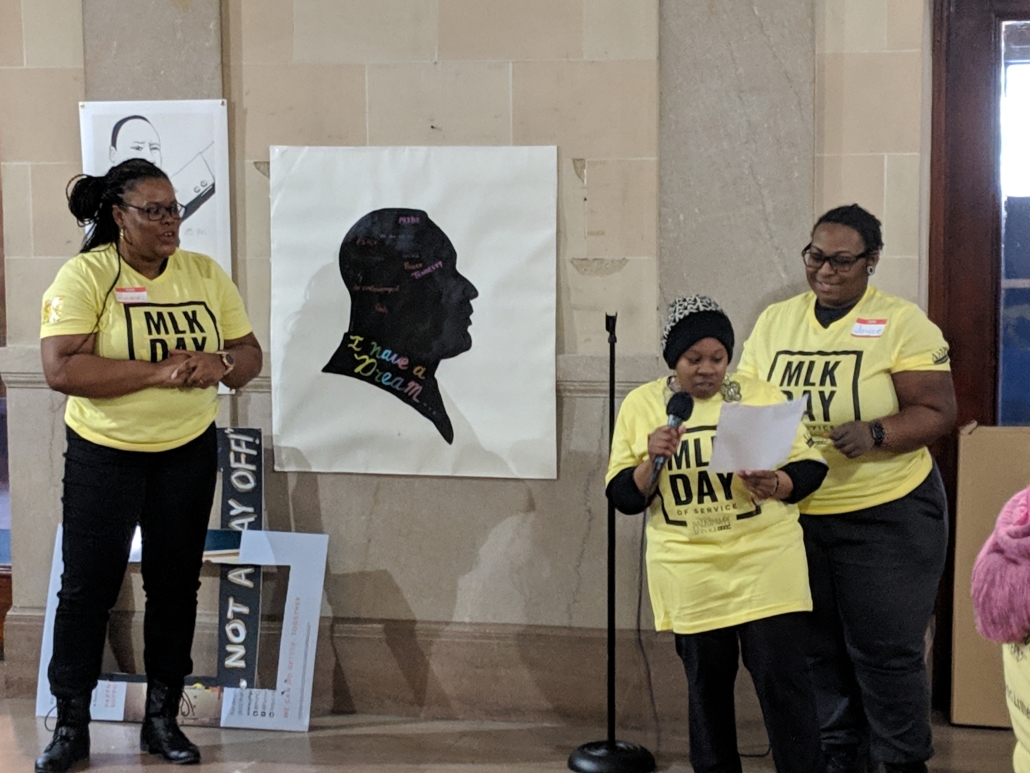
Last year, AHRC NYC was a recipient of a grant through the The Arc of the United States and the Corporation for National and Community Service to organize its first MLK Day of Service project to combat hunger and food insecurity. We saw this as a chance to look at neighborhoods where there is a real need, but also where there are passionate self-advocates and staff who want to be more connected and make an impact in their communities. We identified three neighborhoods (Crown Heights & Bushwick in Brooklyn; Lower East Side in Manhattan) and formed planning teams of staff and self-advocates that lived or worked in that neighborhood and asked: what if we planned a project that fought food insecurity, brought neighbors together, and strengthened community ties? Here is the story of how the Crown Heights team, B’lynx (Brooklyn Links Up) responded to that challenge.

B’lynx is a diverse team of people with and without intellectual/developmental disabilities, committed to enriching the Crown Heights community through innovation, passion, and fun. Since 2014, B’lynx has participated in community-based service projects and volunteer events with other local organizations.

The MLK Day of Service grant gave B’lynx the chance to develop as community organizers and take the lead in planning an initiative to bring people and organizations together to make a difference in Crown Heights. The team was excited to take on this role and when it came time to mobilize, self-advocates and staff began to hit the streets canvasing, recruiting volunteers, and spreading the word.

Recognizing that not everyone would be interested or comfortable doing the neighborhood outreach, the team made sure there were other ways for everyone to get involved and make an impact. Artists decorated boxes that were used for our city-wide food drives and distributed them to local businesses. Others created promotional materials such as flyers and bookmarks to raise awareness and recruit volunteers that were distributed to local libraries, cafes, and community centers. It truly takes a village to make something like this possible!

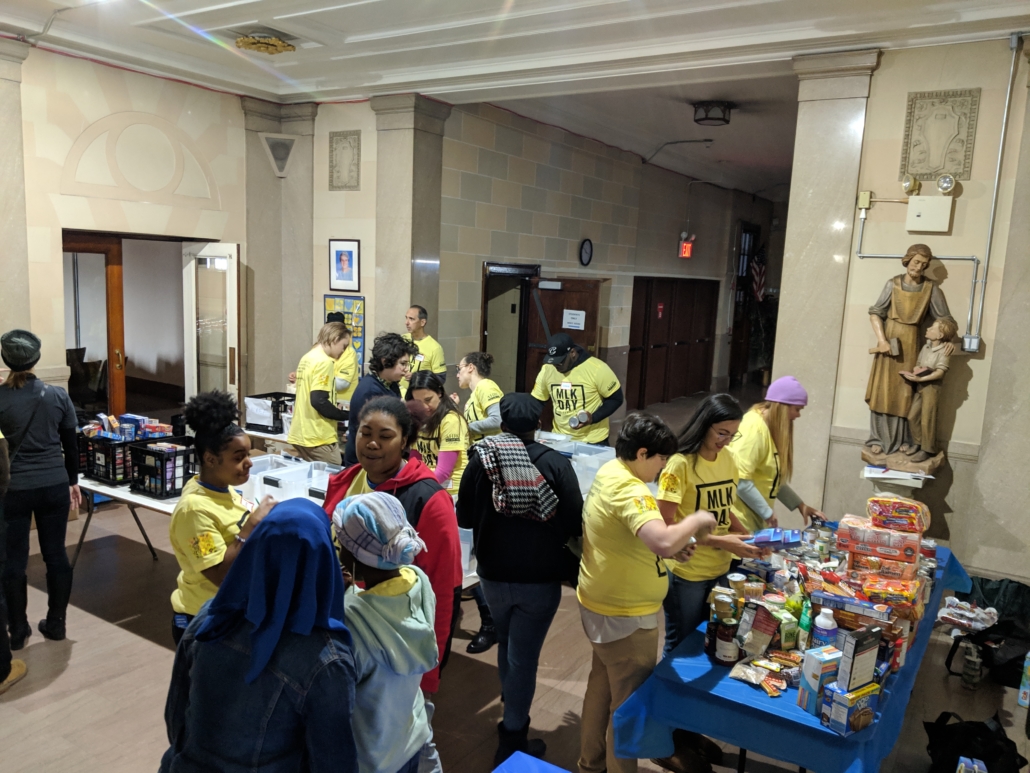
Volunteers organize food for distribution

The hard work of B’lynx paid off. On January 21st, 2019 over 50 volunteers came out in the harsh weather to help those in need, distributing over 500 pounds of food collected through the drive. They also provided hot meals to dozens of households through Rescuing Leftover Cuisine, a nonprofit organization that combats hunger and food waste by delivering excess food from restaurants to those in need. 

On top of the food-related volunteer activities of the day, B’lynx made sure the event also provided a space to showcase community partners and other opportunities to give back! Local organizations, such as community gardens and health centers, were present to share resources. There were arts and crafts tables for kids, healthy eating demos for all ages, and information of other volunteer opportunities in the neighborhood.

The MLK Day of Service has strengthened B’lynx even more and deepened their relationships in the Crown Heights community. This past summer they took an active role in neighborhood block parties, hosting arts activities for local children. B’lynx and the other change teams at AHRC NYC are already busy planning and looking forward to the upcoming 2020 MLK Day of Service, with the hope to help even more people!

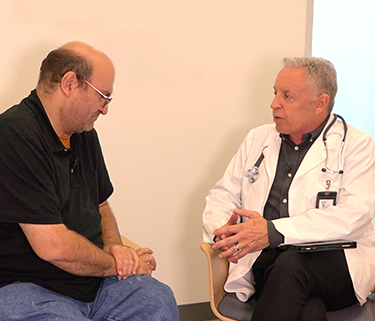
two men, a patient and a doctor, seated and talking

Let’s Talk About Sexual Violence Against Men With Disabilities

Men with disabilities are twice as likely as those without disabilities to experience sexual violence. Yet few people know just how common it is, including health care professionals.

The Arc’s National Center on Criminal Justice and Disability® and the Board Resource Center recognize that health care professionals are in a front line position to educate patients with disabilities about sexual violence and how to report it. The project is releasing new training videos and other valuable online resources to give doctors, nurses, and other health care professionals the practical tools they need to have simple, direct, and honest conversations about sexual violence with male patients who have intellectual and developmental disabilities.

Health care professionals generally have little or no experience talking about sexual violence with this population. And men with intellectual and developmental disabilities may not know if they are victims of sexual violence, how to talk about it to their doctor, how to report it to authorities, or how to access healing services like counseling.

Talk About Sexual Violence provides tools that build the capacity of health care professionals to talk about this issue with greater confidence and lays the groundwork needed to empower patients with disabilities to talk openly about sexual violence, decreasing the likelihood of future violence.

As part of the second phase of the Talk About Sexual Violence project, The Arc and the Board Resource Center are proud to present:

“Survivors need to talk things out. We need a safe place to tell things and be heard. Listen to us, hear us, believe us. Let us talk about it as long as we need to. Let us be brave with you. We are getting out the pain, one conversation at a time.” – James Meadours, National Peer Advocate & Survivor

close up of medical form with stethoscope

Open Enrollment and Disability: What You Need to Know

Disability Open Enrollment Week of Action kicks off Sunday, November 17, 2019 — but you can enroll until December 15!

The Arc believes that everyone, including people with intellectual and developmental disabilities, should have timely access to high quality, comprehensive, accessible, affordable, appropriate health care that meets their individual needs, maximizes health, well-being and function, and increases independence and community participation.

If you are uninsured or looking for more affordable health insurance, visit healthcare.gov or your state’s Marketplace or health insurance exchange. During the open enrollment period from November 1, 2019 – December 15, 2019, you can review private health insurance options and purchase coverage. People with low and moderate incomes may be able to get financial help to pay for premiums and other cost-sharing may be available for individuals and families, depending on the plan.

If you have a disability or health condition, here are key questions to ask:

  • Is there a broad range of health care providers included in the plan’s network?
  • Are there enough medical specialists in the network to meet your needs?
  • Are needed medications included in the plan’s list of covered drugs?
  • Is there adequate access to non-clinical, disability-specific services and supports?
  • Does the plan have service limits, such as caps on the number of office visits for therapy services?
  • Are mental health services covered to the same extent as other “physical” health needs?

How to get help:

Purchasing health insurance can be complicated. If you or your family member needs assistance, healthcare.gov can help. Each state has health insurance “Navigators” to assist with enrollment. Individual health plan information should be available on the website.

If you already have health insurance through the Marketplace, open enrollment is a good time to see if your coverage still meets your needs. It is also important to update income and household information to make sure you are receiving available assistance and to help avoid penalties, if your income has increased.

You can also sign up for insurance outside of open enrollment, if you lose your job, marry, divorce, or have a baby.

a student with books and a backpack.

Advocacy Groups File U.S. Supreme Court Brief Warning That School Vouchers Harm Students With Disabilities

The Arc of the United States, The National Disability Rights Network (NDRN), The Council of Parent Attorneys and Advocates (COPAA), and a coalition of advocacy and legal services organizations represented by the law firm Clinton and Peed filed an amicus brief in the case of Espinoza v. Montana Department of Revenue asking the Court to uphold the decision made by the Montana Supreme Court invalidating Montana’s private school tax-credit scholarship program as it is harmful to students with disabilities.

While families petitioning the court suggest that the program would help students with disabilities, school vouchers and tax-credit programs like Montana’s actually hurt students with disabilities by redirecting public funds to private schools that are largely unbound by the federal laws in place for over four decades that protect the rights of students with disabilities.

When students with disabilities use vouchers or tax credits to attend a private school, typically they forfeit their rights mandated by federal law —including the right to an appropriate, individualized education—because the statute’s key provisions do not apply to private schools. At least seven states have voucher programs that require parents to explicitly waive all or most of their disability rights protections under federal law to participate. In other states, parents often do not realize the rights they are forfeiting: 83% of parents of students with disabilities in such programs report that they receive inaccurate or no information on the loss of those rights, according to a federal watchdog report.

The Court has scheduled to hear oral arguments on January 22, 2020.

Shira Wakschlag, Director of Legal Advocacy, The Arc explains, “For decades, The Arc and its chapters across the country have been at the forefront of establishing and strengthening the right to a free and appropriate education for students, including those with the most significant disabilities. Voucher and tax-credit programs diminish the resources and effectiveness of public school systems in which they operate, leaving students with disabilities behind in the process. We simply cannot afford to go backwards.”

Curt Decker, Executive Director, NDRN explains, “NDRN and its members, which comprise the protection and advocacy network, have long fought to ensure students with disabilities receive the services to which they are entitled. We are very disturbed by the efforts around the country to divert funding from public schools to fund school voucher and voucher-like schemes, including Montana’s tax-credit scholarship program at issue in this case. In our experience, these voucher schemes often require students with disabilities to waive their rights under key special education laws in order to access private schools. Children with disabilities should not be made to choose between attending an underfunded public school and giving up their civil rights to attend a private one. That is an outrageous proposition.”

Selene Almazan, Legal Director, COPAA explains, “Nearly 7 million students with disabilities rely on federal civil rights laws’ protections to ensure access to the general curriculum, to instructional supports, services, and accommodations, and to be held to the expectation that they can achieve commensurate with their peers. If the Montana voucher and tax credit program is allowed to continue, students with disabilities will be stripped of these vital protections, thus putting them at risk of segregation, receive limited supports and services and experience low expectations at school and ultimately in life. We urge the Court to uphold the Montana Supreme Court Decision in support of students with disabilities.”

Issue Before the Court in Espinoza v. Montana Department of Revenue: Whether it violates the religion clauses or the equal protection clause of the United States Constitution to invalidate a generally available and religiously neutral student-aid program simply because the program affords students the choice of attending religious schools.

Joint Amicus Brief: The joint brief establishes that for students with disabilities, the proliferation of private-school voucher and tax-credit programs, including the Montana program at issue in this case, risks restoring a bygone era—during which these students had no right to an education, received no individualized support or services, and were segregated from their peers.

The Arc logo

The Importance of Paid Leave: A Sibling Perspective

By Nayma Guerrero, Member of The Arc’s National Sibling Council

My family is everything.

Nayma and her family

My younger brother is 23 years old. He loves computer science, animation, and art and design. He also enjoys working out at the gym. Things are sometimes challenging for my brother, who has autism, intellectual disability, attention deficit disorder, and depression. Then there’s my sister. Like many 14 year olds, she loves the mall. She also plays soccer and basketball, and likes playing with her dolls. I admire my sister for sticking to it at school, despite having learning disabilities.

Like a lot of families, the day starts at my parents’ house in controlled chaos. My mother takes on what seems like the biggest challenge of the morning shared by moms everywhere: getting my brother and sister out of bed! A true supermom, my mother helps both of them get their school clothes together and makes sure they eat breakfast every day. She truly believes breakfast is the most important meal of the day. After they eat, my mother drives my brother and sister to school before taking care of the grocery shopping and errands.

Both of my parents are very hard workers and make sure my siblings’ needs are met every day. My father works fulltime, so my mom is usually the one who is taking care of my brother and sister.  My brother requires a lot of care, attention, and daily reminders to make sure he’s dressed, gets to school on time, and takes his medication.

A few years ago, my mother ended up in the emergency room. It turned out to be life threatening. My mother needed emergency surgery. We were shocked and worried as any family would be. After her surgery, we were told my mother would need to be on bed rest for about two weeks minimum with little movement. She would need a lot of assistance to get around the house, use the restroom, and shower. We were concerned for my mother but also for my siblings.  My mother is the person my brother depended on the most. And my sister was only 10 at the time.  

My father and I realized it was up to us to help my mother, my brother, and sister. For my father, taking time off meant he didn’t get paid and it was already hard for my family to make ends meet – still is.  I was also working hard, but not getting full time pay or health benefits of any sort. I was working just under 40 hours a week and therefore, part time. Calling off also meant no pay for me. It was really hard for my father and myself to work out a schedule where we could both help my brother with his needs and care for my little sister and my mother. It was also hard because my brother has a difficult time trusting other people, so he needed us. Sometimes, there is just no substitute for family.

Now imagine what it was like for us to shift to relying on one income – we had to save every penny for rent and bills, that’s it. I didn’t know how I was going to make my car payments. We were barely getting by.

Paid leave from our jobs would have helped my family at a time when we needed it most. If I would have had access to paid leave, I would have been able to help my family without losing my pay. My father wouldn’t have had to call out of work with no pay and risk losing his job. I also wouldn’t have had to go some days without pay. I was also scared that my job was going to fire me because I had to call out. With paid leave, we would have been able to provide my brother and sister with better care, while my mom recovered from surgery.

There are many families like mine. When the unexpected happens, family members need to be able to be there for each other – and still keep their jobs.  The U.S. needs a paid leave system so that families like yours and mine can care for loved ones when they need our help.

The Arc logo

The Arc Applauds Commutation of Bobby Moore Death Sentence

The Arc applauds the new ruling by the Texas Court of Criminal Appeals (TCCA) that Bobby Moore is a person with intellectual disability and cannot be executed; commuting his sentence to life in prison.

In its 2002 decision in Atkins v. Virginia, the U.S. Supreme Court recognized the special risk of wrongful execution faced by persons with intellectual disability and banned their execution as cruel and unusual punishment under the Eighth Amendment. Subsequently, in Hall v. Florida (2014), the Court rejected an arbitrary cutoff for IQ scores in making the intellectual disability determination and emphasized the importance of courts consulting clinical standards in their analysis. The Court’s 2017 and 2019 decisions in Moore v. Texas have strengthened this precedent by emphasizing the need to rely on well-established clinical standards – rather than stereotypes – in making intellectual disability determinations in death penalty cases. The Arc filed amicus briefs on Mr. Moore’s behalf when he first went before the U.S. Supreme Court in 2016 and again when his case was remanded to the TCCA in 2017.

“The appeals court decision is a major victory for people with intellectual disability in the criminal justice system and it finally affirms what The Arc and our allies have long asserted: Bobby Moore met the criteria for intellectual disability and his death sentence violated his Constitutional rights under the Eighth Amendment prohibiting cruel and unusual punishment,” said Peter Berns, CEO, The Arc. “We hope the Moore case serves as a loud and clear reminder to the court system that the Supreme Court banned the execution of people with intellectual disability 17 years ago, recognizing their risk of wrongful execution. It is a risk we cannot – and will not take.”

The Arc logo

Chapter Benefit Spotlight: Calling All Conventioneers!

We are already planning for The Arc’s 2020 National Convention, which will take place October 25-28 in New Orleans. As one of our primary learning events and chapter benefits, it is important to us that it exceed your expectations. We welcome your ideas for plenary speakers, breakout session topics, networking activities, and anything else that would intrigue and inspire you to join us in New Orleans. All ideas are welcome and can be emailed to wolf-branigin@thearc.org. Laissez les bons temps rouler!