The Arc logo

Supreme Court Reaffirms Commitment to Clinical Standards, Not Stereotypes, in Determining Intellectual Disability in Death Penalty Cases

The U.S. Supreme Court issued a per curiam (published in the name of the Court rather than specific judges) opinion today reversing the Texas Court of Criminal Appeals (TCCA) and finding that Bobby Moore is a person with intellectual disability and his execution is prohibited by the Eighth Amendment to the U.S. Constitution’s ban on cruel and unusual punishment.

“The Arc applauds the Court’s decision today which again embraces the standards-based approach in determining intellectual disability for which The Arc has long advocated. When it comes to matters of life and death, there is simply no room for courts to ground their determinations of intellectual disability in outmoded and baseless stereotypes. The Arc is grateful to the Court for taking a strong stance today to ensure that its precedent on this issue is properly interpreted in jurisdictions around the country,” said Marty Ford, Senior Advisor, The Arc.

This is the second time Mr. Moore has sought relief from the Supreme Court and won. In 2017, in the same case, the Court rejected Texas’ use of stereotypical and outdated factors—rather than well-established clinical standards—to determine intellectual disability in death penalty cases on the grounds that they “create an unacceptable risk that persons with intellectual disability will be executed.” The Court then sent the case back to the TCCA to determine whether Mr. Moore had intellectual disability in light of its opinion. Following the TCCA’s 2018 finding that he did not have intellectual disability, Mr. Moore again petitioned for Supreme Court review. Notably, the prosecutor in Mr. Moore’s case—the district attorney of Harris County—filed a brief in support of Mr. Moore noting that, in light of the Supreme Court’s 2017 opinion, Mr. Moore is an individual with intellectual disability who cannot be executed.

In its opinion today, the Court noted that “Moore has shown he is a person with intellectual disability” and that the most recent TCCA opinion must be reversed because it continued to exhibit “lay stereotypes” of people with intellectual disability despite the Supreme Court’s clear instruction to rely on well-established clinical standards instead. Chief Justice Roberts, in a concurring opinion, noted that while he still believes the original Moore opinion “lacked clarity,” “it is easy to see that the Texas Court of Criminal Appeals misapplied it here…the court repeated the same errors that this Court previously condemned…” Justice Alito, joined by Justices Thomas and Gorsuch, dissented, noting that “The error in this litigation was not the state court’s decision on remand but our own failure to provide a coherent rule of decision in Moore.

The Arc filed amicus briefs on Mr. Moore’s behalf when he first went before the Supreme Court in 2016 and again when his case was remanded to the TCCA in 2017.

In its 2002 decision in Atkins v. Virginia, the U.S. Supreme Court recognized the special risk of wrongful execution faced by persons with intellectual disability and banned their execution as cruel and unusual punishment under the Eighth Amendment. Subsequently, in Hall v. Florida (2014), the Court rejected an arbitrary cutoff for IQ scores in making the intellectual disability determination and emphasized the importance of courts consulting clinical standards in their analysis. The Court’s 2017 and 2019 decisions in Moore v. Texas have strengthened this precedent by emphasizing the need to rely on well-established clinical standards—rather than stereotypes—in making intellectual disability determinations in death penalty cases.

The Arc has deep sympathy for the family and friends of the victim in this case, and we supported appropriate punishment of all responsible parties. The Arc did not seek to eliminate punishment of Mr. Moore or others with disabilities, but rather, to ensure that justice is served and the rights of all parties are protected. The Arc is committed to seeking lawful outcomes for people with ID and will continue working to ensure that the U.S. Supreme Court rulings on this issue are abided by in jurisdictions across the country.


The Arc logo

Workers Speak Out on Disability and Health: New Report on Paid Family Leave and the Disability Angle

Today, The Arc of the United States (The Arc) and the National Center for Children in Poverty (NCCP) at Columbia University’s Mailman School of Public Health are releasing Disability Perspectives on Paid Leave: A Qualitative Analysis of Leave-taking Among Workers Affected by Disabilities or Serious Health Conditions. This ground-breaking research examines how workers with disabilities and working caregivers of people with disabilities use, need, and benefit from paid family and medical leave. It is one of the only studies to specifically explore whether current paid and unpaid leave policies and programs for working individuals meet the needs of the disability community. Findings offer key insights on how existing leave policies can become more inclusive to this historically under-served group, and highlight the need for a comprehensive, national paid leave policy.

Researchers at NCCP conducted and analyzed in-depth interviews with 90 workers with disabilities and working caregivers in California, New Jersey, New York, and North Carolina. Major findings include:

  • Workers with disabilities and working caregivers take leave for diverse and often disability-specific reasons.
  • Workers want to maximize their time at work and benefit when they can use paid leave in conjunction with other employment benefits.
  • Workers highly value the Family and Medical Leave Act (FMLA) and state-administered paid leave options, which in this study included programs in California, New Jersey, and New York.
  • Multiple barriers and gaps limit workers’ access to leave, including fear of job loss and stigma against disabilities. In states with paid family and medical leave insurance, certain program features also limit access, including low awareness and understanding of the program, inadequate wage replacement, narrow or unclear covered reasons for leave, and inadequate coverage for self-employed and public workers.

Based on these findings, the paper provides recommendations for how policymakers, employers, and advocates can make it easier for all workers to take leave from work during a stressful period of their lives. Most importantly, the findings provide a road map for an inclusive national paid leave policy.

“Our goal with this paper is not only to inform, but also to expand the national dialogue to make paid leave policies and proposals stronger and more inclusive. As this study’s findings show, paid leave is extremely important for people with disabilities and their families, including people with intellectual and developmental disabilities. At The Arc, we believe that our nation can and should put in place an inclusive, comprehensive national paid leave policy that reflects the full range of workers’ leave needs, including people with disabilities and their families. We hope this paper provides the blueprint leaders need to advance this process,” said T.J. Sutcliffe, Senior Director, Income & Housing Policy, The Arc.

The need for paid family and medical leave is universal – nearly all of us will need paid leave at some point to care for a family member, address our own serious medical condition, or welcome a new child into our family. The disability perspective, however, has often been missing from the national conversations and research on paid leave, despite the fact that roughly 1 in 5 Americans has a disability. As such, there is a huge gap in understanding on how the disability community uses paid leave, the frequency of use of this benefit, and whether current federal and state policy frameworks and available paid leave programs meet the disability community’s needs.

“It is crucial to hear from working individuals directly affected by serious health conditions and disability to understand how paid leave policies can work better for them. Our in-depth conversations with workers revealed important patterns and policy considerations that deserve more discussion, such as the need for an inclusive definition of family and flexibility to take leave for myriad reasons. This study bolsters current survey research on disability and paid leave by contributing the lived experiences of working individuals,” said Dr. Heather Koball, Director of NCCP.

About the Study: This qualitative study aimed to (1) understand common usage patterns of unpaid and paid leave programs, (2) to assess the priorities of working caregivers and workers with disabilities regarding taking leave from work, and (3) pinpoint ways in which key stakeholders can better support this population of workers. The research team asked participants their reasons for taking leave and about their leave-taking patterns, as well as what factors influence their access to specific leave benefits.

The National Center for Children in Poverty (NCCP) is a non-partisan public policy research center at Columbia University’s Mailman School of Public Health. Founded in 1989 with endowments from the Carnegie Corporation of New York and the Ford Foundation, NCCP is dedicated to promoting the economic security, healthy development, and well-being of America’s low-income children and families. Using research to inform policy and practice, the center seeks to advance family-oriented solutions and strategic use of public resources at the state and national levels to produce positive outcomes for the next generation.

The Arc logo

Deadline Extended! Get Trained to be a Certified HealthMatters Trainer Today!

Registration for the HealthMatters: Train-the-Trainer webinar series on March 4th, 6th, and 7th at 2:00pm EST has been extended! Chapters will now have until Friday, February 22nd to register online. HealthMatters is an evidence-based program developed by the University of Illinois at Chicago that provides chapters with the skills and knowledge needed to implement a 12-week health and fitness program. Healthy lessons combined with physical activity make this program a proven success with participants. The training is $300 per chapter (normally $3,500!) and we recommend having at least 3 staff members attend together (more are welcome at no additional charge). Register today!

The Arc logo

Chapter Benefit Spotlight: Need a Refresh on Rules, Regulations, and Responsibilities?

If you need a refresh on the rules, regs, and responsibilities of our network check out The Arc’s Bylaws and Standard Terms and Conditions. For example, did you know that:

  • The Arc can provide chapters with a list of The Arc’s individual members from your geographic area annually
  • Chapters are expected to submit updated contact information for corporate officers, board members and key management staff each year
  • Chapters must prominently identify themselves to the public as an affiliated Chapter of The Arc
  • Chapters can establish associate memberships as part of your fundraising program

Make sure you are in-the-know on everything your chapter should be doing, as well as everything we have to offer you!

The Arc logo

Spotlight: Kyle Piccola and Ana Martinez Lead Education Efforts at The Arc of Texas

The criminal justice system is filled with gaps in how it navigates and addresses the needs of people with disabilities. In an effort to address this, Kyle Piccola and Ana Martinez are leading education efforts at The Arc of Texas. Utilizing Pathways to Justice®, they are bringing together law enforcement, victim advocates, legal professionals, and others to build relationships and understanding and create safer communities across the state. We chatted with them about the success of the program, how they’ve been able to implement it, and the future of criminal justice reform.

The Arc of Texas group

What made you want to focus on criminal justice reform in Texas? Why did you choose Pathways to Justice as one of the vehicles for your efforts?

ANA: People with I/DD experience several disadvantages that make them more vulnerable to becoming involved in the criminal justice system as suspects and victims. A one size fits all approach does not give people with I/DD equal and fair treatment when they come into contact with criminal justice system. Texas is a large state with diverse cultural and socio-economic differences. The Pathways to Justice training provides the opportunity for us to bring together police officers, self-advocates, lawyers and judges, victim service providers and community advocates for a training geared towards the needs of that particular community. Our efforts have begun to create systemic change that sparks legislative initiatives and induces a collective and actionable charge for our state.

Can you tell us about what implementing Pathways to Justice has been like for your chapter, and for your community? Did you face any challenges recruiting community partners in law enforcement or victim services, and how did you overcome them?

KYLE: The community wanted and needed this as much as we did! We built a coalition of partners just as fast as we welcomed the program to Texas. Our Pathways to Justice program has strengthened the relationships we have with existing coalition partners and helped us build relationships with new ones. The response has been extremely positive – both from the professional advocates and individuals seeking the training. Our local law enforcement agencies welcomed the opportunity because they understand well that law enforcement agencies are coming into contact with people with I/DD more and more. Since our first Pathways to Justice training, The Arc of Texas has been included in all of the Austin Police Department’s training curriculum. For first the time, the Austin Police Department has five hours of I/DD specific training for their cadet class.

How has Pathways – along with your other criminal justice advocacy efforts – helped build community awareness of The Arc and its mission?

ANA: Pathways to Justice has vastly raised overall community awareness on the need and desire for people with I/DD to be supported in the community. We’ve built relationships with organizations that were only marginally aware of our work and mission. This year we honored the Travis County Mental Health Public Defenders Office and the Austin Police Department as our Community Partners of the Year at our annual Leadership and Legacy Event. Partnering with Austin Police Department and Travis County allowed us to achieve a broader and more meaningful impact.

Why is important for chapters of The Arc to help lead the way on criminal justice reform for people with I/DD?

ANA: Once an individual with I/DD has a criminal record, success in community life becomes substantially more difficult, especially considering existing barriers in employment, housing, and other basic elements of economic security. An unjustly gained criminal record jeopardizes the capability of an individual with I/DD to lead an independent life, and often ends up costing millions in tax dollars to support an individual through institutional social services. Texas still runs 13 institutions where too many people with I/DD end up because they were never given the supports needed to secure appropriate criminal justice representation. This barrier to an independent life can be lessened if there is sufficient community awareness and training to identify and support people with I/DD, especially when they first come into contact with the law.

What advice would you give to other chapters looking to establish criminal justice initiatives?

KYLE: As soon as people heard that The Arc of Texas was working on issues related to criminal justice, we began to receive a lot of inquiries from self-advocates, families, and advocacy organizations needing support. As your chapter begins to build a criminal justice program, plan for the influx of people needing support. This was not something that I necessarily envisioned having to staff up as quickly as the need arrived.

To bring Pathways to your chapter or find out about other ways to get involved with NCCJD:

The Arc logo

The Arc Responds to Three-Month Extension of Money Follows the Person Passing Congress

Last week, the Medicaid Extenders Act of 2019 was signed by President Trump. A three-month funding extension for Money Follows the Person (MFP) was included in this bill. This program moves people with disabilities from institutions into the community by paying for programs not normally covered by Medicaid such as employment and housing services.

“Passage of this bill means individuals with disabilities who have been waiting to transition while funding for the MFP program was in danger, have the opportunity to move out of institutional settings and into the community. If the funding bill did not pass, MFP funds would have run out across the country. This is not only an investment in community-based services, but in the civil rights of people with intellectual and developmental disabilities.

“It is a powerful testament to the value of this program that this legislation was passed so early this Congress, especially after the unsuccessful attempts to cut Medicaid by billions of dollars last Congress. This victory belongs to advocates nationwide who have been actively working to support people with disabilities to live in their communities. We look forward to working with leaders in Congress who supported this legislation on a strategy for longer or permanent extension of MFP.” said Peter Berns, CEO of The Arc.

The Arc logo

Serving Others Has Never Been So Healthy (or Tasty)!

Martin Luther King Jr. Day of Service is a day to celebrate compassion for everyone in our community, and to take action to address social problems and build stronger communities. This MLK Day and throughout 2019, several chapters of The Arc and other community organizations will be developing inclusive volunteering projects that seek to address a critical issue that impacts many Americans, including 13 million children: hunger resulting from food insecurity. Here’s what some of our 2019 grantees are up to:

Volunteers from The Arc Midland stand in front of their organization's sign, one wearing an MLK day of service orange shirt. All are smiling. In Michigan, The Arc of Midland and partner Hidden Harvest will not only be feeding people in need but helping people eat healthily. At their January kick-off event, volunteers with and without disabilities not only provided packaged food to people in need but also taught people how to create easy and nutritious meals from the donated food. This spring and summer, volunteers will be working in The Arc of Midland’s community garden to plant, grow, and harvest fresh food that will be donated to people in need.


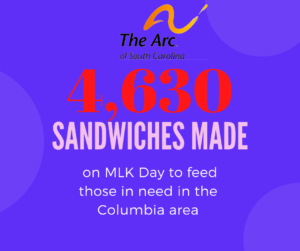
For the past three years, The Arc of South Carolina has been celebrating compassion with every kid’s favorite meal through its annual Peanut Butter and Jelly Sandwich-making Competition. The competition is held at the University of South Carolina, where volunteers from the university, the Best Buddies program, and the Columbia community face-off to make tasty sandwiches for people in need on MLK Day. This year, 4,630 sandwiches were made to provide to people who may not otherwise have a meal that day! Throughout the rest of their MLK Day grant, The Arc of South Carolina will be focusing on feeding people and teaching people about how to cook healthy meals. Through the Cooking EdVentures program, volunteers with disabilities will learn how to make healthy and nutritious meals, and then will donate this food to local partners like the 153 Project, who feed people in need in the Columbia community.

Want to know more about our MLK Day of Service project and other volunteer efforts around the country? Contact Abby Owusu at Owusu@thearc.org.

And – stay tuned for updates from our other 10 grantees this year as they implement their own unique volunteer projects:

The Arc logo

Exciting Staff News from The Arc’s National Office!

Marty Ford appointed Senior Advisor, Julie Ward appointed Senior Executive Officer for Public Policy

After more than 34 years with The Arc’s public policy team (and a total of 40 years in The Arc network), Marty Ford is transitioning from Senior Executive Officer for Public Policy, a position she has held for 8 years, to a new part-time position of Senior Advisor. Marty is a well respected nationwide expert on many public policy issues, including Social Security and Supplemental Security Income, Long Term Supports and Services, and trusts and financial planning approaches. During her tenure as the Senior Executive Officer, Marty led the policy team through a rigorous defense of the Medicaid program, implementation and defense of the Affordable Care Act, enactment of the ABLE Act, and many other significant advances. Marty served three years as Chairperson of the Consortium for Citizens with Disabilities (CCD), a coalition of over 100 national organizations. The Arc deeply appreciates Marty’s work and leadership in these areas and is fortunate that she will continue in her new staff role to support the Policy and Positions Committee of the Board of Directors, advise the Federal Policy Advocacy team, continue to represent The Arc in various external leadership positions, and work closely with the Chief Executive Officer on special projects.

The Arc is also pleased to announce that Julie Ward, the Deputy Executive Officer for Public Policy, has been promoted to the position of Senior Executive Officer for Public Policy. In addition to her new responsibilities, Julie will continue her leadership positions related to health care policy and planning the Disability Policy Seminar. Julie has over 30 years of experience representing people with intellectual and/or developmental disabilities before Congress, the federal agencies, and state legislatures. Prior to holding the deputy executive officer position, she was the Director of Health Policy. She has extensive knowledge and expertise in policies related to the Affordable Care Act, Medicaid, Medicare, private health insurance, medical research, drug development, and public health issues. Previously, Julie represented The Arc and United Cerebral Palsy for seven years as part of the Disability Policy Collaboration (DPC). In that role, she had primary responsibility for budget and appropriations,
employment, TANF, Medicare Part D, and transportation issues. She spent 18 years with the Epilepsy Foundation, the last ten years as the Senior Director of Government Affairs, overseeing the Foundation’s federal and state advocacy program.

Trudy Jacobson appointed Senior Advisor, Casey Nitsch and Laura Rahman to Lead Fundraising Programs

After nearly 10 years with The Arc’s development team, Trudy Jacobson is transitioning from the Senior Executive Officer for Development & Partnerships to a new part-time position of Senior Advisor. Trudy is a well-respected professional in the areas of development and marketing and during her tenure as SEO she led the organization through its rebranding and the growth of its individual, corporate, and foundation support programs including the development of several major corporate partnerships and a national partnership with Comcast NBCUniversal. Trudy has contributed significantly to the growth of The Arc’s overall revenue, and the development of its fundraising program for the future, since joining the staff. The Arc deeply appreciates Trudy’s work and leadership in these areas and is pleased that she will continue in her new staff role to advise the organization in areas of her expertise. She will continue working closely with members of The Arc’s Board of Directors and its Resource Development Committee, represent The Arc to a portfolio of funders, and work with the Chief Executive Officer on other projects.

The Arc is also pleased to announce that Laura Rahman, Director of Individual Philanthropy, and Casey Nitsch, Director of Corporate, Foundation, and Government Support will be taking on additional leadership responsibility at The Arc as part of this transition. Laura joined The Arc in 2011 as a Development Associate and has been promoted twice, assuming her current position during June 2016. She is taking on responsibility for leading The Arc’s fundraising from individuals. Casey joined The Arc in 2011 as a Research Associate and has been promoted twice, assuming her current position during 2016. She is taking on responsibility for leading The Arc’s fundraising from foundations, corporations, and government.


The Arc logo

The Arc Files Amicus Brief Before NY Supreme Court

In late December 2018, The Arc filed an amicus brief before the New York Supreme Court in support of Darius McCollum, an adult with autism charged with unauthorized driving of city trains and buses. In an unprecedented decision, the lower court found that, based on his autism diagnosis, Darius met the criteria for a “dangerous mental disorder” and committed him to a psychiatric institution for the most violent offenders despite him never having committed a violent crime. The brief argues that this placement is wholly inappropriate for someone like Darius, who could thrive in the community with appropriate supports and services.

The Arc logo

Bring Wings to your Community!

Wings for Autism® is an airport rehearsal program, created by the Charles River Center, an affiliated chapter of The Arc, for people with disabilities that are concerned about their comfort with air travel. Since 2014, when The Arc took the program nationwide, 130 events have been held at 57 airports with 66 chapters helping 18,000 individuals with disabilities and their families.

This program receives accolades from families, airlines and airport personnel and has garnered much media coverage television, newspaper and trade magazines. This year the program won the prestigious Zero Project award for Independence in Public Places.

Contact Kerry Mauger to learn about bringing this rewarding program to your community.