The Arc logo

The Arc Responds on Federal Court Ruling Striking Down Medicaid Work Requirements

Washington, DC – The Arc released the following statement in response to the federal court ruling against the U.S. Department of Health and Human Services’ approval of Medicaid waiver projects in Kentucky and Arkansas that include work requirements.

“We are glad that this ruling reaffirms what Medicaid is all about – health care for those who qualify, and access to services for millions of Americans with disabilities. Cutting off Medicaid won’t help anyone work. It’s a bad policy idea that just keeps coming back, and we encourage the Administration and leaders in the states considering work requirements to abandon it once and for all.

“Imposing work requirements on Medicaid recipients isn’t going to help anyone become more self-sufficient. If anything, it will do the exact opposite. Many people with serious health conditions require access to health care services to treat those health conditions and to maintain their health and function. Furthermore, Medicaid specifically covers services, such as attendant care, that are critical to enable people with significant disabilities to have basic needs met, to get to and from work, and to do their jobs. Requiring individuals to prove each month that they meet complicated work rules, or are exempt, just makes it harder for people to qualify for these programs and access the services they need to be employed. The policy serves no purpose other than to remove people from the Medicaid roles,” said Peter Berns, CEO, The Arc.

The Arc advocates for and serves people wit­­h intellectual and developmental disabilities (I/DD), including Down syndrome, autism, Fetal Alcohol Spectrum Disorders, cerebral palsy and other diagnoses. The Arc has a network of over 650 chapters across the country promoting and protecting the human rights of people with I/DD and actively supporting their full inclusion and participation in the community throughout their lifetimes and without regard to diagnosis.

Editor’s Note: The Arc is not an acronym; always refer to us as The Arc, not The ARC and never ARC. The Arc should be considered as a title or a phrase.

The Arc logo

#HandsOff Our Kids: Advocating Against Restraint and Seclusion

This was part of a series called #HandsOff, where we featured calls to action and stories from families across The Arc’s network about how key policy issues impact their day-to-day lives.

Written by: Erik Smith, Dad to a Son with Autism

I went to Washington last month to support my wife in sharing our family’s story about restraint and seclusion. A few weeks before, the new executive of The Arc Rhode Island Family Advocacy Network put out a call to find families who would be willing to provide testimony at a Congressional hearing on this topic. Needless to say, my wife Renee and I jumped at the opportunity. We had mixed feelings about making our family’s experience so public, but felt strongly that we needed to advocate for all families to help them avoid the painful and unnecessary practices of restraint and seclusion that our son Dillon, who has autism, had experienced repeatedly in kindergarten and the first grade.

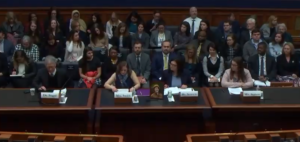
Renee Smith sits in front of Congress testifying, as an audience sits behind her.

Renee started her testimony by describing what our daily lives used to be like. She recounted the regular instances of restraint and seclusion that Dillon experienced, the multiple calls to 911 made by the school, Dillon’s increasing dislike of school, his missed educational opportunities, and the overwhelming stress on our family. I felt proud of Renee as I watched her recount, sometimes through tears, how much harm this had caused our then 6-year-old son and our family as a whole, including our marriage and our jobs. Fortunately, Renee was able to end her testimony on a very positive note. After we moved Dillon to a different public school in the same district that uses positive behavior intervention and support, Dillon is thriving.

In preparing for the hearing, we had the chance to learn more about the history of federal legislation to limit restraint and seclusion. We learned about a law (the Children’s Health Act of 2000) that includes serious limits on these practices. The only problem is that it doesn’t include school settings.

As I listened to Renee, I was struck by the contrast between my professional and personal life regarding the limitations on restraint and seclusion. I am a nurse and I work in a long-term care facility. The Centers for Medicare & Medicaid Services (CMS) strongly regulate the use of restraints in LTC facilities, with these regulations to be enforced through state Health agency survey and certification. I have always been well aware of what I can and cannot do when our patients exhibit challenging behaviors. I have received training by my employer on patient’s rights, on what we are legally barred from doing, and on effective alternatives to restraint and seclusion. I see firsthand how this benefits our patients and staff alike. But as a parent, I see how the lack of such protections have hurt my son.

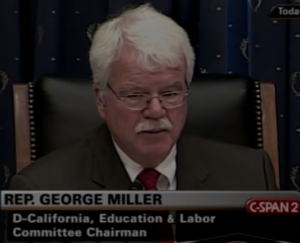
This point was made in 2009 by the former chairman of the House Education and Labor Committee, Rep. George Miller, the last time there had been a hearing on restraint and seclusion:

Federal law restricts the use of seclusion-restraints to emergency circumstances for children in hospitals and community-based residential treatment facilities and other facilities supported by federal dollars. Yet these rules do not apply to public or private school. This means an untrained medical professional is forbidden from inappropriately restraining a patient and, if they do, there are laws specifically targeted to address such behavior. But untrained classroom staff are abusing student in schools without any accountability because of a lack of federal oversight. Our children are bearing physical and emotional burden of a system designed to fail them”

It is now almost a full decade later. Far too many children like my son continue to be restrained and secluded in school. It is past time to correct this problem.

The Arc logo

Disability Docket March 2019: Amicus (Friend of the Court) Briefs

In December 2018, The Arc filed an amicus brief before the New York Supreme Court in People v. McCollum in support of an adult man with autism charged with unauthorized driving of city trains and buses. In an unprecedented decision, the lower court found that, based on his autism diagnosis, Darius McCollum met the criteria for a “dangerous mental disorder” and committed him to a psychiatric institution for the most violent offenders despite him never having committed a violent crime. The brief argues that this placement is wholly inappropriate for someone like Mr. McCollum, who could thrive in the community with appropriate supports and services.

The Arc also received a positive outcome in a prior case in which it participated in an amicus brief, Postawko v. Missouri Department of Corrections. The brief supported the certification of a class of prisoners seeking life-saving medical treatment and alleging that the Missouri Department of Corrections refused to treat them in violation of the Americans with Disabilities Act and argued that class actions are a vital tool for civil rights enforcement for the most vulnerable populations. In December 2018, the Eighth Circuit affirmed class certification since the alleged deficiencies in a prison-wide treatment policy impose a common injury.

The Arc logo

Trump Administration 2020 Budget Request: Old Ideas and Big Cuts

Today, the Trump Administration released a budget request that if passed by Congress, would put the lives of people with disabilities at risk. The proposal includes deep cuts to Medicaid, the core program providing access to health care and home and community-based services for people with disabilities. The cuts come in the same form as those included in the 2017 proposals to repeal the Affordable Care Act (ACA) and cut and cap the Medicaid program. Congress rejected this in 2017, but the Administration proposed budget includes replacing both the Medicaid expansion and ACA subsidies with a block grant, and converting the rest of Medicaid into a per capita cap which would deeply cut the program and cap the amount of funding available. If enacted, states would receive less federal support to administer Medicaid, resulting in restricting eligibility, cuts to services, and growing waiting lists. Furthermore, it would not adjust to changes in health care, drug costs, aging of the population, or emergencies.

Not only would both a block grant or per capita cap harm people with disabilities, but the proposal also includes applying controversial and harmful work requirements across the country. Arkansas is the first state in the nation to take health care coverage away from people who don’t meet a work requirement. In the first seven months of implementation, more than 1 in 5 people subject to the policy lost their health care coverage. Applying this policy nationally, as the budget proposal would do, would have devastating effects on health care coverage — particularly for people with complex health care needs, and likely many people with disabilities.

The Arc logo

Walmart, Disability Employment, and an Opportunity to Lead

By Peter Berns, CEO, The Arc

It’s no surprise that when Walmart, our nation’s largest private employer, announced plans to change the People Greeter role in its stores, a move that affects some employees with disabilities serving in that role, there was a hue and cry in the disability community and beyond. It is heartening that Walmart US President & CEO, Greg Foran, immediately stepped forward to reiterate the company’s commitment to its employees with disabilities, stating that Walmart will look at each situation individually “with the goal of offering appropriate accommodations that will enable these associates to continue in other roles with their store.” Foran further explained: “Let me be clear: If any associate in this unique situation wants to continue working at Walmart, we should make every effort to make that happen.”

As a company that prides itself on its “long-standing history of being an employer of choice for people with disabilities,” and on its 100 points score on the Disability Equality Index, these recent events provide an opportunity for Walmart to demonstrate its leadership and commitment to people with disabilities and their families. Certainly, the first order of business is to support employees with disabilities in the People Greeter role who are not able to perform the new additional responsibilities of Customer Host to transition to other jobs in the company and to actively support them in doing so. The Americans with Disabilities Act (ADA) requires no less.

At a point in time where more than 60% of people with disabilities are not employed, including 65-75% of people with intellectual and developmental disabilities, how Walmart manages the current controversy is of vital interest. Walmart’s customers are watching, as are people with disabilities and their families, disability advocacy and services organizations, academics, lawyers, the news media, and many, many other employers. The company has the opportunity to lead our nation by modeling and demonstrating best practices in employment of people with disabilities in the mainstream workforce.

Walmart can demonstrate the importance of rejecting stereotypes and misconceptions about what people with disabilities can do. True, some people with disabilities, as well as some without disabilities, may not be able to perform all of the requirements of the new Customer Host job, such as lifting 25 lbs. Yet, it is also true that many people with disabilities, including those with intellectual and developmental disabilities, will meet and exceed the minimal job requirements and perform superbly in this new role and others within Walmart stores. Walmart and other employers need be open to and accepting of the reality that an employee with a disability, with appropriate training and accommodation, can be successful in a wide variety of roles. In Walmart, after all, the former People Greeter and new Customer Host roles represent only a tiny fraction of the more than 2 million jobs nationwide.

Walmart can demonstrate that it truly is feasible for any employer to recruit, hire and retain employees with disabilities as part of a company’s overall commitment to diversity, and that the business benefits in many ways by doing so. By working collaboratively with relevant government agencies, educational institutions, and nonprofit developmental disability services, vocational rehabilitation and workforce development agencies, employers can build a robust pipeline of candidates with disabilities for all types of jobs.

Walmart, and other private sector employers that are not currently legally required to do so, could also establish voluntary systems of self-identification for job applicants and employees with disabilities, adopt disability employment goals, and annually reporting that data publicly. Today, both the Federal government, as an employer, and Federal contractors are required to have systems of self-identification and report on progress in meeting defined goals. However, these requirements don’t apply to other private sector employers, nor is the reporting made public.

Many private sector employers assume they are legally prohibited by the ADA from asking about an applicant’s disability status. Yet, as the U.S. Equal Employment Opportunity Commission has explained:

(T)he ADA does, however, provide an exception to the general rule prohibiting disability-related questions in the interview process. Under the ADA, an employer may invite applicants to voluntarily self-identify as individuals with disabilities for affirmative action purposes.1

Walmart and other private sector employers could truly be game changers in employment for people with disabilities by adopting self-identification and hiring goals, for affirmative action purposes, and then sharing and holding themselves accountable for the results.

Finally, Walmart should continue the active communication and candid dialogue it has engaged in with advocacy and social services organizations in the disability community over the past years. Walmart should share with the community the results of its efforts to place People Greeters with disabilities in other roles. It should continue and expand its efforts to work collaboratively with disability nonprofits to advance employment opportunities across the company and, as one of our country’s largest employers, across the nation.


1Recruiting, Hiring, Retaining and Promoting People with Disabilities – A Resource Guide for Employers, https://www.eeoc.gov/eeoc/interagency/upload/employing_people_with_disabilities_toolkit_february_3_2015_v4-2.pdf

The Arc logo

Introducing the Direct Support Professional Workforce Development (DSP) Toolkit

To support individuals with intellectual and developmental disabilities, we know just how important it is to attract, recruit, and retain well-qualified Direct Support Professionals (DSPs). With the right DSP, individuals with I/DD receive the support they need to be included and empowered in the community. This is when the DSP Toolkit comes in.

The DSP Toolkit addresses several resources that chapters of The Arc, as well as individuals with disabilities and their family members can use to find and retain quality direct support professionals. Developed for The Arc by the Research and Training Center on Community Living at the University of Minnesota, the toolkit provides tools and resources that are essentially free and available for download, including a realistic job preview, public service announcements, DSP targeted marketing flyers, and more. Take a look at the DSP Toolkit and get started on finding the direct support professional help that is right for you!

The Arc logo

NCE Is for Everyone!

Attention Chapter Leaders: Help Your Staff Grow and Flourish

While NCE was built by and for executive directors and management staff of The Arc, we realize that leadership happens at every level and that everyone can benefit from the professional development tools, resources, and events that NCE provides. Executive directors of chapters are automatically members for free, but did you know we have developed a system where you can bring the benefits of NCE to your staff?

  • For just $149, you can add one additional individual from your organization to NCE
  • For just $350, you can give the power of NCE to 5 additional members of your staff (Bronze Pass)
  • For just $499, you can add 10 staff members to NCE and all that it entails! (Silver Pass)

Do you want a pass that covers your entire staff? A Gold Pass is the way to go. The Gold Pass is a discounted rate that covers an unlimited number of staff. A Gold Pass allows you to sign up some, most, or EVERYONE in your organization for a fraction of the cost of the Bronze and Silver Passes. And to make the Gold Pass even more incredible, board members are included in that price! See the chart below to find out how much you can save by purchasing a Gold Pass.

Gold Pass Pricing

Includes all benefits listed below for ALL members of your chapter, including board members and executive directors.   

Number of Employees
Within Your Chapter            Price

1-10                                        $150
11-50                                      $250
51-250                                    $500
250-500                                  $750
500-750                                  $1,000
750-1000                                $1,500
>1000                                     $2,000

Find the pass that’s right for you: Individual, Bronze, Silver, or Gold. You can find more information in the NCE Brochure or by contacting Dawn Cooper.

The Arc logo

Next Stop: Success! Building a Sustainable and Effective Transportation Program

A TravelMate participant sits on the metro train holding an iPad.

In 2014, The Arc of Northern Virginia collaborated with software partner ONEder to develop the award-winning TravelMate program. TravelMate provides virtual support on a smartphone or tablet, facilitating more independence using the bus, train, and other transportation. By the end of the second year of the program, 96% of users had increased their ability to travel more independently, and nearly half were able to travel completely independently.

How was the TravelMate program born?

In 2013, The Arc of Northern Virginia received a grant from the Federal Transit Administration to develop more travel trainers for individuals with developmental disabilities. There was most certainly a need; at the time there was only one travel trainer at the Washington Metropolitan Area Transit Authority dedicated to working with individuals with developmental disabilities for all of Maryland, D.C. and Virginia. Kymberly DeLoatche was hired to coordinate the project and in her search for a well-liked travel training program, she found that a universal option didn’t exist. Most staff just kind of “did it on their own”. At the same time, Metro had completed a travel training study, and one of the primary insights was that individuals with developmental disabilities took longer to train because they required more repetition of the trip in order to be successful.

A year prior, while Kymberly was attending an Autism Society conference, she noticed an exhibitor who had created an iPad app using real time photos and videos to support an individual with disabilities. She had seen how powerful the iPad could be in the hands of someone with autism and already knew from watching her son, who has Down syndrome that he would watch videos over and over and then get up and perform the action exactly the way it had been done in the video – an “a-ha” moment about how learning uses visual cues.

Putting these two experiences together was the inspiration for the creation of TravelMate. Kymberly called the creator of the software program she saw at the conference and explained her idea about doing an online curriculum that outlines all the steps in taking public transit. ONEder immediately jumped on board and TravelMate was born. It has been a life changing partnership.

Tell us about the community partnership element. What was the process like getting stakeholders and partners on board?

The Arc of Northern Virginia is fortunate to have a wide circle of community partners. When we first recruited individuals to form a Travel Training Project Advisory Board, it was an easy ask. We brought representatives from school districts, the local Community Services Boards, the Department of Aging and Rehabilitative Services, private and public employment providers, and of course parents and individuals with developmental disabilities. Teachers and job coaches guided the development of the curriculum and assessments. Individuals with developmental disabilities were involved in creating and presenting on curriculum, guides, and training programs. Having this level of community involvement from the very beginning is a key element of the continued success of our programs.

What are some secondary effects you’ve seen as a result of the success of the program?

Using visual cues and photos with a touch screen has proven to be a vastly superior format for learning for individuals with developmental disabilities. TravelMate allows each individual to use a format (visual checklist, choice board, social story, or real time photos or videos) that works best for them. The technology also allows them to get the repetition they need to succeed without having to actually perform the task with a job coach or teacher. Working with schools, transition teams, and employment providers in the community provides a more seamless transition for the individuals from school to the work environment. From the very first training program in 2014, we saw school programs adding more curriculum time for travel training and not just “making it up on their own” as they had been doing in the past.

What – if any – are your next steps for expanding the program’s scope or reach?

The Arc of Northern Virginia has already created and launched the companion to TravelMate called EmployMate. It is like having a virtual job coach in your pocket. Because the ONEder platform is 100% customizable to individual needs, a job coach or teacher can go to the employment site as they normally do, create needed activities, monitor performance, and adjust the curriculum accordingly from their laptop.

With the success of these two curricula, The Arc of Northern Virginia’s Tech for Independent Living team is creating additional ‘Mates to address other daily living tasks. In development now are: DailyMate, for daily home living activities; MoneyMate, for budgeting and banking; SocialMate, for navigating personal and professional relationships; and SafetyMate, for navigating interactions with law enforcement and safety tips for home, work and community.

How can other chapters start programs like this in their communities? 

Any chapter could write a grant for funds for training and licenses to start a program like this in their community. We started with using 5310 Mobility funds from the Department of Transportation’s Federal Transit Administration.

Without having to recreate the wheel, other chapters that have employment programs could use our ‘Mates curricula immediately with their current clients. The curricula can be provided directly, or a chapter can use a “train-the-trainer” model as we have done, to engage partners in the community. For any additional information, feel free to email Peter Leisen, Project Coordinator, at pleisen@thearcofnova.org or phone 703-208-1119 ext. 112.

The Arc logo

Rhode Island Advocate to Testify in Congress on Impact of Restraint and Seclusion on Son With Autism

On Wednesday, February 27, Rhode Island advocate Renee Smith will testify in Congress before the U.S. House Education and Labor’s Subcommittee on Early Childhood, Elementary, and Secondary Education hearing on the use of restraint and seclusion in schools.

The hearing is titled “Classrooms in Crisis: Examining the Inappropriate Use of Seclusion and Restraint Practices”, and Smith was invited to testify because of her now eight-year-old child’s traumatic experiences in school. When Dillon, who has autism spectrum disorder, was in kindergarten and first grade, he and his parents struggled with the school administration for proper, positive supports for him. Restraint and seclusion were repeatedly used to manage Dillon’s behavior, despite the fact that his parents knew other positive methods would lead to a better outcome, and positive reinforcement was a part of the documented individualized education program (IEP) for Dillon with the school.

Far too many times, Dillon was restrained and dragged into the “blue space” – a walled and padded area, with a small opening with a pad cover to keep a child from leaving the space. Again and again, situations escalated to the point where 9-1-1 was called, and if Dillon’s parents didn’t arrive before the ambulance, he would be taken alone to the hospital. The repeated trauma of restraint and seclusion, the threat of going to the hospital, and continued interruptions to his education were having a major impact on Dillon and his family.

“Dillon’s work avoidance, we now know, was in direct reaction to the restraint and seclusion he was experiencing. The more he was restrained and secluded, the less he was interested in school work, which resulted in more restraint and seclusion, a constant downward spiral. It broke my heart when Dillon told us that he no longer trusted any of the adults in that school. Without the school working with us to change this dynamic, we had to do something – we found another public school with a different approach,” said Smith.

Dillon started fresh at a new school, where the behavior program allows children to float between a special education classroom and a regular education classroom for work. There are several cool down spaces and one open space within the office of the school behaviorist. Teachers provide positive reinforcement in their classrooms and one-on-one with their students. Within only two weeks of the new placement, Dillon was in a regular education classroom 100% of the time with supports.

“At his old school, Dillon was trying to communicate that the strategies used were not working for him and not allowing him to develop coping skills for the future. Today, Dillon is doing really well. With the proper supports, he has blossomed as a student and enjoys school,” said Smith.

The Arc Rhode Island (RI) Family Advocacy Network (FAN) recruited Smith to bring this perspective to the halls of Congress. The Arc RI FAN is a newly created office that will lead state-level public policy activities as well as provide training, public awareness and education, and grassroots advocacy building to protect the rights of Rhode Islanders with intellectual and developmental disabilities (I/DD). The Arc has tapped Joanna Scocchi, founder of Rhode Island Advocacy for Children, as the Director. The Arc RI FAN joins a network of more than 620 state and local chapters of The Arc that provide direct support services and advocate for the rights of people with I/DD around the country.

“Dillon’s experience is horrifying, yet it’s happening in schools across Rhode Island and across the country. Nationally, students with disabilities are roughly 20 times more likely than their peers without disabilities to be restrained and secluded. Our kids deserve better – the approach to their education and the environment in which they learn are key ingredients to their success,” said Scocchi.

The Arc logo

#HandsOff: Advocating With Young Children

This was part of a series called #HandsOff, where we featured calls to action and stories from families across The Arc’s network about how key policy issues impact their day-to-day lives.

Written by: Julie Ross, Member of The Arc of Texas and Mother to a Daughter with Down Syndrome

julieross2

My almost seven-year-old daughter Niko is fun and full of energy, loves dancing, singing, and doing daredevil stunts. Niko adores her big sister, playing with her homeschool friends and caring for younger children. In addition to keeping up with her, my job has also been to advocate for her healthcare, inclusion, and civil rights – and it began the day she was born. Niko has Down syndrome and congenital heart disease. While she was still recovering in the NICU, a social worker explained to us about Medicaid and “waitlists”. The social worker said to apply for state and federal healthcare services immediately, even though some of these were adult services, because the wait was 14 years and growing. Afterwards, I joined my state chapter of The Arc and The Arc of the United States and learned that we could impact these issues—and more. We have high expectations for Niko, so if we could eliminate barriers that prevent her from reaching her potential, we were willing to demand change. From the start, we knew Niko would be at the center of these advocacy efforts.

Policies at both the state and federal level greatly impact Niko’s access to services and healthcare she needs to live a full, happy life. And it often feels as if the impact of legislation on the disability community isn’t being considered by elected officials. In order to become a better advocate, I joined state and national disability advocacy organizations and attended rallies led by self-advocates. Niko and I made a host of new friends and I was mentored by other families. I drove with both of my daughters to our state capitol to meet with our elected officials to advocate for Medicaid and Early Childhood Intervention funding.

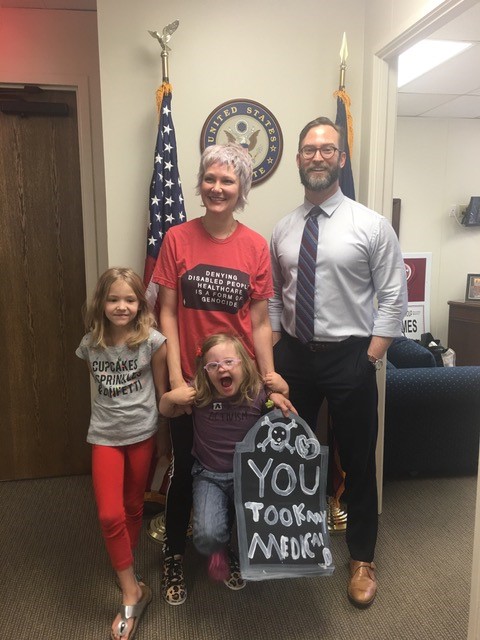
We took advice from The Arc and contacted our federal lawmakers. Niko and I made office visits to Senator Ted Cruz and Senator John Cornyn’s district offices. We talked about the importance of phasing out subminimum wage, fully funding Medicaid, saving the Affordable Care Act, and supporting legislation such as Money Follows the Person to ensure Niko could live free from the threat of institutionalization. At these meetings, I would carry a stash of snacks and coloring books to entertain Niko while I did most of the talking (although she would vocalize occasionally and toss cookie crumbs on the floor). Whenever I felt fear or intimidation of how lawmakers and staff may react to my child attending our meeting, I would remind myself that my taxpayer dollars pay for their offices and these lawmakers work for us! Most of all, I want lawmakers to know my daughter’s name, face, and story to remind them of what is at stake when they vote. And to make that connection, it is important for them to meet Niko in person.

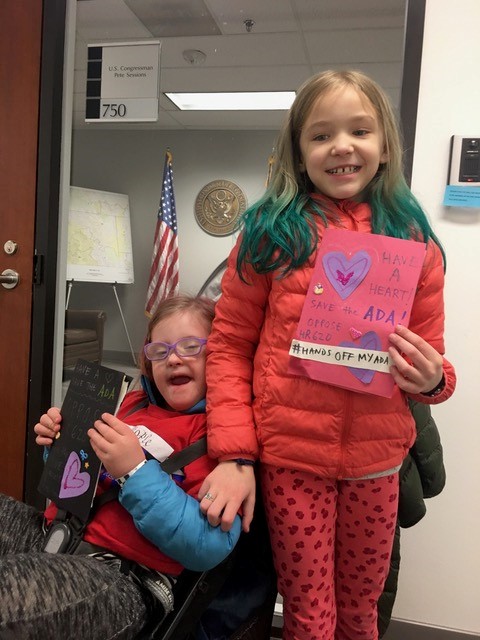
We always try to make a lasting impression. Once we even celebrated Niko’s birthday in our Senator’s offices. I brought balloons, cupcakes, and birthday cards for their staff to sign and share with the Senators – urging them to protect Medicaid and ACA to preserve Niko’s healthcare protections so she could celebrate many more birthdays. And last Valentine’s Day, we asked our Congressman to “have a heart” and oppose a dangerous bill that would have weakened the protections afforded by the Americans with Disabilities Act.

We’ve seen the positive changes that result from state and national disability advocacy. When we exercise our constituent power and families, individuals, and self-advocates deliver our “ask” and our personal stories – we make a tremendous impact. And while Niko still acquires new interests and hobbies as she grows up, I’m delighted that she and I can include advocacy as an integral part of our family life.

julieross1 julieross3