
The Arc logo

The Arc and LSA Form National Collaboration to Support Aging Caregivers and Their Family Members With Disabilities to Plan for the Future

Washington, DC – Lutheran Services in America, Incorporated (LSA), is proud to collaborate with The Arc of the United States’ Center for Future Planning on an initiative to connect older caregivers who support a family member with intellectual and developmental disability to future planning resources.

The Arc has engaged a number of national and state partners to participate in this project including The Arc of North Carolina, The Arc of Tennessee, The National Council on Aging, the Association of Jewish Family & and Children’s Agencies, the University of Illinois in Chicago’s (UIC) Department of Disability and Human Development, and LSA. This one-year project is made possible through a grant to The Arc from The Retirement Research Foundation, a national foundation dedicated to improving the lives of our nation’s elders.

LSA is pleased to engage its member in North Carolina, Lutheran Services Carolinas (LSC), to support the work of this important effort. LSA will work closely with LSC and The Arc to help raise awareness for the future planning needs of aging caregivers in North Carolina and across the country.

According to The Arc, research shows that many aging caregivers are isolated or disconnected from disability services. This initiative will provide training to human services agency staff to conduct in-person outreach to seniors over the age of 65 providing direct support to an adult with intellectual and developmental disabilities; bring information on future planning resources; and encourage caregivers to initiate the future planning process. This collaborative approach among national, state, and local aging, disability, and faith-based human services organizations will leverage the array of resources necessary to reach out to aging caregivers in two states and support them to plan for their family member’s future.

“In our country today, there are nearly one million households with an adult with intellectual and developmental disabilities who is being cared for by someone over the age of 60,” said Charlotte Haberaecker, President and CEO of LSA. “In nearly two-thirds of these families, there is no plan for the future. Through this partnership, we will be able to reach deeper into the communities our human services agencies serve and look for new ways to connect caregivers with the services they need to take the important steps in planning for the ongoing care of their sons and daughters. This project meets a vital need for older adults, especially those who are not connected to the disability community or the social service system.”

“We are excited to work hand-in-hand with The Arc to recruit trainees and help raise awareness about the future planning needs of aging caregivers across our region. Through the relationships we have in our communities and the partners on this project, we will be able to reach senior caregivers more effectively. When you combine our work at LSC with the national scope of the partners on this project, the opportunity to improve the quality of life for caregivers and their adult children has potential to make a real difference in communities across the country.” Ted Goins, President and Chief Executive Officer of LSC.

“The Arc is first and foremost a family organization. We were founded over 65 years ago around a kitchen table by family members who wanted the best life for their loved ones with intellectual and developmental disabilities. Decades have passed and much has changed, but our commitment to supporting families hasn’t wavered.”

 “People with disabilities have made great strides to live independently, be a part of their community, and experience all they want in life. But too many people are facing the next chapter in their lives without a plan. Creating a plan for the future isn’t a simple task which is why we want to support caregivers by helping them navigate the systems in place and provide them with every resource we can. We are extremely grateful to The Retirement Research Foundation for funding our work and look forward to working with LSA, an organization that shares our commitment to supporting families,” said Peter Berns, CEO of The Arc.

About LSA: Lutheran Services in America, Incorporated (LSA) is one of the largest health and human services networks in the country with more than 300 members that provide a broad range of critical services from health care to children and family services, senior services, disaster relief, refugee services, disability support, housing, and employment support, among others. Collectively, LSA members serve 1 in 50 people each year in thousands of communities across the United States and are open to all regardless of their religious affiliation or social or economic background. The LSA network is ranked at #23 on the Philanthropy 400, an annual listing of top charitable groups, and has combined revenue of $21 billion. LSA is affiliated with the Evangelical Lutheran Church in America (ELCA) and The Lutheran Church-Missouri Synod (LCMS). To learn more, please visit www.lutheranservices.org.

 About The Arc: The Arc advocates for and serves people with intellectual and developmental disabilities (I/DD), including Down syndrome, autism, Fetal Alcohol Spectrum Disorders, cerebral palsy and other diagnoses. The Arc has a network of more than 665 chapters across the country promoting and protecting the human rights of people with I/DD and actively supporting their full inclusion and participation in the community throughout their lifetimes and without regard to diagnosis.


The Arc logo

A National Call to Action on Toxic Environmental Chemicals

Last year a group of nearly 50 leading scientists, health professionals and providers, and children’s health and disabilities advocates (including The Arc) came together out of concern over the growing link between toxic environmental chemicals and neurodevelopmental disabilities. Last week, we issued a consensus statement under the banner of Project TENDR: Targeting Environmental Neuro-Developmental Risks.

Our statement is a national call to action that seeks to significantly reduce exposures to chemicals and pollutants that are contributing to autism spectrum disorder, attention deficits, hyperactivity, intellectual disability, and other conditions. Prime examples of these are chemicals in everyday use to make plastic more flexible, upholstery less flammable, and crops more plentiful.

The prevalence of neurodevelopmental disabilities has been increasing significantly according to the CDC, while the programs and services that are needed to support them remain under attack. It’s time to change how we do business in prevention. We need to shift the burden of proof to show that chemicals are safe before we allow them to affect a baby’s developing brain.

Read the New York Times and CNN coverage of the consensus statement. For more information about Project TENDR, see https://projecttendr.com/

While we must work together to prevent developmental disabilities resulting from toxic exposures, we must work simultaneously to protect the services and supports for those who live with these disabilities now. Want to get involved in advocating for services and supports for people with disabilities? Sign up for The Arc’s Disability Advocacy Network.

A woman in a motorized chair plays with a small dog on a grassy field in front of a community of houses

Moving to a New State With Medicaid, SSI, and Disability Services: A 2026 Checklist

Updated: July 23, 2026

Moving is hard. Moving when you rely on Medicaid, Social Security, or other disability services can feel risky. One paperwork delay can mean a gap in care, equipment, medication, or supports that keep daily life stable.

This guide is a checklist to help you plan a move across state lines while protecting benefits and services as much as possible.

Start Here

The most important thing to know: many programs don’t “transfer” when you cross state lines. You often have to close, reapply, or re-qualify. This is especially true for:

  • Medicaid and Medicaid home and community-based services (HCBS)
  • Supplemental Nutrition Assistance Program (SNAP), also known as food benefits
  • State disability services and waivers

Some benefits are federal and continue, but details can still change:

  • Supplemental Security Income (SSI) benefits continue, but you need to update the Social Security Administration (SSA) about your new address and living situation. Most states supplement SSI benefits with additional payments. This state supplement payment changes if you move to a different state.
  • Social Security Disability Insurance (SSDI) benefits continue, but you still need to update your address with the SSA.

Social Security Benefits When You Move

Will I lose my SSI or SSDI if I move to another state? Usually, no, but you must report your new address.

Supplemental Security Income (SSI)
You should immediately report all address and living arrangement changes to the SSA. You can do this by calling your local SSA field office using the information available here. Call the SSA as soon as possible because you can be penalized if you don’t report address changes by the 10th day of the month following your move. SSI beneficiaries can’t update their address online, but you can check whether your address on file with the SSA is out-of-date by logging into your my Social Security account. Important: SSI amounts can change when you move because some states add a state supplement and some don’t. SSI amounts can also change if you move in with family members.

Social Security Disability Insurance (SSDI)
You should report address changes to the SSA. The easiest way for SSDI beneficiaries to update their mailing address is online through your my Social Security account.

Medicaid Waivers When You Move

Does Medicaid transfer to another state?
No. Medicaid is administered by states. When you move, you generally need to end coverage in your old state and apply in your new state. However, eligibility requirements vary state-to-state, which may affect your coverage.

Federal rules require states to cover eligible residents and outline residency standards. You generally become a resident based on where you live and intend to remain, and states may not impose a durational residency requirement in key Medicaid-related eligibility rules. However, it takes time for your new state Medicaid agency to process your application. Federal rules require states to take a maximum of 90 days to process an application based on disability and 45 days for all other applications, although states may fall behind.

Can Medicaid cover bills during a gap?
Federal regulation generally requires states to allow Medicaid eligibility before the month of application if the person would’ve been eligible and received covered services during that period—note that eligibility now includes work requirements for certain individuals. This period of retroactive eligibility can be up to one month for those enrolled in Medicaid through the expansion pathway and up to two months for all other individuals, including those eligible for Medicaid on the basis of disability. Some states have approved demonstrations that change how retroactive eligibility works, so it’s important to ask your new state directly.

What happens to HCBS waivers when you move?
This is where families get hit hardest. Many HCBS services are provided through waivers that can have caps and waiting lists. Moving often means:

  • Reapplying for waiver services in the new state
  • Completing new assessments
  • Potentially joining a waiting list

CMS will require states to publicly report HCBS waiver waiting list numbers and average wait times beginning in July 2027, highlighting how serious unmet need can be. You can also find data on this from KFF.

The reality: Don’t assume you can line up the same home and community supports on the day you arrive. Build a backup plan.

Health Insurance When You Move

I have Marketplace insurance. What happens if I move?
Moving can qualify you for a Special Enrollment Period. HealthCare.gov explains that a move to a new ZIP code or county may qualify, and you may need to show proof of the move and that you had qualifying coverage for at least one day in the 60 days before your move. The Special Enrollment Period begins after you update your address and confirm the move with the Marketplace and typically will last up to 60 days after this.

I have Medicare. What happens if I move?
Medicare is federal and doesn’t stop when you move, but plan networks can change. If you have a Medicare Advantage plan or Part D plan, you should check whether your plan works in your new area.

Special Education Services When You Move

If my child has an IEP, does the new school have to follow it?
IDEA requires the new school district to provide comparable services to what’s in your child’s current IEP while they decide whether to adopt the IEP or develop a new one.

Best move: request copies of evaluations and the current IEP before you move, then provide them to the new district immediately.

Decision-Making Supports and Guardianship

Will guardianship or other legal authority automatically carry over?
Not always. Guardianship is state law, and transfers can be complicated. Guardians must often petition both the state in which they currently reside and the state they plan to move to for transferring guardianship.

A major tool that helps is the Uniform Adult Guardianship and Protective Proceedings Jurisdiction Act (UAGPPJA), which creates clearer rules for transfer and recognition across states. The Special Needs Alliance reports that 47 states, Puerto Rico, and Washington, DC have enacted UAGPPJA.

Practical guidance: talk to an attorney in both states, especially if there’s an existing court order.

SNAP (Food Benefits) When You Move

Can I keep SNAP when I move to a new state?
SNAP is federally funded but run by states. When you move, you should first cancel your SNAP benefits in your current state (aim to do this within two weeks of moving). Then you should re-apply for benefits in your new state as soon as possible.

SNAP processing timeliness also matter. USDA notes states must generally provide benefits to eligible households within 30 days of an initial application and within 7 days for people eligible for expedited service.

Housing Assistance When You Move

Can I move with a Section 8 voucher?
Often yes, through “portability.” Portability doesn’t usually apply to vouchers tied to a specific building or unit rather than you, the tenant.

HUD explains portability as the process of moving your Housing Choice Voucher subsidy to a new jurisdiction, with rules that can include a one-year requirement in the initial jurisdiction in some cases.

Special Needs Trusts & ABLE Accounts

Do special needs trusts need to be updated when I move?
Often, yes. State rules and Medicaid interactions can vary. Have the trust reviewed by an attorney in the new state soon after the move.

What happens to my ABLE account if I move?
You should always update your address on your ABLE account, but you don’t always need to open a new account when you move. You can choose to rollover your money into a new account run by your new state, or you can choose to have an account with any state that accepts outside residents into their program. Learn more about choosing a state ABLE program here.

ABLE eligibility expanded as of 1/1/2026 and an eligible person may have only one ABLE account at a time. You can rollover your money into a new state ABLE plan once every 12 months.

A Closing Note

This is a lot. And it’s unfair that families have to become experts just to keep services stable.

But planning early can prevent the worst gaps. Build a paper trail, ask direct questions, and don’t assume systems will coordinate without you.

If you want local help, contact your nearest chapter of The Arc. They often know the agencies, the workarounds, and the realistic timelines.

The Arc logo

This June, Help the Men in Your Life Be Healthier

Father And Son PortraitIn June, we celebrate Men’s Health Month and encourage men of all ages with disabilities to learn more about preventable health problems and to practice good health habits.

Why raise awareness about men’s health?

According to the Movember Foundation, around the world, men die an average of 6 years earlier than women. One of the key reasons for this difference is because men often don’t practice good health habits.

Men are less likely to visit a doctor when they are ill. And, when they do visit a doctor, they are less likely to talk with their doctor about the symptoms they experience. As a result, men reduce their chances of receiving the best care for their illnesses.

Men with disabilities often experience additional obstacles and challenges to good health. Barriers to health care and good health may include:

  • Difficulty getting to/from a doctor or inaccessible medical equipment
  • Challenges clearly communicating with a doctor about symptoms, treatment options, and medications so that the patient understands why testing out different treatment options or medications may be necessary
  • Challenges finding doctors who have expertise and are comfortable working with and treating people with disabilities
  • Lack of insurance to visit the doctor or inability to pay for services
  • Lack of education about good health habits
  • Perception from some doctors that problems are because of disability, not general health issues

Perception from some people that people with disabilities cannot practice good health habits

How can I help the men with and without disabilities I know to be healthier?

The Arc logo

2015: A Year in ABLE

This month, states are beginning to launch ABLE Act programs and some people with disabilities can now take advantage of this new opportunity to build assets while preserving eligibility for means-tested federal benefits. Let’s take a look at what’s happened over the last 18 months.

As 2014 closed, Congress enacted the Stephen Beck, Jr. Achieving a Better Life Experience (ABLE) Act. This legislation recognized the extra costs of living with a disability and is anticipated to positively impact the economic futures of people with disabilities and their families. Lead sponsors in the Senate were Bob Casey (D-PA) and Richard Burr (R-NC); other key senatorial champions were Ron Wyden (D-OR) and Orrin Hatch (R-UT). ABLE was introduced in the House of Representatives by Ander Crenshaw (R-FL) and leading co-sponsors were Chris Van Hollen (D-MD), Cathy McMorris Rodgers (R-WA), and Pete Sessions (R-TX) with critical support from Kevin McCarthy (R-CA). By December 3, 2014, it had garnered 380 of the 435 U.S. representatives as co-sponsors and passed the House by a vote of 404-17. The Senate version of ABLE secured 78 co-sponsors, making ABLE one of the most bipartisan laws ever passed by the U.S. Congress. On December 19, 2014, President Obama signed the ABLE Act into law.

This law will ease financial strains through the use of tax-advantaged savings accounts. Qualifying individuals would be those who: 1) experience disability onset before age 26, and 2) either are a Social Security disability program beneficiary or submit a disability certification (meet certain criteria for the Social Security Administration’s (SSA) definition of disability and possess a written diagnosis from a licensed physician). Account funds may be used for a variety of disability-related purposes, such as basic living expenses; education; housing; transportation; employment training and support; assistive technology and related services; personal support services; health, prevention, & wellness expenses; legal, financial, & administrative services; oversight and monitoring; as well as funeral & burial expenses, all the while protecting eligibility for means-tested federal benefits, including SSI and Medicaid.

The law established new requirements which apply to ABLE account holders who are also SSI recipients. Once an account exceeds $100,000, an individual is placed into a special SSI suspension period with no time restrictions. During this time, the beneficiary’s Medicaid eligibility will remain intact but cash benefits will be suspended. When ABLE funds once again dip below $100,000, SSI is automatically reinstated.

The law also established requirements specific to Medicaid eligibility. The $100,000 limit that applies to the SSI program does not apply to Medicaid. However, upon the beneficiary’s death, remaining funds in the account may be required to pay back the state for Medicaid services provided during the individual’s lifetime.

Shortly after ABLE’s passage on the federal level, a legislative frenzy to create ABLE programs ensued at the state level. Responding to this enthusiasm, in March 2015 the Internal Revenue Service (IRS), advised that states could move forward with these legislative plans even though federal regulations were not yet in place. The agency assured that once regulations were published, there would be a “transition relief” period, which would provide “sufficient time” for states to execute changes which would ensure federal compliance.

In June 2015, the Department of Treasury and the IRS published proposed regulations. A public comment period followed, and in October, advocates voiced their concerns at a public hearing held in Washington, DC. Treasury and IRS officials took advocates’ words to heart, and in November, the entity released interim guidance that lessened some administrative burdens and program costs while creating a more accessible program. Among other things, participants would no longer be required to provide medical documentation upon opening an account.

Lastly, in December 2015, a major revision to the original ABLE legislation was signed in law, lifting the residency requirement, thus permitting states to offer national rather than state-resident only programs.

In the meantime, people with disabilities and their advocates sought further changes that would widen the scope of the law. As a result, in March 2016, three new ABLE improvement bills were introduced. Each seeks to strengthen a different aspect of the original bill. Below is a short summary of each:

  • The ABLE Age Adjustment Act would raise the age limit for eligibility for ABLE accounts to individuals disabled prior to age 46. The Senate bill (S. 2704) is sponsored by Senator Bob Casey while the House version (H.R. 4813) is sponsored by Representative Chris Van Hollen.
  • The ABLE Financial Planning Act would allow tax-free rollovers between an existing 529 college savings account and an ABLE account. Senator Bob Casey has introduced the Senate bill (S. 2703), while Representative Ander Crenshaw is sponsoring the House version (H.R. 4794).
  • The ABLE to Work Act would allow individuals to exceed the annual contribution limit and save more money in an ABLE account if the individual earns income. The Senate bill (S. 2702) is sponsored by Senator Richard Burr while the House version (H.R. 4795) is sponsored by Representative Ander Crenshaw.

Today over 90% of the states have enacted their own ABLE act and most are focusing on implementation. Opening their ABLE programs earlier this month, Ohio and Tennessee are leading the way; Nebraska is expected June 30; and Florida is set to offer accounts July 1. With the exception of Florida, all will be national programs. It is anticipated that up to 40% of the remaining states that have enacted legislation will have programs active by year-end. For more information on where a particular state is in the process, please see The Arc’s ABLE implementation chart.

Update: On June 30, 2016, Nebraska opened their ABLE program.

Update: On July 1, 2016, Florida opened their ABLE program

The Arc logo

The Arc’s Center for Future Planning™ Launches Financial Literacy Training for Low-Income Families With Children With Disabilities

Washington, DC – The Arc’s Center for Future Planning™ is pleased to announce it has received a $200,000 two-year grant from the MetLife Foundation. This funding will be dedicated toward developing a new financial literacy training program for families that include a child with intellectual and developmental disabilities (I/DD), with a specific interest in reaching historically underserved racial and ethnic communities.

Research has shown that disability and poverty are intertwined, and many families that have a child with I/DD struggle financially. Often, income declines when a child with I/DD is born because parents take time off of work or leave the workforce entirely to care for the child’s needs. This reduction of household income, combined with the income and asset limits in many public means-tested benefits available to these families, only complicates asset building.

The training will address these challenges by educating and supporting low-income families to lay the foundation for a secure financial future for their child with I/DD. More specifically, The Arc will develop a financial literacy curriculum that can be later distributed throughout The Arc’s national network of over 650 chapters. Topics to be covered will include credit, debt, choosing financial products and services, investing, and asset protection, as well as disability-related topics, such as information on benefits for people with disabilities, as well as special needs trusts and ABLE Act accounts.

“During our 65 year history, The Arc has always recognized the importance of supporting families of people with I/DD. In these challenging economic times, it is all the more important that we work with families of children with I/DD to stabilize the family’s financial situation. This support from the MetLife Foundation will allow The Arc to assist families in achieving long-term financial stability,” said Peter Berns, CEO of The Arc.

The Arc will lead a team to create a nationally replicable, culturally competent curriculum to provide financial literacy education to low-income families. After piloting the training with three chapters, The Arc will modify the curriculum so that it can be distributed through our network of chapters around the country. This work will also be supported by the Family Support Research and Training Center through a subcontract with the University of Illinois at Chicago and made possible by grant number 90RT5032-02-01 from the National Institute on Disability, Independent Living, and Rehabilitation Research (NIDILRR) at the US Department of Health and Human Services Administration for Community Living (US DHHS/ACL).

The mission of The Arc’s Center for Future Planning is to support and encourage adults with I/DD and their families to plan for the future. The Center provides reliable information and assistance to individuals with I/DD, their family members and friends, professionals who support them and other members of the community on areas such as person-centered planning, decision-making, housing options, and financial planning.

The Arc advocates for and serves people with intellectual and developmental disabilities (I/DD), including Down syndrome, autism, Fetal Alcohol Spectrum Disorders, cerebral palsy and other diagnoses. The Arc has a network of over 650 chapters across the country promoting and protecting the human rights of people with I/DD and actively supporting their full inclusion and participation in the community throughout their lifetimes and without regard to diagnosis.

Editor’s Note: The Arc is not an acronym; always refer to us as The Arc, not The ARC and never ARC. The Arc should be considered as a title or a phrase.

The Arc logo

Federal Agency Committed to Hiring, Promoting Employees With Disabilities

Keith Coburn 2Eighty-five percent of working-age individuals with disabilities are either unemployed or underemployed. Of the 15% that are employed, only half are working in inclusive jobs in the community. Fortunately, new government regulations are focused on changing these grim statistics. A recently proposed rule would require federal agencies to achieve a workforce participation rate of 12% for people with disabilities. One proactive agency, the Federal Communications Commission (FCC), is already leading by example, implementing an initiative dedicated to individuals with disabilities working in competitive and inclusive positions. The Arc’s employment division, The Arc@Work, has been supporting the FCC with their hiring efforts.
After working seasonal and part-time jobs for years, Keith Coburn was ready for the stability and security that comes with full-time employment. So, he reached out to his local chapter of The Arc, The Arc of Prince George’s County in Maryland, where he was connected through The Arc@Work to an opportunity at the FCC. A year and a half on the job, Keith performs a variety of tasks that range from sorting mail to updating and maintaining the database of licensing sales and transfers. As a problem-solver and a “master of Excel”, Keith’s responsibilities have grown steadily at the FCC and he is in the process of receiving his second promotion.

The quality of Keith’s work and his strong work ethic have made, and continue to make, a huge impression on all those who have had the opportunity to work with him. When asked to describe Keith, his supervisors, Annette Smith and Lisa Scanlan, expressed nothing but high praise. “Dependable”, “great team member”, and “great work product” were only some of the ways they described Keith’s performance.

“When Keith is assigned work, he always completes his task on time,” commented Annette. Lisa summed it up by adding: “He always steps up to the plate. He is the ideal employee.” Keith attributes his success to his determination. His advice? “Stick with it. Be flexible and be persistent,” said Keith.

The Arc@Work is a social enterprise that supports employers to successfully locate, hire, and support employees with intellectual and developmental disabilities. To learn more, visit our website at thearc.org/thearcatwork or contact Katherine Murphy at Murphy@thearc.org.

The Arc logo

The Arc of Delaware Reaches Fair Housing Settlement

Washington, DCThe Arc of Delaware and its counsel Relman, Dane & Colfax, The Arc of the United States, and Community Legal Aid Society, Inc. are thrilled to announce the recent settlement of The Arc of Delaware’s disability discrimination complaint against Sugar Maple Farms Property Owners’ Association, Inc. (SMFPOA). That complaint, filed in March 2015 with the U.S. Department of Housing and Urban Development (HUD) and the Delaware Division of Human Relations (DHR), sought a declaration that SMFPOA violated the Fair Housing Act when it refused to approve The Arc of Delaware’s acquisition of property meant to house four individuals with intellectual and developmental disabilities (I/DD) in a single family home integrated within the community. The complaint sought damages to compensate for the loss of housing opportunities and for violations of the federal and Delaware Fair Housing Acts due to disability discrimination. After DHR issued a finding of discrimination in March 2016, SMFPOA agreed to settle the case and has entered into a Conciliation Agreement with DHR, HUD, and The Arc of Delaware as of May 26, 2016.

“This case shows the importance of vigorously enforcing the Fair Housing Act,” noted Michael Allen, a partner with Relman, Dane & Colfax. “Although the Act has prohibited disability discrimination for nearly 30 years, we still need to fight every day to redeem the promise of community living for people with disabilities.”

In July 2014, Terry Olson, Executive Director, submitted a bid on behalf of The Arc of Delaware for a lot owned by SMFPOA. The Arc of Delaware intended to build a single family house in a Milford, Delaware residential subdivision with 65 other lots. His offer was accepted by the seller contingent on SMFPOA’s approval of the sale. However, once SMFPOA learned that residents with I/DD would be living there, it told Mr. Olson that such use was barred by its covenants and also expressed concerns about the amount of parking that would be required by the residents’ support staff.

Mr. Olson tried to explain that The Arc of Delaware’s use was protected by the Fair Housing Act and offered to accommodate the extra parking needs while maintaining a uniform appearance within the community. He also offered to give SMFPOA members a tour of a similar home in the area in order to allay any concerns about daily operations. Shortly thereafter, The Arc of Delaware received a letter from SMFPOA reiterating its position that the sale was not approved because it would violate SMFPOA’s covenants and suggesting that allowing people with I/DD into the community would reduce property values and disturb the “quiet enjoyment” of neighbors. The loss of the property and subsequent delay in state funding have deprived The Arc of Delaware and its clients of at least four community-based housing opportunities.

The Fair Housing Amendments Act of 1988 (FHAA) makes it unlawful to “make unavailable or deny” a dwelling because of disability as well as to refuse to make “reasonable accommodations in rules, policies, practices, or services, when such accommodations may be necessary to afford such person equal opportunity to use and enjoy a dwelling.” Federal courts have consistently held that community supported housing for unrelated individuals with I/DD does not constitute a “business” and does not violate “single family” restrictions, and Delaware law expressly recognizes such housing as “single family” properties for zoning purposes. Further, the courts recognize that most discriminatory remarks are made in coded language, such as the need to “maintain property value.”

Once the complaints had been filed, DHR performed an investigation and issued a finding of discrimination in March 2016. Subsequently, SMFPOA agreed to settle the case. Among other things, the Conciliation Agreement requires SMFPOA to:

  • Apply the same terms and conditions of rental to anyone occupying its properties without regard to disability or any other protected class;
  • Provide written compliance reports to DHR and/or HUD when requested;
  • Allow HUD and DHR to inspect the premises at any time within one year of the agreement;
  • Notify its members and residents in writing of rules, policies, and practices relating to its non-discrimination policy and to prominently display the Equal Housing Opportunity logo within any relevant advertisements it distributes;
  • Ensure that all of its current board members receive comprehensive training on the Fair Housing Act within 90 days of signing the agreement and that all future board members receive such training within 30 days of their election;
  • Pay The Arc of Delaware $55,000 in damages, including attorneys’ fees and costs.

Mr. Olson remarked: “It is challenging enough in Delaware for individuals with I/DD to find affordable housing in the community. When you add discrimination to the mix, it makes it nearly impossible. This victory will help ensure that individuals with disabilities in Delaware will have the same rights as other citizens to live in the community of their choice.”

Shira Wakschlag, Staff Attorney with The Arc of the United States, noted: “For more than 65 years, The Arc has sought to enforce and protect the human and civil rights of individuals with I/DD by working to ensure those with disabilities are able to live in the community free from discrimination and institutional settings. Without the vigorous enforcement of state and federal disability rights laws in instances of discrimination such as this one, this fundamental right would be eroded.”

Relman, Dane & Colfax, a civil rights law firm based in Washington, D.C., served as lead counsel on the case, with The Arc of the United States and Community Legal Aid Society, Inc. serving as co-counsel.

The Arc advocates for and serves people with intellectual and developmental disabilities (I/DD), including Down syndrome, autism, Fetal Alcohol Spectrum Disorders, cerebral palsy and other diagnoses. The Arc has a network of over 650 chapters across the country, including The Arc of Delaware, promoting and protecting the human rights of people with I/DD and actively supporting their full inclusion and participation in the community throughout their lifetimes and without regard to diagnosis.

Editor’s Note: The Arc is not an acronym; always refer to us as The Arc, not The ARC and never ARC. The Arc should be considered as a title or a phrase.

The Arc logo

Statement From Julie Petty, Loretta Claiborne, Ricardo Thornton, and Frank Stephens

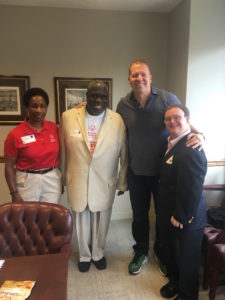
IMG_0788On June 6, 2016, a group of self-advocate leaders met with Gary Owen to discuss offensive content in his Showtime comedy special “I Agree With Myself”.
Statement from Julie Petty, Loretta Claiborne, Ricardo Thornton, and Frank Stephens:
Today, Julie Petty (Bentonville, Arkansas), Loretta Claiborne (York, Pennsylvania), Ricardo Thornton (Washington, D.C.), and Frank Stephens (Fairfax, Virginia), representing a broad coalition of disability advocates, met with Gary Owen, a comedian and entertainer. The meeting was arranged for both sides to listen and hear one another’s perspectives about a segment on Mr. Owen’s comedy special on Showtime.

Prior to the meeting, Mr. Owen decided to remove the segment in his Showtime special in which he depicts people with intellectual disabilities. Effective immediately, the special will still be available On Demand but will not include this portion.

The meeting was educational, positive and productive. The outcomes from the meeting were significant. Mr. Owen made positive commitments regarding use of the “R word” in his comedy routine.

The coalition has agreed to end its advocacy efforts in this situation. The coalition, through the voices of self advocates Julie Petty, Loretta Claiborne, Ricardo Thornton and Frank Stephens, express our appreciation to Mr. Owen for listening and acting positively to further understanding and healing.

The Arc logo

Roll the Vote

I am an individual with a disability, diverse needs, and I am also civically engaged and politically active. I’ve discovered that it is nearly impossible for me to shy away from my civic duties and the issues that affect me the most. You can thank former First Lady Barbara Bush for this, as one of the most defining civic moments was when I was eight, and I gave her a tour of the residential care facility in which I lived at the time. When she asked me, “What do you want to be when you grow up?” My response was, “I want to be the first female President of the United States, but I don’t know. I have this wheelchair thing.” Mrs. Bush reminded me that one of our great presidents, FDR, also had a wheelchair thing. She also said that the MOST important thing I could do was register to vote when I turned 18.

This event inspired me to learn as much as I could about the political process and the various levels of governance. On my 18th birthday, I decided to follow the advice of Mrs. Bush and I registered to vote. It is the best decision I’ve made in my life. Ever.

Registering to vote was an uncomplicated process for me. Being informed on the issues and candidates: that was a little more challenging. I don’t speak political acronyms or legalese. Finding people who could explain things to me in an understandable manner, without treating me as intellectually inferior, was dang near impossible.

I heard a saying once that goes like this: “What’s the best way to eat an elephant? One bite at a time, of course.” I promised myself that I would approach political involvement and voting the same. Even today, I take one bite at a time, and one step at a time. I spend months reading and researching issues, ballot initiatives, and candidates so I am comfortable and confident in my decisions.

I continued to pay attention to major milestones in the disability community. In 1990 the ADA was signed into law, the same day I left the residential care facility where I had met Mrs. Bush. I spent the rest of my formative years in a small town (400-ish people) in a very rural state. South Dakota has an approximate total population of 800,000. With numbers that small, I realized that every vote is very important; it all matters.

I continued to play an active part in civics and in 2002 I was very thankful for the passage of the Help America Vote Act. This act provided information, resources and technologies which have made the voting process much easier for me. However, improved access and information does not automatically eliminate ignorance. That’s what humor is for.

In the 2014 US Senate election for South Dakota, I was happy to vote for former governor M. Mike Rounds. I had spent months volunteering for his campaign. I was anxious-nervous, anxious-excited (like a kid at Christmas) as Election Day dawned. I went to vote.

This was the first time I was ever voting in a community that was not my hometown, and in a midsized city in South Dakota. The poll watcher, who was rather elderly, asked to see my driver’s license. No problem. She asked me to sign the register. Then, she stopped herself, “Honey, can you write your name?” “What?” “Do you know how to write?” Uh, yeah. The woman behind me in line, whom I’ve known for years, goes “Kati can not only write her name, she can spell it, too.” “What?” “I’ll have you know the woman you are speaking about is college educated, and intelligent.” “Oh. Sorry.” I signed in, went to vote and didn’t think any more about the issue. The uninformed woman, was effusively apologetic. “I just didn’t know they let your kind vote.” “Really, what kind is that…humankind?” Well, no, uh…

Subsequently, I’ve seen the poll-watcher at various events in the community. I feel like I should write her a thank you note. I genuinely appreciate her. She is a constant reminder for me that while we, as the Disability Community, have come a long way, we still have much work to do to be seen and valued as equals. It is people like this woman who continuously emphasize just how important my vote is, and why it is vital that I show up to the poll.

In the 1990s, there was a movement called ROCK THE VOTE, to register and politically engage young people. With the upcoming presidential election, the time has come to ROLL THE VOTE, to register and politically engage people with diverse needs and disabilities.


Kati is a small town, South Dakota woman who rolls through life. She is simply trying her best to positively change the world. The former governor for whom she voted is now United States Senator Mike Rounds (R-SD), and it is Kati’s pleasure to work for him as an administrative assistant and researcher in one of his regional offices.