Posts

The Arc logo

Celebrating 24 Years of the Family and Medical Leave Act

This week, The Arc celebrates the 24th anniversary of the Family and Medical Leave Act (FMLA). This landmark law ensures that millions of workers don’t have to choose between their job and their own health or the health of a family member.

Here are three things that people with intellectual and developmental disabilities and their families need to know about the FMLA:

  1. The FMLA offers much-needed leave for workers (including workers with disabilities) and family caregivers. Qualified workers at companies with 50 or more employees can take up to 12 weeks of unpaid family or medical leave each year. The FMLA specifies allowable uses, notably for a worker to address their own serious health condition, to care for a new baby, and to care for a spouse, child, or parent with a serious health condition.
  2. The FMLA protects against job loss. When a worker returns from FMLA leave, the employer must restore the worker to his or her previous job, or an equivalent job with the same pay and benefits.
  3. The FMLA ensures continued access to health insurance. If a worker has employer-sponsored group health insurance, the employer must continue to cover the worker under the same terms and conditions as if the worker had not taken FMLA leave. If the worker’s health insurance covers a family member, that coverage must also continue.

Family and medical leave has always enjoyed widespread public support – but the FMLA was a hard-won victory. Congress considered bills every year for 8 years before finally approving the FMLA on a bipartisan basis. Getting the FMLA across the finish line was testimony to the power of coalition. Organizations representing women, families, workers, seniors, people of faith, businesses, health professionals, and people with disabilities worked closely together to secure the FMLA.

The voices and views of people with disabilities and their families have always been a core part of that advocacy. In the 1980s and 1990s, groups like The Arc were deeply engaged in coalitions working to enact the FMLA, and people with disabilities and family caregivers shared many compelling stories in Congressional hearings and in the media. More recently, thanks to disability community advocacy, in 2015 the Department of Labor clarified that workers can use FMLA leave to care for a sibling with a serious health condition.

The FMLA was an important first step. But more work remains.

Today, about 40 percent of American workers aren’t covered under the FMLA, and many can’t afford to take unpaid leave. Only 14% of workers have paid family leave to care for a new child or seriously ill loved one. And gaps still exist in how you can use FMLA leave, such as being able to use leave to attend a child’s IEP meeting.

That’s why, as The Arc’s Robin Shaffert recently highlighted, we are joining the call for a robust federal paid family and medical leave program that adheres to a core set of principles. All employees must be able to access paid leave of meaningful length and for the full range of needs established in the FMLA. Families come in many shapes and sizes, so “family” must be inclusively defined. Paid leave must be affordable and cost-effective for workers, employers, and the government. And we must ensure that people who take paid leave do not experience adverse employment consequences as a result.

As President Clinton stated when he signed the FMLA into law on February 5, 1993, “Family and medical leave is a matter of pure common sense and a matter of common decency.” We couldn’t agree more. On the FMLA’s 24th anniversary, we celebrate its success and renew our commitment to a robust and inclusive federal paid family and medical leave program.

The Arc logo

The Arc on Leaked Draft Executive Order That Would Impact People With Disabilities Legally Residing in the US and Seeking to Legally Immigrate

Washington, DC – In light of a recently leaked draft Executive Order that would impact people with intellectual and developmental disabilities (I/DD) who are legally residing in the United States as well as people with I/DD who are hoping to legally immigrate, The Arc released the following statement:

“We are facing a civil rights crisis in our nation and people with disabilities are in the crosshairs with the latest draft Executive Order being circulated in the White House. The Executive Order, if finalized and signed by the President, would discriminate against immigrants with disabilities, making it harder to legally enter or remain in the country. To deport individuals with intellectual and developmental disabilities who are in our country legally or prevent them from immigrating, goes against the values of our nation.

“At The Arc we believe people should have a fair opportunity to legally enter and reside in the United States and become a citizen, without restrictions based on disability. This includes those needing protection as refugees, asylees, and victims of human trafficking.

“Focusing on an individual’s need for support is a form of discrimination against people with disabilities we have seen before. But Congress, in the past, addressed the problem by ensuring that people with intellectual disability are provided accommodations as they try to enter our country legally, become citizens, and achieve the American dream like their peers without disabilities. Broadening the criteria for excluding or deporting immigrants based on need for support will harm people with disabilities and their families who have much to contribute to our society.

“If a family is otherwise eligible to enter or remain in our country, they shouldn’t be turned away or turned out because their child or another family member has a disability and may need to access government services to live and participate in the community.

“We urge President Trump to reject this Executive Order. We also call on Members of Congress, as they have done in the past, to stand up for people with intellectual and developmental disabilities and their families as they seek inclusion in America,” said Peter Berns, CEO of The Arc.

The Arc advocates for and serves people with intellectual and developmental disabilities (I/DD), including Down syndrome, autism, Fetal Alcohol Spectrum Disorders, cerebral palsy and other diagnoses. The Arc has a network of over 650 chapters across the country promoting and protecting the human rights of people with I/DD and actively supporting their full inclusion and participation in the community throughout their lifetimes and without regard to diagnosis.

The Arc logo

Navigating School: The Arc@School Launches Website to Help Students With Disabilities and Their Parents With Special Education Advocacy

“The secret in education lies in respecting the student.” – Ralph Waldo Emerson

Opportunities for students with intellectual and developmental disabilities (I/DD) have come a long way since children were warehoused in institutions with no future or a real education. One giant leap forward was the enactment of the Individuals with Disabilities Education Act (IDEA) in 1975, which for the first time required schools to educate all students with disabilities—including students with I/DD.

The IDEA lays out a process that schools must follow to identify which children with disabilities require additional services to learn, and which supports and services a child needs. That process often leads to the development and implementation of an individualized education program (IEP). The IEP is the roadmap for that child to succeed. The IDEA has led to a generation of people with I/DD whose education opened doors to employment and meaningful lives in the community. However, far too many families and students do not experience an IEP process where their role and their rights are clear and respected. Instead, they feel left out of the process, which is often overwhelming and confusing.

So in 2016, The Arc launched a new initiative, The Arc@School, to build the capacity of The Arc’s nationwide network of chapters to support students with I/DD and their families in developing and implementing IEPs that will help students with I/DD graduate from high school and pursue post-secondary education and employment.

Many students and their families seek advocates to help them understand the IEP process and their rights, and many chapters of The Arc provide lay special education advocacy services for students with I/DD and their families. The Arc@School’s newly-launched website aims to be an online resource for students with disabilities, their parents, and advocates that includes information, best practices, and a resource directory, where you can find links and contact information for chapters of The Arc, protection and advocacy programs, parent centers, and state education agencies in your state.

A successful IEP is the foundation for a future in the community, leading a life of one’s own choosing. If we are to improve outcomes for students with I/DD, we must follow Emerson’s guidance and focus on an IEP approach that respects the student’s goals to achieve his or her dreams.

The Arc logo

New Project Announcement: The Arc’s National Center on Criminal Justice and Disabilities® and The Board Resource Center

Building Capacity of Primary Care Providers to Discuss Sexual Violence with Women with Intellectual/Developmental Disabilities

Introduction

In September of this year, The Arc’s National Center on Criminal Justice and Disability® (NCCJD) was awarded a one-year grant from The Special Hope Foundation. Working with The Board Resource Center, a California-based consulting firm, this funding will be used to teach health care professionals about how to address and help prevent sexual violence against women with intellectual/ developmental disabilities (I/DD).

Background

This project will address the alarmingly high rate of sexual violence experienced by women with I/DD. About 20% of all women are sexually abused each year. However, women and girls with developmental disabilities are four to ten times more likely to face sexual abuse. Up to 68% of women with developmental disabilities will be abused before they are 18, and up to 90% will experience abuse during their lives (Valenti-Hein, D. & Schwartz, L. 1995).

Health care providers are in a unique position to have open dialogue about sexual violence prevention with their female patients. However, many times they do not have experience talking about victimization with women with I/DD in a manner that is accessible and culturally competent for all. In order for providers to have meaningful conversations about the high risk of violence people with I/DD face, they need training on effective ways to provide patients with safe environments to share their experiences, often for the first time.

By learning how to use effective plain language communication strategies, they can provide a safe place for women to share openly. These strategies can improve communication with all patients, since plain language strategies apply to a number of different populations who struggle with comprehension of information. Ultimately, this project will improve health care delivery by giving providers effective tools to support women with I/DD to discuss or disclose sexual violence.

Project Objectives

This project, funded by The Special Hope Foundation, builds the capacity of primary care providers to discuss the high risk of sexual violence women with I/DD face. It will equip providers with training and tools to create safe, open, and accessible conversations about what sexual violence is and what women can do to report it or stop it from happening. Together, and under the guidance of an advisory committee, we will achieve the following objectives to decrease the incidence of sexual violence: 1) Develop two training videos and materials on discussing sexual violence with female patients. 2) Disseminate tools to health care organizations, regional centers, advocacy groups, and people with I/DD and their families, ultimately reaching 500,000 individuals. 

Both The Arc and The Board Resource Center have a shared vision that emphasizes accessibility, education, and empowerment for people with I/DD.
 

References

Valenti-Hein, D. & Schwartz, L. (1995). The sexual abuse interview for those with developmental disabilities. James Stanfield Company. Santa Barbara: California.

The Arc logo

The Arc on Commutation for Death Row Inmate Abelardo Arboleda Ortiz in Final Days of Obama’s Presidency

Washington, DC – The Arc commends President Obama for commuting Abelardo Arboleda Ortiz’s sentence from death to life in prison without the possibility of parole. Mr. Ortiz’s diagnosis of intellectual disability should have ruled out the death penalty per a 2002 Supreme Court ruling, Atkins v. Virginia. While the Court’s prohibition of the execution of defendants with intellectual disability could not be clearer, many states continue to define intellectual disability in a manner that significantly deviates from clinical standards, resulting in inconsistent application of Atkins and a miscarriage of justice for many defendants.

“With this decision, President Obama not only ensured justice for an individual with intellectual disability, he also affirmed the Supreme Court’s Atkins v. Virginia and Hall v. Florida rulings. We thank him for ensuring that justice was finally served in this case.

“Sadly, this is one of many cases where an individual with intellectual disability was wrongly being sentenced to death despite the protections promised by the Supreme Court. We have much work to do to ensure access to justice is accessible for all citizens. The Arc remains committed to ensuring the rights of people with intellectual and developmental disabilities, and we will continue our legal advocacy work to make sure that the Supreme Court ruling on this issue is followed in jurisdictions across the country,” said Marty Ford, The Arc’s Senior Executive Officer of Public Policy.

The Arc has been involved in this case for years, having filed two amicus briefs in support of Mr. Ortiz, the first in 2010 in support of his appeal before the Eighth Circuit Court of Appeals and the second in 2015 in support of his petition for writ of certiorari (request for review of the lower court’s decision) before the United States Supreme Court. Most recently, in December 2016, The Arc submitted a clemency letter to President Obama requesting the commutation of Mr. Ortiz’s sentence.

“In this case, the pursuit of justice was a team effort, and The Arc was a leading player. At every step of the way, from the circuit court to the Supreme Court, The Arc had Mr. Ortiz’s back, pitching in to draft a key amicus brief and fighting for his rights in support of our legal team. This is the right decision not only for Mr. Ortiz, but for the future of legal advocacy for people with intellectual and developmental disabilities,” said Amy Gershenfeld Donnella, attorney for Mr. Ortiz.

Read more about this case on The Arc’s blog.

The Arc advocates for and serves people with intellectual and developmental disabilities (I/DD), including Down syndrome, autism, Fetal Alcohol Spectrum Disorders, cerebral palsy and other diagnoses. The Arc has a network of over 650 chapters across the country promoting and protecting the human rights of people with I/DD and actively supporting their full inclusion and participation in the community throughout their lifetimes and without regard to diagnosis.

The Arc logo

Justice for Abelardo Arboleda Ortiz in Final Days of a Presidency

By Shira Wakschlag | Director, Legal Advocacy & Associate General Counsel for The Arc

“In this case, the pursuit of justice was a team effort, and The Arc was a leading player. At every step of the way, from the circuit court to the Supreme Court, The Arc had Mr. Ortiz’s back, pitching in to draft a key amicus brief and fighting for his rights in support of our legal team. This is a win for not only Mr. Ortiz, but for the future of legal advocacy for people with intellectual and developmental disabilities,” said Amy Gershenfeld Donnella, attorney for Mr. Ortiz.

The Arc is thrilled to announce that President Obama has commuted the sentence of Abelardo Arboleda Ortiz—an individual with intellectual disability—from death to life in prison without the possibility of parole.

The Arc has been involved in this case for years, having filed two amicus briefs in support of Mr. Ortiz, the first in 2010 in support of his appeal before the Eighth Circuit Court of Appeals and the second in 2015 in support of his petition for writ of certiorari (request for review of the lower court’s decision) before the United States Supreme Court. Most recently, in December 2016, The Arc submitted a clemency letter to President Obama requesting the commutation of Mr. Ortiz’s sentence.

In the brief before the U.S. Supreme Court, The Arc argued that:

In implementing this Court’s decisions in Atkins and Hall, both judges and clinicians must carefully evaluate whether a defendant satisfies the clinical definition of intellectual disability according to the consensus of the scientific community…In finding that Mr. Ortiz is not an individual with intellectual disability, the district court mistakenly relied on irrelevant testimony regarding Mr. Ortiz’s adaptive strengths rather than relevant testimony regarding his adaptive deficits, thereby rejecting the scientific community’s well-established guidelines governing intellectual disability. Broad acceptance of the district court’s mistaken reasoning would deprive individuals with intellectual disability of the protections and supports to which they are entitled under state and federal law and the U.S. Constitution.

This is a major victory in protecting the rights of individuals with intellectual disability in the criminal justice system and in fulfilling the promise of Hall v. Florida and Atkins v. Virginia. In Atkins, the U.S. Supreme Court recognized the special risk of wrongful execution faced by persons with intellectual disability and banned their execution as cruel and unusual punishment under the Eighth Amendment. In its more recent 2014 Hall decision, the Court reinforced its earlier decision that people with intellectual disability not be executed, requiring that consideration of evidence beyond IQ tests be taken into account when determining intellectual disability. While the Court’s prohibition of the execution of defendants with intellectual disability could not be clearer, many states continue to define intellectual disability in a manner that significantly deviates from clinical standards, resulting in inconsistent application of Hall and Atkins and a miscarriage of justice for many defendants.

The Arc has deep sympathy for the family and friends of the victim in this case, and we support appropriate punishment of all responsible parties. The Arc does not seek to eliminate punishment of Mr. Ortiz or others with disabilities, but rather, to ensure that justice is served and the rights of all parties are protected. The Arc is committed to seeking lawful outcomes for people with intellectual disability and will continue working to ensure that the U.S. Supreme Court rulings on this issue are abided by in jurisdictions across the country.

Learn more about The Arc’s legal advocacy work on behalf of people with intellectual and developmental disabilities.

The Arc logo

The Arc on the ACA: “For People With Disabilities This Is a Matter of Health, Independence, and So Much More”

Washington, DC – As the U.S. Senate passed a budget resolution that begins the process of repealing the Affordable Care Act (ACA), The Arc released the following statement and background information on why the law is critical for people with intellectual and developmental disabilities (I/DD):

“Repealing the ACA without a replacement turns back the clock to a time when too many people with disabilities were discriminated against in the health insurance market. For those who were lucky enough to find affordable coverage, many were faced life and death care decisions because of arbitrary financial limits under those plans, or were stuck with service or support options that segregated them from the community.

“All people with disabilities need comprehensive, affordable care – the ACA took our country a giant step forward toward accomplishing this goal. The Arc has long supported expanding Medicaid coverage to adults and raising the income eligibility. Due to those changes, millions of Americans, including people with disabilities, gained access to affordable, comprehensive health care.

“This is about people’s lives – their health, independence, financial stability, and so much more. The clock is ticking for millions of Americans, including people with disabilities,” said Peter Berns, CEO, The Arc.

The ACA made significant progress in expanding access to health care for individuals with I/DD. The ACA allowed states to extend their Medicaid programs to childless adults earning up to 138% of the federal poverty level. This change has provided coverage to individuals with I/DD and other disabilities and chronic health conditions who were not otherwise eligible for Medicaid, were in the waiting period for Medicare, or did not have access to employer sponsored health insurance because they were not working or working in low wage jobs without benefits.

  • The ACA provided federal money to support Medicaid expansion. The additional federal contribution to expanding Medicaid has helped many people with disabilities access health care. It has also enabled states to continue and expand programs that provide supports and services to people with I/DD.
  • Several provisions of the ACA were designed to assist states to rebalance their long term supports systems, allowing more people with I/DD to receive the services and supports they need while living in the community instead of costly and outdated institutions. These include the Community First Choice Option (CFC) and the State Plan Home and Community-Based Services Option (also known as 1915(k) and 1915(i).
  • The ACA reversed years of discrimination against people with disabilities and chronic health conditions through its insurance reforms. Prior to the ACA, when people with disabilities or chronic health conditions tried to purchase health insurance in the individual market they often could not obtain coverage at all because of their pre-existing conditions; others faced sky high premiums, or were only granted very limited coverage.

Learn more from The Arc’s ACA fact sheet, and sign up for our Disability Advocacy Network to know when to take action when it matters the most.

The Arc logo

Two Small Words Bring Meaningful Change for Special Needs Trusts

By Marty Ford

The enactment of the 21st Century Cures Act (P.L. 114-255) on December 13 brought with it a very short but meaningful provision for people with disabilities. By adding only two words (”the individual”) to an existing statute, section 5007, the Fairness in Medicaid Supplemental Needs Trusts, will allow individuals who have disabilities to set up their own self-settled trusts for purposes of the Medicaid program. This technical fix was long needed to address a technical legislative drafting error in a 1993 federal law which was later interpreted to have Congressional intent.

Self-settled special needs trusts are an important planning tool for many individuals with disabilities who receive certain government benefits, such as Medicaid and Supplemental Security Income (SSI), and who receive funds from other sources, such as an inheritance or personal injury lawsuit. Without such a trust, these individuals would lose their government benefits that are essential for basic living and medical expenses. Prior to enactment of this new law, individuals with disabilities who didn’t have a living parent or grandparent couldn’t create their own self-settled special needs trust without going to court. This new law moves us forward in addressing the needs of many people with disabilities who can and should be able to handle their financial affairs without the need for court intervention or other obstacles that stand in the way.

The Arc logo

A Little Age, a Lot of Perspective

Jill Vaught, Executive Director of The Arc of Indiana Foundation 

It’s not very often that I’m happy to be reminded of how old I am. Today I was. You see, I grew up at a time when people with disabilities were considered disposable. If they hadn’t been sent to live in institutions, they lived in the community – but certainly weren’t included.

Today I received a photo. A student from the Erskine Green Training Institute (EGTI) had gone to one of the food courts at Ball State University for lunch. While there, he ran into friends from high school. He was invited to join their table and later go to a campus event with them.

What does this have to do with my age? I’m glad I’m old enough to remember when scenes like that weren’t possible. It helps me truly appreciate The Arc and how far we’ve come.

I have been lucky enough to work for The Arc in one way or another for 20 years. During that time I’ve seen some amazing things, but nothing has touched my heart quite like EGTI, which opened in Muncie, Indiana in January.

One of the many things that makes The Arc of Indiana such a special organization is that we still take our direction from self-advocates, families and our chapters. In 2012, it became very obvious that the lack of employment opportunities was an issue that had to be addressed.

The reason people with disabilities couldn’t find jobs wasn’t because they didn’t want to work. It wasn’t because our chapters weren’t working hard every day. It wasn’t that families weren’t trying. It always seemed to come back to training or, more specifically, the lack of good postsecondary training options.

In January, 2016, EGTI opened its doors to provide postsecondary vocational training opportunities in hospitality, food service and health care. EGTI is housed inside a Courtyard by Marriott. Students reside in the hotel for 10 – 13 weeks as they attend classes, receive hands on training and gain experience though an internship. In addition to work skills, the students are improving their self-confidence, self-determination, soft work skills, problem solving skills, relational skills, and communication skills.

I’m happy to report that the program is working. Graduates are securing jobs with a competitive salary and benefits. We are doing exactly what we set out to do. But the thing that I enjoy the most is getting to know the students and watching them grow in skills and independence.

Zach, the young man from the story I mentioned above, told me this week that what he loves the most about being at EGTI is getting to enjoy the college environment and experience what going to college is like. He has been taking classes at a local community college, but now he has access to a full college campus.

Leslie was one of our first students. About half way through the program she called her mother and told her to pack up her things because she wasn’t coming home. She learned that she was a “city girl” and she was moving to Indianapolis. She picked Indy in part because of her love of horror movies and Indianapolis hosts an annual horror film convention. She had a choice!

Aaron was working two jobs and still didn’t make enough money to be independent. He recently completed a program in Nutritional Services and is how working at Parkview Hospital full time with benefits. Because of his tremendous work ethic, he had hospitals fighting to hire him!

Larry, a dietetics graduate is working in the cafeteria of an elementary school. His mother told me at graduation that the first few weeks of the program she expected a call every day asking her to come and pick him up because nothing had ever worked before. She never got that call.

So far 22 students have completed the program and 17 are currently enrolled. We’ve had three graduation ceremonies and I haven’t been able to get through any of them without crying.

I can’t help but think of all of the friendships I missed out on because society wasn’t as accepting when I was growing up. I wish I could have gotten to know the Heidis and Jimmys and Sarahs that grew up in my hometown.

So yes, I’m glad I’m old. I’m glad I understand just how important the work of The Arc is and where we would be without all of the incredible chapters of The Arc across this county.

If you’d like to get to know the amazing students attending EGTI, please visit our website at www.erskinegreeninstitute.org and follow us on Facebook, Twitter, and Instagram @ErskineGreen

The Arc logo

From 1959 to Today, Workers Still Need Paid Leave

By Robin Shaffert, Senior Executive Officer, Individual and Family Support, The Arc 

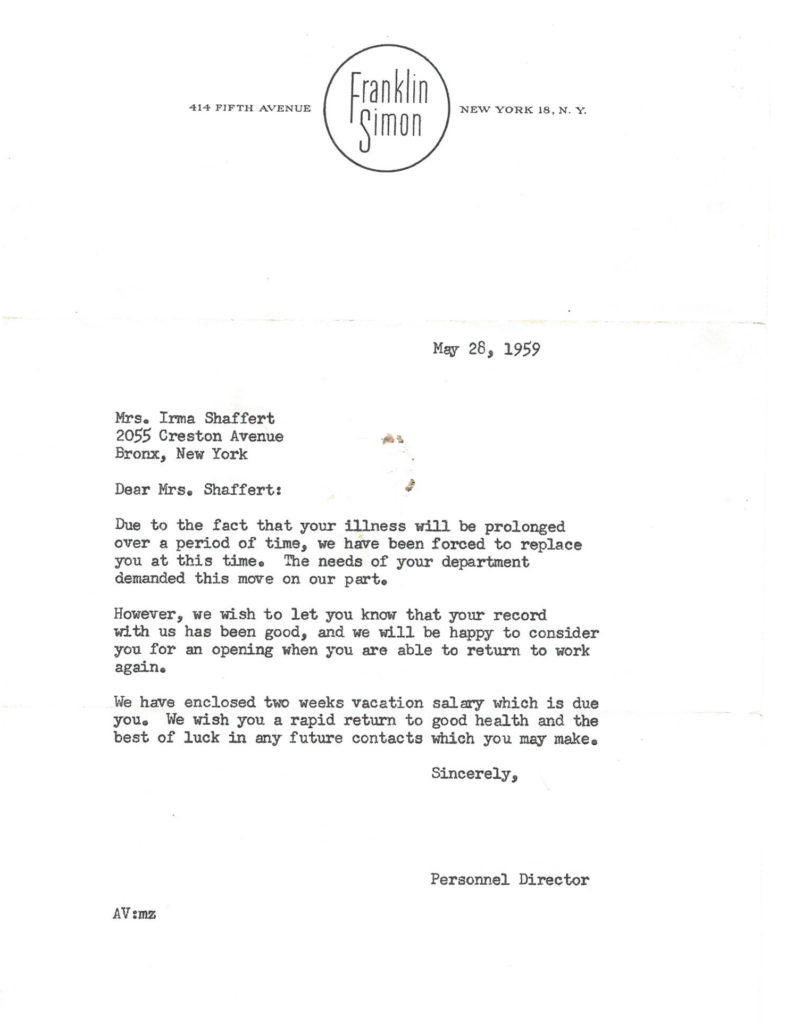
KM_C554e-20161207133340Among my grandmother’s papers was a letter dated May 28, 1959, from her employer, the New York retailer Franklin Simon, informing her, “Due to the fact that your illness will be prolonged over a period of time, we have been forced to replace you at this time.”

“However,” the letter continues, “[W]e wish to let you know that your record with us has been good, and we will be happy to consider you for an opening when you are able to return to work again.” She received “two weeks vacation salary which is due you,” but no sick leave or notice pay.

I was shocked. My grandmother had been fired because she needed surgery. When I found the letter a few years ago, the Family and Medical Leave Act had been the law for almost 20 years. Large employers like Franklin Simon couldn’t just fire employees when they needed time off for medical care. Or, at least, they couldn’t fire many of their full time employees.

Born in Austria-Hungary in 1900, my grandmother came to this country with her husband and her son as a refugee from the Nazis in 1940. A housewife in Vienna, here she worked first in a factory sewing clothes for dolls and later as a saleswoman at Franklin Simon.

By 1959, my grandmother was living alone in a fourth floor walk-up in the Bronx. Her husband had died, and her only son was married and had a new baby. I don’t know what financial hardship my grandmother endured when she lost her job. As far as I know, she never reentered the workforce.

Being able to take time off from work for my own medical care, after the birth of my children, and to care for my parents and my sister who had congenital heart disease is only one of the many ways that life has been easier for me than it was for my grandmother. But even today many people can still be fired if they need to take time off from work. And, for many unpaid leave is an empty promise because they simply can’t afford to take time off without pay.

At The Arc, our mission is to promote and protect the human rights of people with intellectual and developmental disabilities (I/DD) and actively support their full inclusion and participation in the community throughout their lifetimes. People with disabilities and their family members are an important part of the American workforce, and like all working people, they need access to paid leave. In my work, leading the Center for Future Planning®, I focus on the needs of the over 800,000 families in which adults with I/DD live with aging caregivers 60 and over. As these parents age and continue to support their sons and daughters to build full and independent lives, the need for flexibility can be critical.

We are joining the call for a robust federal paid family and medical leave law that adheres to a core set of principles. All employees (regardless of the size of the employer, length of service, and number of hours worked) must be able to access paid leave of meaningful length. People need to take leave for different reasons, and all employees should be able to access paid leave for the full range of personal medical and family caregiving needs established in the Family and Medical Leave Act. Families come in many shapes and sizes, so “family” must be inclusively defined. We must design a program that is affordable and cost-effective for workers, employers, and the government. Finally, we must ensure that people who take the leave do not experience adverse employment consequences as a result.

In the disability community, we know how important it is to celebrate one another in good times and to provide support in harder times. An inclusive and robust paid family leave program is an important building block of that support.