Close up of a person holding a small leather wallet in their left hand and pulling out a folded dollar bill

Stuck in Time: SSI Desperately Needs Updating

By: Bethany Lilly

My parents celebrated their golden wedding anniversary last year. Fifty years is a long time, and so much has changed—the internet, cell phones, self-driving cars, and we’ve seen so many disability rights victories. Next year, the Supplemental Security Income (SSI) program will also turn 50. But this milestone for SSI is almost disappointing because in those 50 years, the rules of SSI have barely changed. Passed in 1972, SSI was designed to keep the lowest income adults and children with disabilities and older adults from living in poverty. But Congress has ignored this crucial lifeline and failed to update it, instead leaving people with disabilities and older adults trapped in deep poverty, for fear of going over the limits and losing benefits. Rules that haven’t been updated in a half century govern how much money people who rely on SSI can earn, how married couples who receive the benefit are treated by the federal government, the amount of income the program provides, and how much help family and friends are allowed to give to loved ones on SSI. Rules about how much people can save haven’t been updated for almost 40 years!

SSI is supposed to fill in the gaps of other government support programs, paying for housing and other expenses that aren’t covered by Medicaid. But the current rules make that almost impossible. If someone is relying on SSI, the cost of renting a one-bedroom apartment almost anywhere in this country will consume more than the maximum monthly SSI payment of $794, leaving practically nothing for other expenses like groceries and other necessities. And limiting savings to only $2,000 means that many people cannot save enough to even move into an apartment or house. People can end up trapped in institutional settings, with no ability to afford an alternative. Like so many other parts of the disability service system, SSI is crucial infrastructure that is crumbling due to decades of neglect.

Nothing has made that clearer than the pandemic. With a maximum monthly SSI benefit of $794, people with disabilities are struggling to afford the necessities of pandemic life like masks, grocery delivery, and increased prices for so many basic goods. Restricted from saving more than $2,000, no SSI recipient could rely on their savings to get them through the past 17 months and the uncertainty that is ahead during this ongoing pandemic. Accepting help from family, friends, or mutual aid means a benefit cut. And because of marriage penalties, couples face an even harsher financial reality. Even the government’s COVID relief efforts created problems–stimulus checks and unemployment insurance expansions created eligibility issues because the systems used to implement these rules are equally archaic, unable to adjust to new benefits. For the millions of people with disabilities who are eligible for Medicaid because they are eligible for SSI, this was not only an issue with income security, but also put their access to health care and home and community-based services (HCBS) at risk.

Just as the pandemic highlights the need to expand HCBS and finally address the workforce crisis for direct care workers, it also shows us that the program that is supposed to pay for everything else is trapping people with disabilities in poverty. Enough is enough. We must fix these archaic SSI rules.

President Biden acknowledge the need for change during the presidential campaign, calling for five major reforms to the SSI system:

1) increasing benefits to at least the federal poverty line

2) increasing income limits to encourage work

3) eliminating harmful rules penalizing help from family and friends

4) eliminating marriage penalties

5) increasing asset limits

Any one of these changes would dramatically improve the lives of the 8 million people who rely on SSI, including almost 1 million children with disabilities. It would help ensure that people with disabilities can live with their families and friends in their own communities, with the supports they need.

We have a rare opportunity – right now – to fix the crumbling disability service system by fixing SSI, expanding HCBS, and passing a national paid leave program. We must act on this opportunity!

#CareCantWait

50 years is a long time. Just ask my parents.

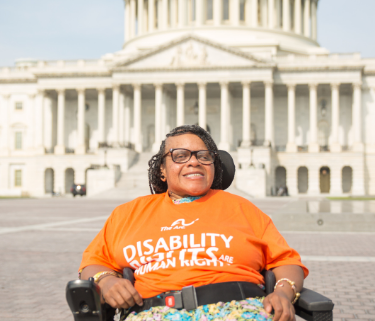
A woman sits in a motorized wheelchair with the US Capitol building in the background. She is smiling and wearing glasses, colorful floral pants, and an orange shirt with The Arc's logo that reads "Disability Rights are Human Rights"

The ADA Turns 31

Today, we mark 31 years since the passage of the Americans with Disabilities Act (ADA). The Arc is proud of our long history advocating with and for people with intellectual and developmental disabilities (IDD) and working to ensure that their most fundamental rights and the protections guaranteed by the ADA are recognized and fulfilled.

Thelma Green, 61, is a self-advocate in Washington, D.C. who The Arc profiled in a story in 2017 about the importance of Medicaid in her life. On this anniversary of the ADA, Thelma, a wheelchair user, shared reflections on what the landmark law means to her. She was a young woman when the ADA passed in 1990.

“The biggest change is that I got more than once choice for transportation and being able to get around and have stuff more accessible,” she said.

Thelma says before the ADA was passed into law, navigating the community was tough.

“Back then, they didn’t have accessible cabs or Metro Access. It was really difficult,” Thelma tells The Arc.

And she says daily living was more challenging and people treated her with less respect.

“I think it was more difficult before because people weren’t really listening to us. They weren’t taking people with disabilities seriously enough until a family member stepped in,” she explained.

The ADA transformed the country in important ways, changing expectations for the lives of people with disabilities. The law requires accessibility and bans discrimination in almost all private businesses, and has significantly reduced discrimination in state and local government services. The transportation and paratransit provisions have yielded greater mobility and community participation. Employment provisions have been important, for example, providing protections in the hiring process and expanding the use of job accommodations for workers with disabilities. The built environment has tangibly changed based on the requirements of the ADA, for example, ramped building entrances and curb cuts on sidewalks are now common. In major ways, people with disabilities are closer to the goals of equality of opportunity, full participation, independent living, and economic self-sufficiency defined in the law.

But Thelma knows the fight for equity is far from over, and The Arc and our allies are advocating for stronger enforcement of this civil rights law.

“You have to continue on fighting for the same rights that everybody else has. We need to have more accessible places for people with wheelchairs and crutches to make it much easier for them to get it and more accessible buildings,” she said.

On this anniversary, Thelma also wants people to recognize and be sensitive to people who have hidden disabilities that are not always obvious. Across the United States, more than 6 million people have hidden, or invisible disabilities, like autism, sensory disorders, or dyslexia. And, they also entitled to the protection of the ADA.

As we renew our commitment to the ADA, and the charge to eliminate unjustified segregation and exclusion of people with disabilities from American life, The Arc reaffirms our goal to protect against forms of discrimination based on disability, race, sex, gender identity and expression, sexual orientation, national origin, or any other protected status. We will keep fighting to defend the rights and lives of Thelma and all people with disabilities and their families, and advance toward full inclusion for all.

The Arc logo

The Arc Denounces Ruling on Use of Shock on Residents With Disabilities at Judge Rotenberg Educational Center

In a stunning reversal, the U.S. Court of Appeals for the D.C. Circuit overturned the Food and Drug Administration’s ban on the use of electric shock devices that has inflicted painful abuse on residents of the Judge Rotenberg Educational Center (JRC) in Canton, Massachusetts for decades. JRC is an institution for children and adults with intellectual and developmental disabilities and mental health issues. The Arc and The Arc of Massachusetts, alongside several disability rights organizations and empowered self-advocates across the country, fought for decades to stop this practice.

By the FDA’s own count, as many as 50 JRC residents wear the shock device. Staff members use remote controls to administer shocks for perceived misbehavior. JRC is the only place in the country that uses the barbaric and inhumane practice, despite substantial evidence that the shocks are painful and traumatizing to residents, and alternative positive behavioral supports exist, and are proven more effective.

“In 2021, we should not still have to fight tooth and nail for people with disabilities to live free from fear and torture. The Arc denounces this ruling, as it strips dignity away from those living at this facility and threatens the civil rights of all people with disabilities. We will continue to fight for the end of this abusive practice,” said Peter Berns, CEO, The Arc.

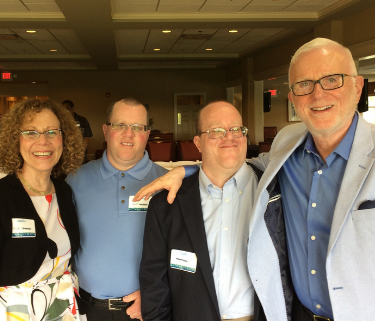
A mother, father, and two adult sons stand smiling with their arms around each other. They are indoors and have nametags and business clothes on.

The Social Security Law That Keeps Parents Awake at Night

By Micki, Grassroots Advocate

My husband and I consider ourselves to be informed parents. When our twin sons Zach and KC were diagnosed with intellectual disability in infancy, we tried to learn all we could to be a good mom and dad. We attended educational programs, joined local organizations that focused on families like ours, and did what we thought was best for our sons.

When they reached the age of 18, we were advised to apply for Supplemental Security Income, a federal income program for those 18 and older who are blind, have a disability, or are aged and have very little income. That went without a hitch. A few years later, one of our sons received a letter from Social Security stating that because he had worked for several years in the community, his benefits would switch from SSI to SSDI, Social Security Disability Insurance, a program for those with disabilities who are part-time workers. He qualified because after graduating from high school, he started working as a front-end clerk/bagger at a supermarket. It has always been and because of our son’s disability, will always have to be, part-time work. He has continued to work in this position for 21 years. He is very proud of this achievement. Again, the switch from SSI to SSDI went without us having to complete any paperwork.

During the first few years that he worked, we were still figuring out how much work he could do. On occasion, the store manager wanted him to put in extra hours because another employee called in sick or didn’t show up to work. It was difficult for him to say no, even if he couldn’t really manage the work. We received a few letters from Social Security stating that he earned too much money when that happened. We spoke to someone from Social Security, but nothing was said about him losing out on higher benefits when his parents retired or passed away. Nor was anything explained to us about how much he could earn while still maintaining benefits. Since he continued to receive payments, we assumed the past problems were just that: in the past.

Foolish assumption.

Some 15 years later, in 2016, when my husband turned 66 and applied for Social Security, he requested that Zach and KC receive SSDI benefits as Disabled Adult Children (DAC) under his work record. DAC benefits would be far more generous than our sons’ own benefits because my husband worked for many more years and also earned more.  My husband and I were counting on these benefits to help our sons with their living expenses when we were no longer able to provide financial support. My husband was told that our son who was the front-end clerk would never be able to receive DAC benefits because he earned too much money a few times, occurrences that took place 14 and 15 years ago. Social Security sent us a document showing when his income was too high—it was seven times total, and each time was under $40.

What should we do? Everyone we spoke with was stumped, including attorneys who specialize in denied Social Security Disability applications. With much persistence, we eventually found someone who explained that the things our son had paid for to help him work, like the medication he took to help him focus or the costs of his job coach, could be used to offset the income that exceeded Social Security’s requirements. We learned these are called Impairment Work Related Expenses, IRWEs.

Even though we’d been told that throwing away backup documents from tax filings after seven years was safe, we never did. Luckily, we had the receipts showing those costs which filled a box large enough for a 10-ream case of paper. We took it to the local Social Security office and requested that they review the materials and reconsider our son’s denial of DAC. The Social Security employee was taken aback by the number of documents in the box. He said he wasn’t allowed to work overtime and had no idea how long it would take him to go through it all!

After several nerve-wracking months, we heard from Social Security. They reversed their decision. Our son was approved as a DAC!

There are many families like ours who had and/or continue to experience a similar nightmare. Many of our loved ones work part-time in jobs with fluctuating hours which results in income varying from one month to another. Countless families don’t know about IRWEs or understand the complex rules of Social Security. We are all understandably terrified of doing anything that might put our children’s future benefits in jeopardy. Some find it easier to have their family member not work at all, thereby isolating them from the community and depriving them of self-worth.

The current law is a huge disincentive to work and it’s just too complicated.

Our son is now living by himself in the community. Being self-sufficient means the world to him. His DAC benefits along with his limited earnings cover his expenses, such as rent, utilities, groceries, etc. Without the SSDI DAC benefits, he would no longer be able to live independently in the community.

Parents of adults with intellectual disabilities want the assurance that their loved ones will continue to have meaningful lives after they’re gone. Knowing that their adult children can work and maintain DAC benefits is one critical way of guaranteeing that—the law needs to change.


Find out how you can help Micki’s family and others in the same position.

Learn more and act now!


The United States Capitol Building

Better Care Better Jobs Act Will Make Huge Investment in Disability Services

The system that provides supports and services for people with intellectual and developmental disabilities (IDD) and their families has fallen far short of their needs for decades, and the COVID-19 pandemic exposed and worsened this reality.

The Better Care Better Jobs Act (BCBJA) introduced today will make a huge investment necessary to change disability services into the future. This bill puts into motion the proposals that were included in President Biden’s American Jobs Plan, which prioritizes the crumbling care infrastructure in this country and recognizes the importance of fixing it and building back for the future.

“Every day, people with disabilities are waiting for their lives to start and often going without the supports they need to achieve their goals. Families that want a different life than an institution or nursing home are forced to navigate a patchwork system of supports with waits and no guarantees. Family members are often forced to either quit or limit their job choices to provide care due to lack of services. And the direct care workforce is underpaid and undervalued.

“We are desperately overdue for a huge investment in disability services. The Better Care Better Jobs Act introduced today will be a game-changer and must be enacted quickly for the disability community to be a part of our economic recovery from this disastrous pandemic,” said Peter Berns, CEO, The Arc.

When the BCBJA becomes law, it will provide huge funding enhancements to states which focus on improving and expanding their Medicaid home and community-based services (HCBS) delivery system. The bill would provide funding to expand access to services for people who are currently on waiting lists for these vital services, and create more and better direct care jobs for the paid workforce that provides these services.

Learn more about how HCBS are vitally important to the lives of people with IDD and their families.

A man and his son each kneel beside an air traffic controller, mimicking his outstretched hand signal. Behind them is the wing of a plane and a city skyline.

A Father’s Love: The Rewards of Disability

A father and adult son stand together, smiling, in front of a black train with green hills and mountains in the background. To the left of the train is a yellow building. Jose Velasco is thankful for the incredible journey of fatherhood. The father of two did not foresee the life he and his wife, Deya, and their son and daughter created, together. This Father’s Day, Jose reflects on nearly three decades of being a dad and how disability has rewarded his life in ways he had not imagined when the family began their autism journey. Each day of that journey, Jose has only wanted one thing.

“The single biggest thing we want is for our kids to be happy,” he said. “Seeing the resilience my son has demonstrated has been absolutely phenomenal. I’ve learned so much about kindness.”

Jose’s 27-year-old son is named in his father’s honor. Jose, Jr. is on the autism spectrum, a diagnosis that has presented challenges along the way, while instilling determination and a growing realization that disability does not minimize ability.

When asked to describe his best memories with his father, it is clear there are just too many. Jose, Sr. has always been there for his son.

“Where to begin … I think it goes all the way since I was born,” Jose, Jr. told The Arc. “He is the equivalent of my best life-long friend. We have done great things together, from flying on a biplane, to riding numerous trains (steam, diesel, old and new) to high-adventures in the Rocky Mountains, like hiking and white water rafting. Spending a lot of time together has been one of my favorites things, including various journeys around the U.S. and Mexico.”

Jose, Sr. is a member of The Arc of the United States Board of Directors. He is program director in the Business Process Intelligence organization of global software company SAP. He is also ambassador of the company’s Autism at Work program, which has provided more than 600 employment opportunities for people on the spectrum. But Jose is most proud of his title as dad.

“Seeing Jose, Jr. succeed, happy, and how he has inspired people,” he said describing the greatest rewards of being Jose’s father.

This spring, Jose, Jr. accomplished a major achievement. After several years of setting goals, persisting, and working hard, he graduated from Austin Community College earning an Associate of Applied Science degree in Computer Information Technology – Computer Programming – Software Testing Specialization.

“He worked so hard for that. He worked really, really hard,” said Jose, Sr. “It was a reward for my wife and me, but for him as well.”

“The equivalent of winning a race. It was two-year degree, it took me close to 7 years and it felt great to have finished something I started,” Jose, Jr. said with pride.

Jose, Sr. is a disability rights advocate not only for his son, but – for all. He joins The Arc and other advocates who are urgently calling on Congress to act to fund $400 billion for the Medicaid home and community-based service (HCBS) system, increase wages for the direct care workforce, and create more of these jobs.

For years, the service system that people with intellectual and developments disabilities and their families rely on, Medicaid, has needed an update. People are stuck on waiting lists, the direct care workforce is underpaid, and too often, unpaid family caregivers are filling in the gaps in service. The COVID-19 pandemic has magnified these problems and exposed the cracks and gaps in the care infrastructure when it comes to supporting people with disabilities.

Jose, Sr. is hopeful this investment by Congress would help secure a life of opportunity and independence for his son in the future and the disability community as a whole.

“There are very high hopes from our IDD community for the HCBS investment to take place. Expanding access to services, the creation of direct care jobs, and an increase in wages are cornerstone elements of a sustainable platform to deliver quality services that so many people need.”

Being a father to a child with a disability has taught Jose many life lessons.

In high school, Jose, Jr. went out for the wrestling team. He fell in love with the sport but the skills didn’t come naturally. After several early elimination losses, Jose, Sr. and his wife felt heartbroken for their son and lovingly suggested that he help support the team as a student assistant. But, Jose, Jr. – determined – taught his parents a valuable lesson.

“He said ‘you guys don’t get it. I want to be a wrestler,’” Jose, Sr. explained.

Jose, Jr. started training and working out and it paid off.

“He won. The gym went crazy. It was the beginning for him of something special,” Jose, Sr. shared holding back tears.

It was in that moment Jose, Jr. decided he wanted to go to college.

Today, Jose, Jr. works for the Internal Revenue Service. He started a new position earlier this year and has risen to the challenges of the new role.

This Father’s Day, Jose, Jr. has this message for his dad:

“This is what I would put in a card for Father’s Day: Dad, all I want to say is thank you. Thank you for being my father, for raising me, teaching me, and protecting me.”

Like father, like son. Jose, Sr. is also thankful. The rewards of disability and fatherhood are immeasurable.

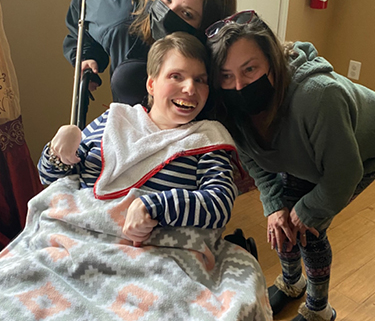
Three people, two standing and one seated with a blanket over them. The two women standing in the back have face masks on.

One Family’s Story of Moving From an Institution to the Community

We Were Afraid of Change, But The Arc Was There

When Amy was born in 1967, her family was told that she needed to live in an institution to get the medical care and services she needed due to her inability to speak and move independently. Her family followed doctor’s orders and placed in her an institution in California, where the family lived at the time. All her sister, Laurie, recalls of the institution is her sister’s tears. She cried every time the family left from a visit.

Amy lived in institutions for many years—but she and her family never could have imagined what waited for them on the other end of her time there.


Life at the Northern Virginia Training Center

The family moved to Virginia in 1975. Amy and Laurie’s parents found eight-year-old Amy a place in the Northern Virginia Training Center—another institution. For many years, the institution was all that Amy, Laurie, and their family ever knew. Amy appeared very happy there. As a child and teenager, Amy attended a day program in the local school system, and there were dentists and doctors on the campus of the institution. Amy and Laurie’s family would even invite staff from the institution to join them for family dinners. As an adult, Amy began to seem a bit sad when she aged out of the services available by the school system. Her post-high school activities included a day program where she crushed cans.

Amy’s family was dedicated to Amy and making sure she could get out and do things she liked. However, the institution did not have the resources to take Amy and the other residents off the institution campus and they did not even have a lift that could help them move Amy around. So, if Amy wanted to go somewhere, her family had to take her. As Laurie and their parents got older, they weren’t as able to do this and it really limited Amy’s ability to get out and go shopping or see movies. Similarly, when Amy would get sick or have surgery, Amy and Laurie’s parents would have to stay with her in the hospital because there was not enough staff from the institution to provide care, and the hospital staff were not trained to take care of her properly.

When Virginia decided to close the institution in 2016, Amy and Laurie’s family were one of many who would fight for the institution to remain open—firmly committed to the center that had served their family for so many years. This at times put Amy and Laurie’s family and other supporters of the institution in direct conflict with The Arc and its local chapters, which were powerful advocates to expand community-living supports and end the use of institutions.

However, Amy and Laurie’s family could read the writing on the wall and began talking with The Arc about what life could look like next for Amy.


The Arc: New Freedom

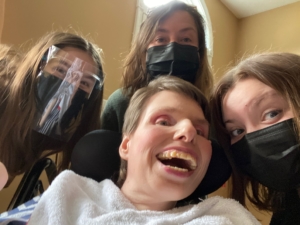
Four people in a selfie. Three are in the background of the photo wearing black masks and shields, and one person is in the front, smiling without a mask. They have short brown hair.

Laurie was working for an elected official in Virginia and knew the leadership at her local chapter of The Arc.

While they had different opinions, The Arc of Greater Prince William County’s leader, Karen Smith, was very respectful to Amy and Laurie’s family. Karen learned about Amy’s unique needs and preferences and helped build a group home setting that would work for her. Through it all, The Arc never gave up on Amy and Laurie’s family and made sure to reassure them that Amy would get the help she needed in the community.

The transition went smoother than the family expected. Amy’s group home was near Laurie and her parents, and the family could visit Amy as much as they wanted.

Most importantly, there were huge and wonderful changes for Amy.

Laurie and her parents worried at first about Amy having her own room. In the institution, Amy shared a room with the same roommate for nearly 30 years. They thought she would be scared and would want them to stay overnight with her. Laurie had even packed an overnight bag just in case Amy needed her. However, Amy loved having her own space—and decorating her own room. According to Laurie, “she has more new comforters than I have ever had in a lifetime.” Amy also enjoys the atmosphere of the home. She is treated as an individual, lives in a beautiful neighborhood with a garden out front to explore, and sits on the screened porch to enjoy the view of the woods behind her home.

Amy is also able to go out on her own and do things she wants to with Laurie or the group home staff. Amy, a housemate, and her staff go to shows together and her group home staff take her out to shop at the mall and go to the movies regularly. Amy also attends a day program for adults in the community that she is always very excited for. The day program is also only a mile from Laurie’s home and Laurie is welcome to visit her sister at any time. According to Laurie, “it is really nice to be able to pop in and say ‘hey, how’s it going’ and hang out with her.”

In this past year, due to the COVID-19 pandemic, life has changed again for Amy and Laurie. However, even in a terrifying pandemic, the group home staff have still helped Amy do things that matter to her. Though she has not been able to get out as much, Amy has been using her iPad and phone extensively. Laurie regularly gets videos of Amy where she makes faces and expresses to Laurie how she is really feeling. Laurie can send gifts to Amy to keep her cheerful and in early April 2021, Laurie and Amy were finally able to reconnect in person. They are hoping to take a shopping trip soon!


Advice for Others on Embracing Change and the Possibilities it Brings

We asked Laurie what she would want to tell others about her family’s experience over the years. She said that “there is always a fear of change,”— but in that change is a possibility for growth you may not have imagined before.

“I can’t emphasize enough how much The Arc of Greater Prince William County was there to make sure that people are happy. They go out of their way to make sure that people get what they need, like getting a much-needed haircut in the pandemic. The people there put a real personal stamp on everything they do. I just want to make sure that they get all the credit the deserve—especially the group home manager, who is wonderful.”


How You Can Help

There are still institutions open today in 36 states across the United States. For many, the institution is all they know– and they and their families may fear what change means for them.

There may be fear from past failed attempts at community living or concerns that people with more support needs can’t be safe and healthy in the community. But that fear can be overcome with the right level of supports and a caring community-based disability service provider, like The Arc of Greater Prince William County and The Arc’s chapter network.

What we know is that most people with disabilities and their families do want access to a life in the community, no matter the level of supports necessary to make that happen. But when they try to find what they need, too often the system fails them and makes them wait for services. This must change.


Join us to help make sure that everyone can get the support that they need in their community!

Visit thearc.org/MedicaidCantWait to learn more and see how to advocate with us.

A close up photo of two people with their arms around each other and their heads together, smiling.

Celebrating Strength This Mother’s Day: A Mother’s Persistence

This Mother’s Day, The Arc celebrates the unconditionaA selfie of a mother and her two teenage children on a couch, with checkered blinds in the background. l love and infinite strength of mothers. We recognize the mother figures and grandmothers who nurture and support us – no matter what. We embrace the challenges of motherhood. We revel in the joys.

If you ask Kendra Mendoza, a mother of two in North Providence, Rhode Island and friend of The Arc, what her role as a mother means to her, the answer is clear.

“It means everything to me. It is my sole first purpose in this life – being a mom,” she shared with us.

Kendra is a mother and a fighter, a force of nature to be reckoned with and admired. The single mother has taken on the state disability services agency, school boards, health care providers, and landlords. Kendra stops at nothing to make sure that her 17-year-old son Joshua receives respect, compassionate care and support, and opportunities to thrive in school and beyond.

Joshua was born with a rare genetic disorder and several other developmental disabilities. He requires complex medical care and supervision around the clock. Kendra says he is a blessing.

“Whenever I look at Joshua, I see ability and potential,” she said. “He has taught me so much. He takes life and smiles through it.”

Joshua underwent brain surgery at two days old. He has had two more brain operations since. With his mother by his side every step of the way, Joshua has far exceeded doctors’ expectations.

Joshua lives in the moment. When asked for this story during breakfast what he loves most about his mother, he replied: “You feed me!”

Eating is one of Joshua’s favorite activities. He is known at his local Wendy’s and Dunkin’ Donuts. Joshua also loves reading and art. He enjoys playing Memory on his tablet and going on car rides and walks to the store. He likes listening to music, especially John Legend and Ed Sheeran. Joshua helps out around the house, clearing the table and putting dishes in the sink, as well as tying up the trash.

Kendra’s determinatioA mother and her son in a wheelchair testify in a public policy hearing. n as a mother extends into advocacy. Working with The Arc Rhode Island, she advocated in the General Assembly in support of special education reform to give parents and guardians more rights in the Individualized Education Program, or IEP, process. In testimony before the Rhode Island House of Representatives, Kendra and Joshua shared challenges with the IEP process for families and why is critical that students with disabilities receive a Free Appropriate Public Education, or FAPE, as mandated by federal and state law. Kendra is also part of a group of parents, guardians, and educators in Rhode Island advocating for the creation of an independent special education ombudsman office to investigate special education disputes and serve as a resource for parents and guardians. The office would also provide an outlet for anonymous reports of possible violations.

In her advocacy, Kendra has worked closely with Joanna Scocchi, Director of The Arc Rhode Island.

“Kendra is an example of the many parents who are fighting not just for their own child, but for all children to lead a full life with opportunities, hopes, and dreams,” said Scocchi. “It takes the determination of parents and advocates to advance the goal of ensuring that society understands every child is entitled to – and deserves – an education that meets their unique needs and prepares them for further education, employment, and independent living.”

Like so many mothers, Kendra manages to persist, one battle after another, but always with the nagging feeling that things should be easier. It’s nearly a universal feeling across the disability community.

“I don’t understand why we have to fight all the time for things that should be common sense,” said Kendra.

Since the start of the COVID-19 pandemic, Kendra has worked closely with Joshua’s IEP team to try to ensure that he continues to receive an education remotely. People with intellectual and developmental disabilities are at higher risk of contracting the virus and health outcomes are often worse. Trying to keep Joshua safe and in virtual learning has felt like a second and third job. Kendra hopes Congress passes a national paid leave policy so that unpaid family caregivers don’t have to choose between a paycheck and the health and well-being of their loved ones.

The Arc and many other groups that represent caregivers urged the White House and Congress to include paid leave in forthcoming legislation and President Biden has urged Congress to do so. The pandemic has highlighted what family caregivers have known for decades—we need paid leave now.

There is one more thing about Kendra Mendoza you should know. When she’s not with Joshua, she’s supporting women with disabilities in a group home. Kendra is employed as a direct support professional, or DSP. She helps the women she serves with dressing, eating, and preparing for their day.

Many years ago, Kendra decided to pursue a career in health care in order to learn as much as possible about the road ahead as a mother to a child with multiple disabilities. This Mother’s Day, she reflects on her children and how she is the lucky one.

Kendra says the simple moments mean the most.

“The moment your kids smile and they know they’re safe,” she said. “They remind me of my purpose. They push me to grow as a person.”

The Arc logo

No One Should Have to Live Like This: Steve’s Nine-Year Wait for Freedom

Thousands of people with disabilities in the U.S. use Medicaid to get the supports and services they need to live and be healthy every day. But, people with disabilities must often wait several years to get access to the type of supports they want and need in their own homes. Many are forced into nursing homes and institutions to get the services they need.

But this comes at a critical cost: freedom.

Meet Steve

Steve has cerebal palsy. For most of his young life, and like many people with disabilities, he lived with his mom. When Steve was only 22 years old, his mom became very ill. Because she could no longer provide the supports he needed, Steve was forced to move into a nursing home to get the care he could no longer receive in his childhood home. Even though Steve knew he could make it in the community with the right supports, he was forced to make this move. This was because his family was concerned about his well-being if he lived independently, and because they feared the appropriate supports were not available to him.

The nursing home put Steve in the long-term Alzheimer’s unit with people who were often in their 80s and 90s. This was not Steve’s choice. Steve was placed in an available bed where all long-term residents were put.

Steve hated living in the nursing home and often felt like the care he got from staff was lacking.

“I had to wait an hour for someone to respond when I asked for help. Sometimes, the nurses would come in and turn the call light off instead of helping me. I was always the last to be fed. When I needed to go to the bathroom, I would wheel my chair out to the hall and tell the staff—but they would walk away. I had to fight with the nurse to get medications. If I told someone I wasn’t getting taken care of, the care would be worse because the staff would get mad at me. At night, I couldn’t sleep because the other residents were screaming or because staff were buffing the floor.”

After a year in the nursing home, Steve’s case manager got him on the waiting list for Medicaid home and community-based services (HCBS). Access to HCBS would allow Steve to move out of the nursing home and get the help he needed in his own home in the community.

“I spent eight years on the waiting list… Every year, I got a letter about where I was on the waiting list. Every time I got that letter, I was so discouraged and disappointed because it felt like my name was not coming up. And, I thought that I would never get out.”

Finally, after nine years in the nursing home, Steve’s name did come up, and he got out.

“On my last day in the nursing home, I went to the administrator and told her, ‘thank you for kicking me out—you made my wish come true.’ When I got out and got [HCBS services], I finally had the freedom to do what I wanted to do… I could eat when and what I wanted—and the food was actually warm. I could sleep better at night. I could use the bathroom when I needed to. I could go out with friends without having to come back at a certain time. I did not have to fight nurses to get my medication. I had freedom—and a life like yours.”

Now, Steve lives independently in his own home in the community, with support from paid caregivers. While he does still experience challenges with things like getting transportation services, finding safe and affordable housing, and finding paid caregivers, he believes he is where he belongs.

Steve’s nine years in a nursing home profoundly impacted him and he wants to make sure no one has to live the way he had to.

“Just because we are disabled, [doesn’t mean we don’t deserve] equal rights—we do not belong in an institution. We should have the same opportunities as anyone else. Everyone should get the help they need in their home, [and everyone should have the right to live the life they want].”

To others with disabilities, Steve offers these words of encouragement.

“People will say there are no other options for you in your area besides an institution…Do your research. Have a backbone, be tenacious, and don’t ever give up. You are always going to have roadblocks—but you have to find your way past them. You can do it.”

Check out this video to learn more about the role of Medicaid HCBS and Supplemental Security Income in Steve’s and other advocates’ lives.

This injustice must end.

No one should have to give up their freedom to get the services they need. The Arc works every day:

  • To make sure people can get the Medicaid HCBS they need
  • To end long waiting lists for HCBS services
  • To close institutions, which still exist in 36 states nationwide

Join us! Visit thearc.org/MedicaidCantWait to learn more and see how to advocate for HCBS with us.

The Arc logo

The Arc Encouraged by Proposal for Huge Investment in Disability Services and Direct Care Workers

Washington, D.C. – For years, the service system that people with intellectual and development disabilities (IDD) and their families rely on has fallen far short of meeting their needs. The COVID-19 pandemic has magnified this problem and exposed the cracks and gaps in the care infrastructure when it comes to supporting people with disabilities. The Arc is encouraged by the Biden Administration’s announcement today that The American Jobs Plan includes a $400 billion investment to support and grow the direct care workforce, expand service delivery and eliminate waiting lists so that people with disabilities and unpaid family caregivers can return to the economy. This investment is long overdue, and like crumbling roads and bridges, the Administration recognizes that the home and community-based service (HCBS) system, a central part of the care infrastructure, needs and deserves the same critical investments. Now, Congress must act.

Growing the direct care workforce, expanding access to services, and supporting family caregivers are key to our economic recovery. The Administration’s plan to provide more funding for HCBS, create jobs and increase wages and benefits for direct care workers addresses the rising level of need for these services. It also targets the longstanding inequities experienced by the direct care workforce that were made worse by the pandemic. These direct care workers are mostly women of color; they are denied a living wage due to underfunding of the Medicaid HCBS system that pays their wages. A well paid, well trained workforce that can grow with and meet the increasing need is critical to recovery and to providing people with disabilities and their families quality supports and services they need and want to receive in their homes and community. The Arc was also thrilled to see the plan include a permanent reauthorization of the Money Follows the Person program, a Federal program that supports people with disabilities and aging adults to move out of large congregate settings and back to their homes and communities. The Arc has been advocating for all of these advances for years.

We are pleased with the Administration’s proposal for this major investment in and recognition of the value of people with disabilities, their families, and the direct care workforce. Congress must now act to make this important investment in the service delivery system and the direct care workforce a reality by including these provisions in any new infrastructure and recovery legislation.

“As the largest disability rights organization in the country, The Arc is pleased to see the value of people with disabilities, family caregivers, and direct support professionals recognized and upheld in the Administration’s bold American Jobs Plan.  The proposal is a welcome first step and we will not rest until the needs of people with IDD and the direct support workforce are fully addressed,” said Peter Berns, CEO of The Arc of the United States.