

National Family Caregivers Month: What Families of People With Disabilities Want You to Know
Updated October 7, 2026
November is National Family Caregivers Month, a time to recognize the family members and friends who provide ongoing support to people with disabilities, health conditions, and other support needs.
Family caregiving is a major part of life in the United States. About 63 million Americans, or nearly 1 in 4 adults, are family caregivers, according to a 2025 AARP and National Alliance for Caregiving study. That’s up from 43.5 million a decade earlier.
For family caregivers of people with intellectual and developmental disabilities (IDD), support can span a lifetime and change as people age. Parents, siblings, spouses, and other relatives may help with transportation, healthcare, employment, personal care, decision-making, or navigating disability services. Families often take on more when the services and supports a person needs aren’t available.
The Arc’s most recent Family and Individual Needs for Disability Supports (FINDS) survey shows the consequences of those gaps. More than half of caregivers, 54%, reported being very or extremely stressed. Nine in 10 said caregiving affected their employment, and 81% said they provided more support themselves when services became harder to find.
Those numbers tell us something important about the systems surrounding families. They don’t tell us what caregiving, disability, and family life actually feel like.
For National Family Caregivers Month, family caregivers of people with IDD share what they wish more people understood about their lives, their relationships, and the support families need.
What Is National Family Caregivers Month?
National Family Caregivers Month is observed every November in the United States to recognize family caregivers and bring attention to the support they need. Each year, Caregiver Action Network announces a theme for the month. As of September 2026, the 2026 theme hasn’t yet been announced.
What Is It Like to Care for a Family Member With IDD?
There’s no single experience of caring for a family member with IDD. These families describe love, connection, discrimination, medical needs, and the challenge of navigating systems that often fall short.
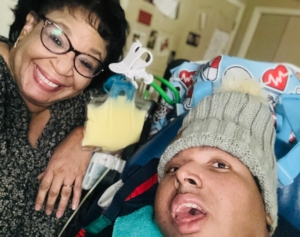
Debbi and Josh
Debbi Harris, mother to Josh with complex medical needs: “It’s captivating to watch how Joshua navigates the complex world around him with what we consider to be so many limitations. But he has learned to use what he has in the best way he can to communicate, to gather information, to relate pain or contentment or frustration—and he’s proud of it. He has been through more medically than most people will ever experience, yet he comes back undiminished. The challenging aspect of being a parent or caregiver of a person with IDD is how the rest of the world perceives Josh. They limit his humanity and do not invest the time it takes to get to know him as the unique human that he is.”

Dena and Eli
Dena Drabek, mother to Eli with a congenital heart defect: “Eli has undergone three open-heart surgeries, seven cardiac catheterization procedures, and one round of ECMO life support. Watching your child endure so much from the very beginning takes a major emotional toll as a parent. On the flip side, we have a bond unlike most because of what we have been through together. This path has also encouraged us to celebrate all of life’s little moments and be grateful for every opportunity along the way.”
Ray Hemachandra, father to Nicholas with autism and intellectual disability: “Being a caregiver for someone with intellectual and developmental disabilities is no different from being a caregiver for anyone else. You work to meet the individual’s needs; honor their strengths, their uniqueness, and their beauty; and appreciate every day and every moment spent together. You ask for help when you need it, too. A challenge is asking for help in a society and culture that see lesser value in disability and in disabled lives. A challenge is navigating and overcoming a scarcity-based public support system that constantly, relentlessly requires your loved one’s deficits be documented and emphasized.”
What Do Family Caregivers of People With Disabilities Need?
Family caregivers need reliable disability services, adequate funding, a strong direct support workforce, financial security, and relationships and lives beyond caregiving.

Patricia and Barbara
Barbara Davis, sister to Patricia with intellectual and physical disabilities: “Better funding is needed but is a low priority in state and federal budgets. Families caring for someone with IDD are just like other families. They want each member of their family to be safe and healthy and to have the opportunity to reach their fullest potential.”
Em Braman, mother to Eden with Down Syndrome & OCD: “The needs of the person you are caring for always come first so you may cancel or ask to reschedule get-togethers frequently,” she shares. “This is not due to not wanting to get together with the other person, it is because my loved one comes first. Our lives just look different and just because it looks different does not mean it is bad or less meaningful. My family enjoys life and enjoys living life together.”

Jamie and Sam
Jamie Mistretta, sister to Sam with intellectual disability and autism: “When a support service is unavailable, this limits my sister just as much as it limits me and my family. Her support services are what give her access to her everyday life. When a sibling or other family caregiver is sick or otherwise unavailable, our loved one still needs and deserves support.”
Mariela Azarpira, mother to Samir with intellectual disability, hydrocephalus, and apraxia: “I want to tell people that it is important to fight for them, advocate for them, speak for them, include them, don’t let them give up on them, and don’t let them label them,” she asserts. “People with disabilities are perfect the way they are, so don’t outcast them and don’t allow anyone to do it. They matter too.”
Debbi Harris: “Many of our loved ones require attention 24/7 and staffing that care is a national crisis at this time. It can be exhausting. Caregivers experience chronic illnesses related to stress much more widely than others. I have chronic migraines and other stress-related health conditions. I try to write, or play the flute, or read, but I cannot focus long, and I am needed all of the time. I often feel lonely and isolated. I have my immediate family around me but find myself craving relationships I see others experiencing on social media. Even if I had the opportunity, though, I am usually exhausted and overwhelmed. I don’t have the capacity to participate socially in a normal way, and I don’t fit in. People are afraid I will talk about my son. They think their problems will seem too small or superficial, so they avoid me because they still do need to vent, as we all do. And, the aspects of caregiving I need to talk about, there is no one to listen.”
What Do Family Caregivers Worry About as Their Loved One Gets Older?
As people with IDD and their family caregivers get older, questions about accessibility, changing support needs, and who will be there in the future can become more urgent.

Eden and Em
Em Braman: “As my child gets older, I see accessibility as a much larger issue than when she was younger. It frustrates me that while she can physically access places, there are minimal accommodations to assist her in accessing the understanding needed in those locations. For example, a museum without plain language guides for the displays or a listening session where materials are not sent out ahead of time for her to read and reread for understanding or when a medical office will not let her come in ahead of time for a preview of the office to calm her anxiety.”

Mariela and Samir
Mariela Azarpira: “I am a mama bear 24/7. I am in contact with his program and aide every day asking questions like, ‘How was his day? What else do we need to do for him?’ It’s important to have clear communication with each person he is involved with daily. I want him to thrive and make sure everyone is on the same page regarding my son.”
Ray Hemachandra: “For parents of children with disabilities, the responsibility for two lives carries across the lifespan—not just caring about that person’s life, but full responsibility for the care of that life. For example, the normal fear around losing your job, getting ill, or dying is much more about what happens to your child, including your adult child, if and when that happens. Who is going to care for your child? Who is going to love your child? I wouldn’t trade my son for anything or anyone in the world. But I carry all that with me every day.”
For families thinking about these questions, The Arc’s Center for Future Planning can help people with IDD and their families plan for the future.
What Do People Get Wrong About Caring for Someone With a Disability?
One of the biggest misconceptions is that disability makes a family’s life less meaningful or that caregiving can be understood only in terms of sacrifice. These families describe something much more complex.
Dena Drabek: “I often sense that others feel pity for our situation. The commitment I have to my son is not about what I have to give up. It’s about investing in him, nurturing his potential, and helping him discover his own unique gifts so that he can share them with the rest of the world.”

Nicholas and Ray
Barbara Davis: “There sometimes is the assumption that acting as my sibling’s caregiver is only a burden. It can be difficult, but I love my sibling. Being involved in her care is extremely rewarding.”
Ray Hemachandra: “My son isn’t a burden. He’s a blessing. When he is supported appropriately for his needs, he can contribute just as much to his family, to his community, and to our world as anyone else. He wants to know you and be your friend.”
Jamie Mistretta: “I am often asked, ‘Do you think your life would be different if your sister didn’t have a disability?’ I cannot even imagine a life where my sister doesn’t have a disability. My sister’s disability is a large part of who she is; it is a large part of her character. Disability or not, my sister will still be my maid of honor at my wedding someday. I love her for everything she is and everything she is not.”
How Can We Better Support Family Caregivers of People With Disabilities?
The families in these stories are asking for what families of people with IDD have always needed: systems that actually support them and their loved ones.
That means reliable home and community-based services, a strong direct support workforce, financial stability, workplace flexibility, and plans for the future that do not depend on one person being available forever. Just as important, people with disabilities need the services and opportunities that allow them to make choices, participate in their communities, and build lives beyond the support any one family member can provide.
Their stories show why strong disability services support both people with IDD and the families who love them.
What Support Is Available for Family Caregivers of People With Disabilities?
Family caregivers of people with disabilities may be able to get help through disability services, Medicaid home and community-based services, school supports, future planning resources, workplace leave, and local disability organizations. What’s available varies by state and by the needs of the person with a disability.
Chapters of The Arc can also help families find local services, resources, and disability supports in their communities.
Resources for Family Caregivers of People With Disabilities
Find help and support:
Learn about policies that affect families: